Life 360 Physiotherapy Center, HIG-16, Sector 1, Shankar Nagar, Raipur, Chhattisgarh 492007
-
For Appointment: 09115719395 , 07000784644 , 07714908010
-

At Life 360 Physiotherapy Center, led by Dr. Nitu Verma, India’s first lady chiropractor, we are dedicated to delivering top-quality chiropractic and physiotherapy care. Recognized as the best chiropractor in India, Dr. Verma specializes in holistic treatments for pain relief, spinal alignment, and sports injury rehabilitation. Our clinic in Raipur provides personalized care designed to address the root causes of discomfort and restore balance to your body, helping you achieve long-term health and wellness. Experience relief and recovery with India’s leading chiropractic expert at Life 360 Physiotherapy Center.
For Appointment: 09115719395 , 07000784644 , 07714908010
-poster-082141.png)
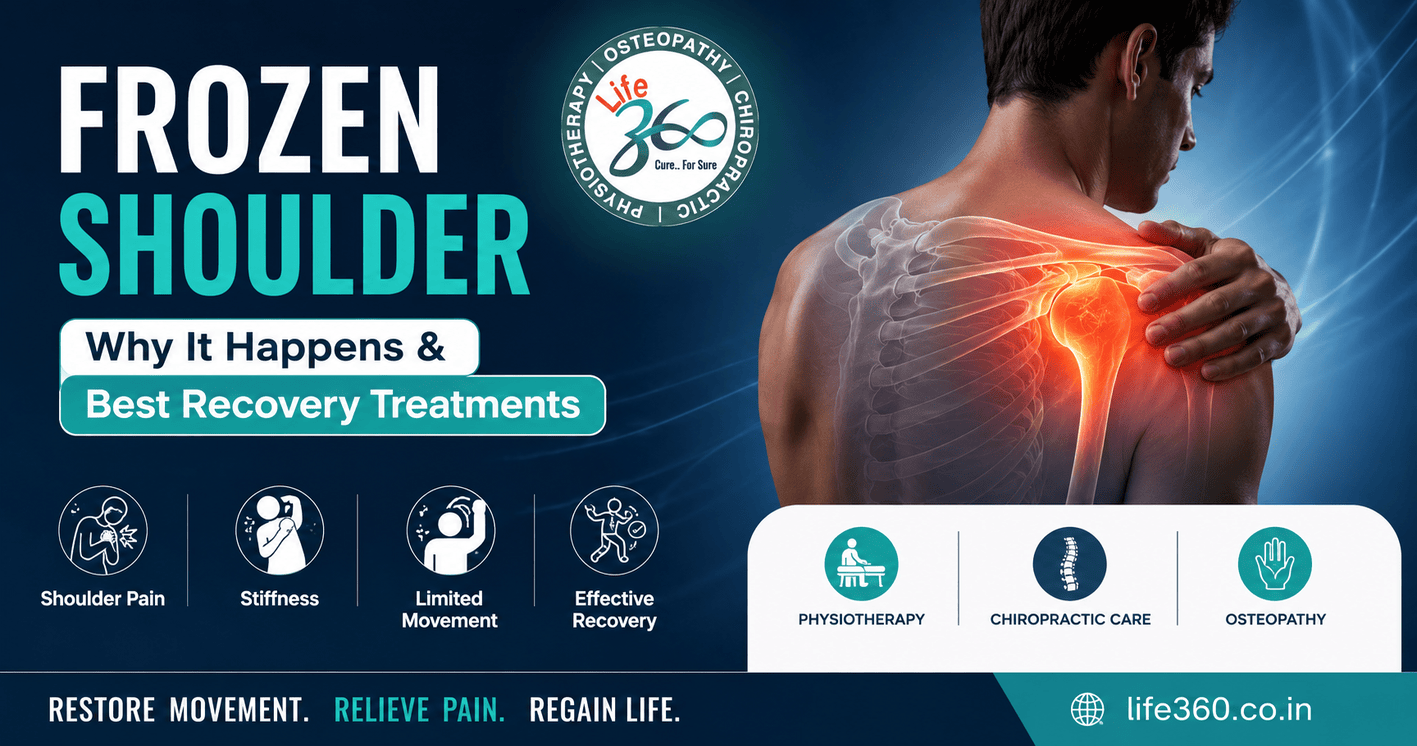
Quick Answer: Frozen shoulder (adhesive capsulitis) — a progressively stiff, painful shoulder that ruins sleep and blocks daily tasks — takes 1.5 to 3 years to resolve untreated, but with stage-matched physiotherapy and manual therapy, most patients regain functional movement in 2–4 months. Diabetics face up to five times higher risk. In Bhilai, Chhattisgarh, Life360 Chiropractic Centre in Smriti Nagar provides complete frozen shoulder recovery. Call 08819801000.
It starts small — a twinge reaching for the overhead shelf, a pull while hooking a blouse or tucking a shirt. Within weeks the shoulder aches at night; within months, combing hair, wearing a seatbelt on the Durg highway, or reaching your back pocket becomes impossible. The frustrating part for most Bhilai patients: they were told to "wait, it opens on its own." Technically half-true — and a terrible plan, because untreated recovery takes years and often stays incomplete.
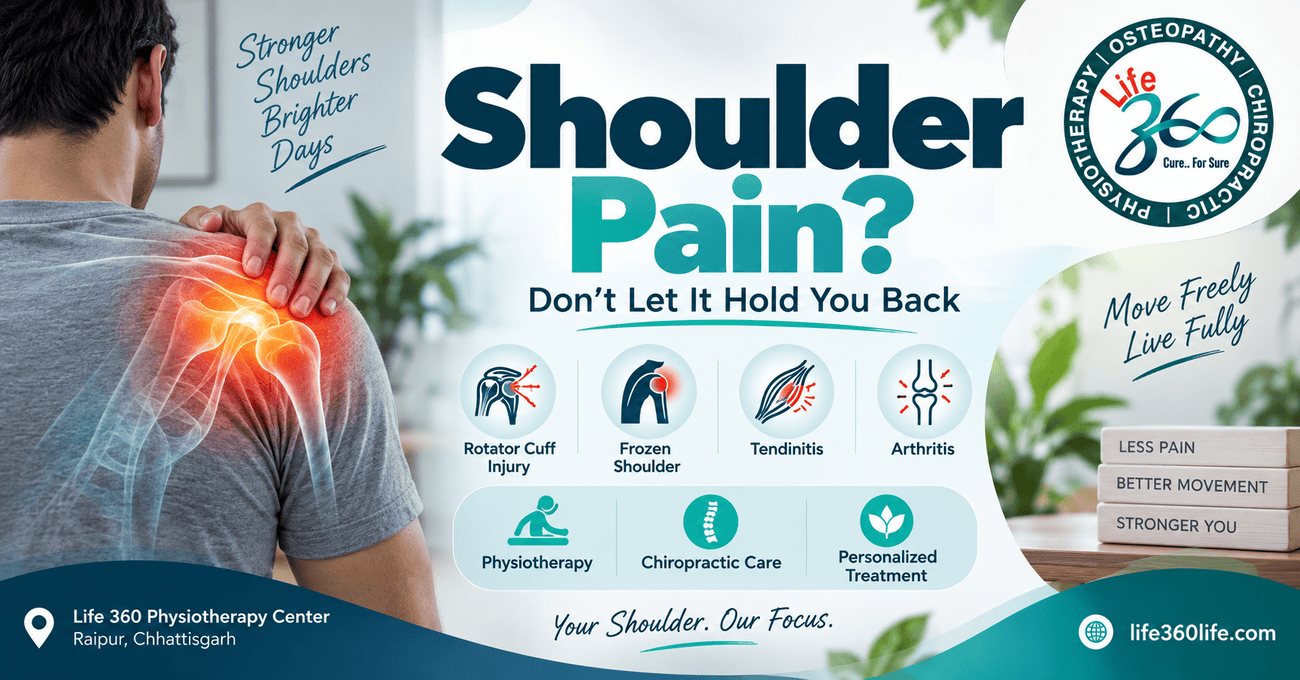
Direct Answer: The shoulder joint sits inside a flexible envelope called the capsule. In frozen shoulder, this capsule becomes inflamed, thickens, forms adhesions, and contracts — shrinking the joint's available space so movement is physically blocked in every direction. Both your own effort and someone else's hands cannot move the arm past the block — the defining feature that separates it from muscle or tendon problems.
|
Stage |
Duration (untreated) |
What You Feel |
Correct Treatment Focus |
|---|---|---|---|
|
Freezing |
2–9 months |
Rising pain, worst at night; stiffness begins |
Pain control, gentle mobility — NOT aggressive stretching |
|
Frozen |
4–12 months |
Pain eases, stiffness peaks; daily tasks blocked |
Progressive capsular stretching and mobilization |
|
Thawing |
6–24 months |
Movement slowly returns |
Strengthening and full-function restoration |
The most common treatment error we correct in Bhilai: forceful stretching during the painful freezing stage — which inflames the capsule further and prolongs the disease. Stage-matched care is the entire game.
Direct Answer: Adults 40–60, women slightly more than men, and above all — diabetics, who face up to five times the risk, often more severe stiffness, and a chance of both shoulders being affected. Thyroid patients, and anyone whose shoulder was immobilized after injury or surgery, are also high-risk. In our clinic, nearly half of frozen shoulders arrive with diabetes — if you are diabetic and your shoulder is stiffening, act now, not after six more months.
Direct Answer: Rotator cuff problems allow someone else to raise your arm fully (passive movement preserved); frozen shoulder blocks everyone. Cervical problems send pain from the neck down the arm with tingling. Getting this diagnosis right matters — the treatments are entirely different, and months are lost treating the wrong one.
Which stage you are in decides everything — assessed by pain pattern, night symptoms, and the movement map.
Graded hands-on techniques (Maitland/Mulligan) that progressively stretch the contracted capsule — the engine of recovery in the frozen stage.
Gentle mobility, positioning, and manual care that calm the inflamed capsule so the recovery phases arrive sooner.
Months of guarding load the rotator cuff, trapezius, and shoulder blade muscles with trigger points — released so the joint work progresses faster.
Stiff cervical and thoracic segments slow every shoulder recovery — mobilized as part of the plan.
Pendulum swings, wall climbs, towel and pulley stretches — progressed weekly, because the shoulder recovers through daily minutes, not weekly visits alone.
Direct Answer: Night pain typically improves within 3–4 weeks. Functional movement — dressing, reaching, overhead use — returns for most patients within 2–4 months of structured care. Diabetic shoulders run somewhat slower. Full range continues improving up to 6 months. Compare that with 18–36 months untreated — and up to 40% of untreated patients keeping permanent restriction.
Address: Opp: Dream Homes, 42A, Cross Street 1, Smriti Nagar, Bhilai, Chhattisgarh 490020
Phone: 08819801000
Website: https://life360.co.in
Q1. Where can I get frozen shoulder treatment in Bhilai?
Life360 Chiropractic Centre, Smriti Nagar, Bhilai — stage-matched frozen shoulder programs serving patients from Bhilai, Durg, Kumhari, and across Chhattisgarh.
Q2. Does frozen shoulder really open on its own?
Slowly, over 1.5–3 years — and studies show up to 40% keep residual stiffness permanently. Treatment compresses the timeline to months and completes the recovery.
Q3. Why does my shoulder hurt most at night?
Lying still pools inflammation, and lying on the shoulder compresses the inflamed capsule. Night pain marks the freezing stage — and is typically the first symptom treatment improves.
Q4. Why did I get frozen shoulder with my diabetes?
Elevated glucose stiffens capsule collagen through cross-linking — raising risk up to fivefold. Sugar control plus early treatment gives diabetic shoulders their best outcome.
Q5. Should I stretch through the pain?
No — aggressive stretching in the painful stage inflames the capsule and worsens the disease. Stage-matched loading is the correct path; that judgment is what professional care provides.
Q6. Can both shoulders freeze?
Yes — in roughly 14% of cases, most often diabetics, sometimes one after the other. Both are treated in parallel when needed.
Q7. Is frozen shoulder the same as a rotator cuff tear?
No — in cuff tears, passive movement stays free; in frozen shoulder, all movement is blocked. Different disease, different treatment — assessment decides.
Q8. How many sessions does frozen shoulder need?
Typically 15–25 sessions over 2–4 months with a daily home program. Diabetic and long-neglected shoulders may need more.
Q9. Are steroid injections necessary?
Not usually — they can ease early-stage pain, but movement returns only through capsular stretching and mobilization. Many patients recover fully without injection.
Q10. How should I sleep with a frozen shoulder?
On the good side hugging a pillow, or on your back with a small pillow under the affected arm. Avoid lying on the frozen shoulder.
Q11. Can frozen shoulder come back?
Rarely in the same shoulder; the opposite shoulder carries some risk (especially in diabetics). Maintenance mobility exercises reduce it.
Q12. When is surgery or manipulation under anesthesia considered?
Only for rare resistant cases after months of proper structured care — the overwhelming majority never need it.
Q13. Where is Life360 Chiropractic Centre located?
Opp: Dream Homes, 42A, Cross Street 1, Smriti Nagar, Bhilai, Chhattisgarh 490020. Phone: 08819801000.
Dec 05, 2024

:-early-warning-signs-you-should-never-ignore-icon-044150.png)

-icon-054426.png)
-icon-080621.png)
-icon-081941.png)
-icon-092359.png)
-icon-093248.png)
-icon-093852.png)
-icon-094609.png)
-icon-095238.png)
-icon-103429.png)
-icon-103224.png)
-icon-104305.png)
-icon-074623.png)
-icon-075551.png)
-icon-080620.png)
-icon-081325.png)
-icon-083016.png)
-icon-085607.png)
-icon-090354.png)
-icon-091256.png)
-icon-092441.png)
-icon-093257.png)
-icon-094048.png)
-icon-094827.png)
-icon-095622.png)
-icon-092325.jpg)
-icon-100332.png)
-icon-101125.png)
-icon-101922.png)