Oct 17, 2026

Author : Dr. Nitu Verma (P.T)

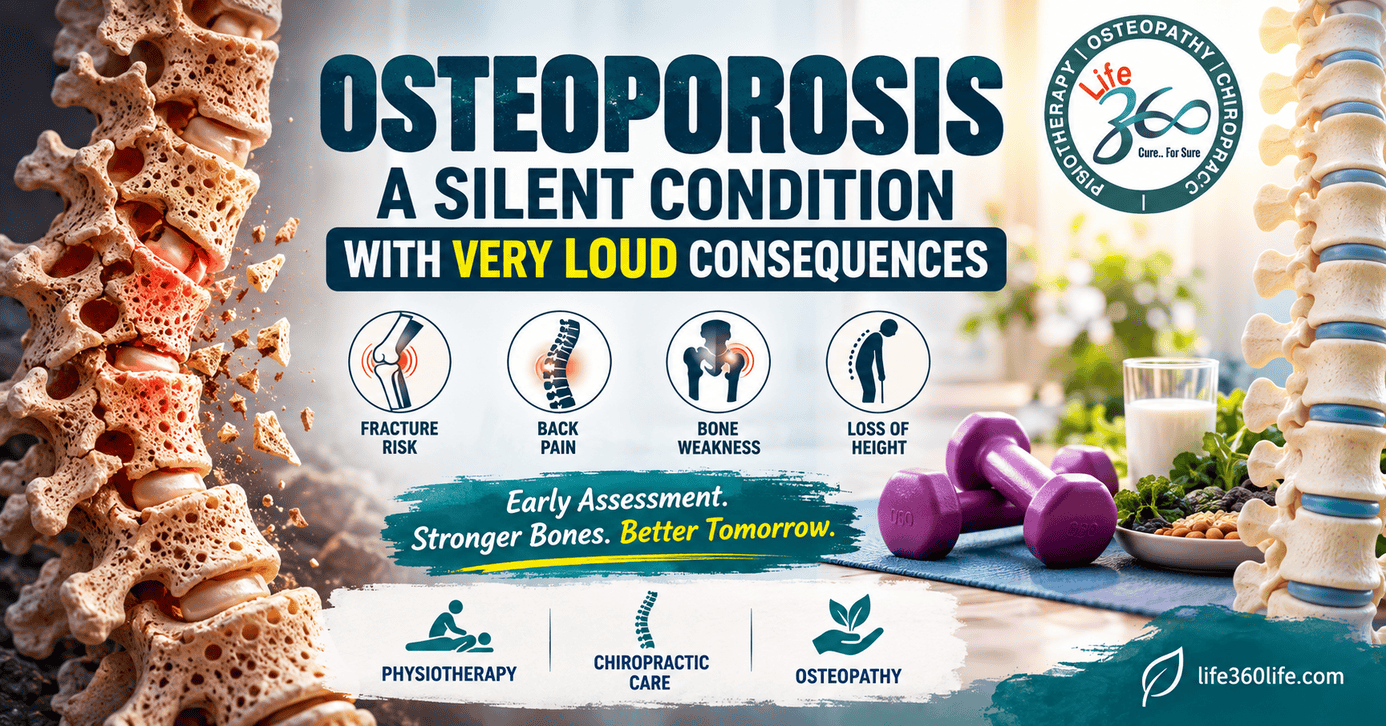
The pink dumbbells get me every time.

A woman in her sixties, told to do gentle exercise for her bones, working away with the same one-kilogram weights she bought four years ago. Same weight, same ten repetitions, four years running. Her bones stopped paying attention to that in about week three. Most osteoporosis treatment in Raipur fails for exactly that reason, not for want of effort.
Osteoporosis causes no symptoms. None at all, until something breaks.
That's what makes it unlike everything else I treat. No pain that pushes you to do something. No stiffness you'd notice getting dressed. For a lot of people the first sign is a wrist that snaps in a small fall, a spine that fractures while lifting a bucket, or a hip that goes and takes their independence with it.
The part worth holding on to is that bone is living tissue and it responds to what you do with it. Bone density is not decided by genetics alone. It responds to loading, at every age, and it responds measurably.
But it has to be the right loading. Telling somebody to do some exercise is not a bone programme.

What is osteoporosis?

A condition where bone loss has gone far enough that the internal architecture of the bone turns porous and structurally weak, so bones break under forces that shouldn't break anything.
Your bones are constantly being taken apart and rebuilt. Osteoclasts remove old bone. Osteoblasts build new bone. Through youth the building runs ahead of the removal, bone mass climbs, and it peaks somewhere in the twenties to early thirties.
Then the balance tips the other way. Removal starts outrunning replacement, and density slowly falls.
Osteopenia is the stage before that, where density has dropped but hasn't crossed the osteoporosis threshold. It's a warning, and it's the best moment anybody gets to act.
Diagnosis is by DEXA scan, which measures bone mineral density and gives you a T-score.

Who this happens to

Women after menopause, most of all. Oestrogen protects bone, and when it declines there's an accelerated stretch of bone loss in the years straight after.
Age, in both men and women.
Low body weight and a small frame.
A family history of osteoporosis or of hip fracture.
Vitamin D deficiency, which is enormously relevant here. Vitamin D deficiency in India is widespread across all sorts of populations despite no shortage of sunshine, including urban adults who spend their days indoors. Limited sun exposure, skin pigmentation, clothing coverage and what people eat all feed into it.
Low calcium intake, common in diets short on dairy and green leafy vegetables.
Inactivity, and especially long spells of bed rest or a limb kept immobilised.
Smoking and heavy alcohol intake.
Long-term corticosteroid use. This is a major cause and patients are routinely not warned about it. Somebody on steroids for a chest condition or an autoimmune disease for years should have had a conversation about their bones somewhere along the way. Most of the ones I meet in Raipur never did.
Certain medical conditions, including thyroid and parathyroid disorders, rheumatoid arthritis, coeliac disease and other malabsorption problems, and chronic kidney disease.
Early menopause, or hysterectomy with the ovaries removed.
And eating disorders or long periods of not eating enough for the training being done, which includes young athletes.

The few clues you actually get

Silent doesn't mean invisible. A handful of signs suggest fractures may already have happened, usually in the spine.
  • Height loss of more than about three centimetres from your tallest adult height
  • A forward stoop developing in the upper back
  • Sudden back pain after something minor. Bending, lifting, sometimes a heavy cough
  • Back pain that started suddenly, is worse standing and walking, and eases when you lie down
  • Any fracture from a fall from standing height or less, at any site, in an adult over fifty
Spinal compression fractures are often silent, or get filed away as ordinary back pain, and a great many of them are never diagnosed at all. Height loss and a new stoop are the most useful clues you'll get.
Anyone over fifty who breaks a bone in a low-impact fall should be assessed for osteoporosis. That recommendation has been around for years and it is ignored constantly. Wrist fractures especially. The cast comes off, the wrist works again, everybody moves on, and nobody asks the obvious question about why a wrist broke from a fall in the kitchen.

Which exercises actually build bone?

Progressive resistance training and weight-bearing impact work. Bone responds to those two kinds of load and largely ignores the rest, which is where the general advice falls apart.
Weight-bearing impact works. Force travelling through the skeleton against gravity. Brisk walking, stair climbing, and where it's appropriate and safe, light jumping or heel drops. Weight bearing exercise for osteoporosis has to load the bone, not merely move it about.
Resistance training works. Muscle pulling on bone stimulates bone formation at that site. Progressive resistance training has good evidence behind it for bone density, and the word progressive is carrying the whole sentence. Same weight forever, no effect.
Site specificity matters. Bone strengthens where you load it. Walking loads the hips and spine and does nothing whatsoever for your wrists. If you want stronger wrists and forearms, you have to load the upper body.
Swimming and cycling do not build bone. They're excellent for cardiovascular fitness and kind to painful joints, and they're non-weight-bearing, so their value for bone density is limited.
Gentle stretching and low-intensity movement on its own doesn't do it either.
So somebody who swims every morning and does nothing else can have very good fitness and almost no bone-loading stimulus. That's an unwelcome thing to tell a disciplined seventy-year-old who has been in the pool at six every day for a decade. I tell them anyway, and then I ask them to add two resistance sessions a week without giving up the swimming.
What I can't tell you is how much density any individual will gain. The honest answer is that it varies, and that fracture prevention rather than a better T-score is what I'm actually aiming at.

Which movements should I avoid with osteoporosis?

Loaded forward bending, sit-ups and crunches, forceful twisting under load, and high-velocity spinal manipulation. Where density is well down, especially with previous spinal fractures, those carry a real risk of vertebral compression fracture.
Loaded forward bending. Bending forward holding a weight, or repeated deep flexion of the spine, drives compressive force onto the front of the vertebral bodies. That's exactly where compression fractures happen.
Sit-ups and crunches, for the same reason.
Forceful twisting of the spine, especially under load.
High-velocity spinal manipulation, which is generally avoided in established osteoporosis. I'm trained in manipulation and I don't use it on these spines.
Uncontrolled high-impact activity, in anyone with severe density loss or a fracture history.
None of that means moving less. It means picking movements that load the bone along its long axis, so upright loading, resistance work, and controlled impact, while keeping repeated loaded spinal flexion out of the programme. Spinal fracture prevention is mostly a matter of what you keep out of the routine.
Extension work, which strengthens the back extensors and pushes back against the stoop, gets priority over flexion work in osteoporosis.

What I assess

A run through the risk factors. Menopause status, medication history with a hard look at steroids, family history, what you actually eat.
Your height, measured properly and compared against the tallest you remember being. It costs nothing and it tells me a great deal.
Posture, with attention to the curve of the upper back.
Strength in the back extensors, hips and legs.
Balance and fall risk, because how strong your bones are only matters in relation to whether you hit the floor.
The movements you do every day, tested as you actually do them.
And referral for a DEXA scan and blood tests where they're indicated, including vitamin D, calcium and thyroid function. Physiotherapy doesn't diagnose osteoporosis. It works out who needs testing and it manages what comes after.

What does osteoporosis treatment in Raipur involve?

Progressive resistance training, graded weight-bearing work, back extensor strengthening, balance and fall prevention, daily movement retraining, home safety, and referral for the medical side.
Progressive resistance training is the foundation, loaded properly and moved up steadily, targeting the hips, spine and upper limbs. Light unchanging resistance keeps nobody's bones interested. Bone density exercise in Raipur has to get heavier over the months or it is just a habit.
Weight-bearing and impact work, graded to current bone status and fracture history. Brisk walking and stairs at one end, heel drops and light hopping at the other, where it's safe.
Back extensor strengthening, which counters the stoop directly. Strong extensors go with lower vertebral fracture risk and better posture.
Balance and fall prevention training, because a fracture needs two ingredients: a weak bone and a fall. Fix one and leave the other and the risk is still sitting there. Balance work using an established fall-prevention structure is not an optional add-on in this group.
Posture and movement education for daily life. How to lift. How to get out of bed. How to pick something up off the floor without loading a flexed spine. Hinging at the hip rather than bending through the back, over and over until it's automatic.
Home safety and hazard reduction, since everything that prevents a fall prevents a fracture.
Nutrition and sunlight guidance, with calcium sources discussed and referral to a doctor for testing and any supplementation decisions. On sunlight, in Raipur, this needs to be practical. Early morning, with the arms and legs bare, well before the heat makes the whole idea unreasonable. Nobody in this city is standing in the sun at one in the afternoon, and I don't ask them to.
Post-fracture rehabilitation, for people who've already broken something, restoring function while building the strength that protects against the next one.

If you're under thirty-five, this is about you too

Peak bone mass is reached by the early thirties. Everything after that is managing a decline.
Which means the most effective osteoporosis prevention happens in the teens and twenties, through weight-bearing activity, enough calcium and vitamin D, not smoking, and not spending years under-eating. A higher peak buys you more reserve before you get anywhere near the threshold.
This matters most for young women, who carry more of this condition later in life and who are the likeliest to drop weight-bearing activity in adolescence and never pick it back up.

Where can I get osteoporosis treatment in Raipur?

Dr. Nitu Verma (PT) runs bone health programmes at Life 360 Physiotherapy Center in Shankar Nagar, Raipur. I am a physiotherapist with further training in chiropractic and osteopathic technique.
Osteoporosis physiotherapy in Raipur here is built around the two things that actually change your fracture risk. Progressive loading that gives bone a reason to adapt, and balance training that stops you hitting the floor. Where a DEXA scan, blood tests or medical treatment are indicated, I'll say so and refer rather than working around it.
Anyone comparing options for the best physiotherapy for osteoporosis Raipur offers should ask whether the resistance gets heavier over the weeks. If the answer is no, it is not a bone programme.

Book a bone health assessment

If you're postmenopausal, if you've lost height, if you've taken steroids long term, or if you've broken a bone in a minor fall, come and get your risk assessed and get a programme built around it.
Life 360 Physiotherapy Center
HIG-16, Sector 1, Shankar Nagar, Raipur, Chhattisgarh 492007
Also at Life360 Chiropractic Centre, Smriti Nagar, Bhilai
Bring any DEXA scan report and recent blood tests including vitamin D. Dr. Nitu Verma (PT) sees bone health patients at Life 360 Physiotherapy Center, Shankar Nagar, Raipur.

Questions patients ask

Can exercise really increase bone density?
Progressive resistance training and weight-bearing impact exercise have good evidence for maintaining and improving density at the sites you load. Bone is living tissue and it adapts to what you ask of it.
Is walking enough?
Walking helps the hips and spine and isn't enough on its own. It gives your wrists and arms no meaningful stimulus, and you need progressive resistance training for the full effect.
Why doesn't swimming help my bones?
Because it's non-weight-bearing. It's excellent for fitness and comfortable for sore joints, and it provides very little of the gravitational and impact loading that stimulates bone formation.
Which osteoporosis exercises should I be doing?
Progressive resistance work for the hips, spine and upper limbs, upright weight-bearing activity such as brisk walking and stairs, back extensor strengthening, and balance training. Osteoporosis exercises that never get harder stop working within weeks.
Are sit-ups safe with osteoporosis?
Repeated loaded forward bending of the spine, sit-ups and crunches included, increases compressive force on the front of the vertebrae, which is where compression fractures happen. Extension-based exercise is generally preferred.
Is vitamin D deficiency common in India?
Yes. Plenty of sunshine and plenty of deficiency, driven by limited sun exposure, skin pigmentation, clothing coverage and dietary patterns. Testing is worth doing in anyone with a bone health concern.
At what age should I have a bone density scan?
Discuss it with your doctor. It's commonly considered for postmenopausal women, adults over 65, anyone on long-term steroids, and any adult over 50 who fractures a bone in a low-impact fall.
Does losing height mean I have osteoporosis?
Losing more than about three centimetres from your tallest adult height can point to vertebral compression fractures and needs assessing. It's one of the few visible clues in a condition that otherwise gives you nothing.
Where do I find an osteoporosis doctor in Raipur?
A physician or endocrinologist orders the DEXA scan and the blood tests and decides on medication. A physiotherapist builds the loading and balance programme around it. Dr. Nitu Verma (PT) provides osteoporosis treatment in Raipur from Life 360 Physiotherapy Center in Shankar Nagar.
Can osteoporosis be reversed?
Density can be improved with medical treatment where it's indicated, enough calcium and vitamin D, and progressive loading exercise. Preventing fractures, through both stronger bone and fewer falls, is the practical goal.
 
Go to Top