At Life 360 Physiotherapy Center, led by Dr. Nitu Verma, India’s first lady chiropractor, we are dedicated to delivering top-quality
chiropractic and physiotherapy care. Recognized as the best chiropractor in India, Dr. Verma specializes in holistic treatments
for pain relief, spinal alignment, and sports injury rehabilitation. Our clinic in Raipur provides personalized care designed
to address the root causes of discomfort and restore balance to your body, helping you achieve long-term health and wellness.
Experience relief and recovery with India’s leading chiropractic expert at Life 360 Physiotherapy Center.
Conatct Us
Life 360 Physiotherapy Center, HIG-16, Sector 1, Shankar Nagar, Raipur, Chhattisgarh 492007
The report comes out of the bag before the shirt comes off. Supraspinatus. Partial thickness. Underlined in pen by somebody at the scan centre.
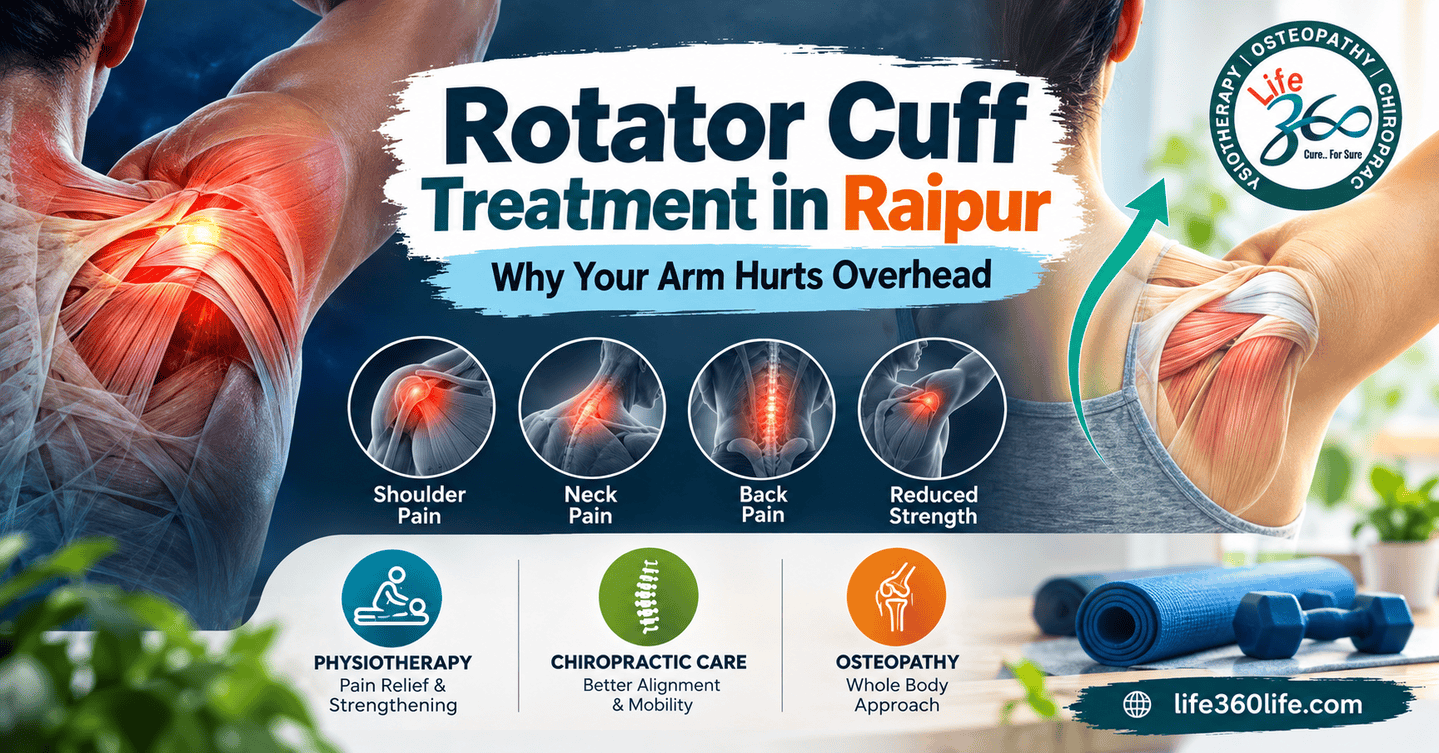
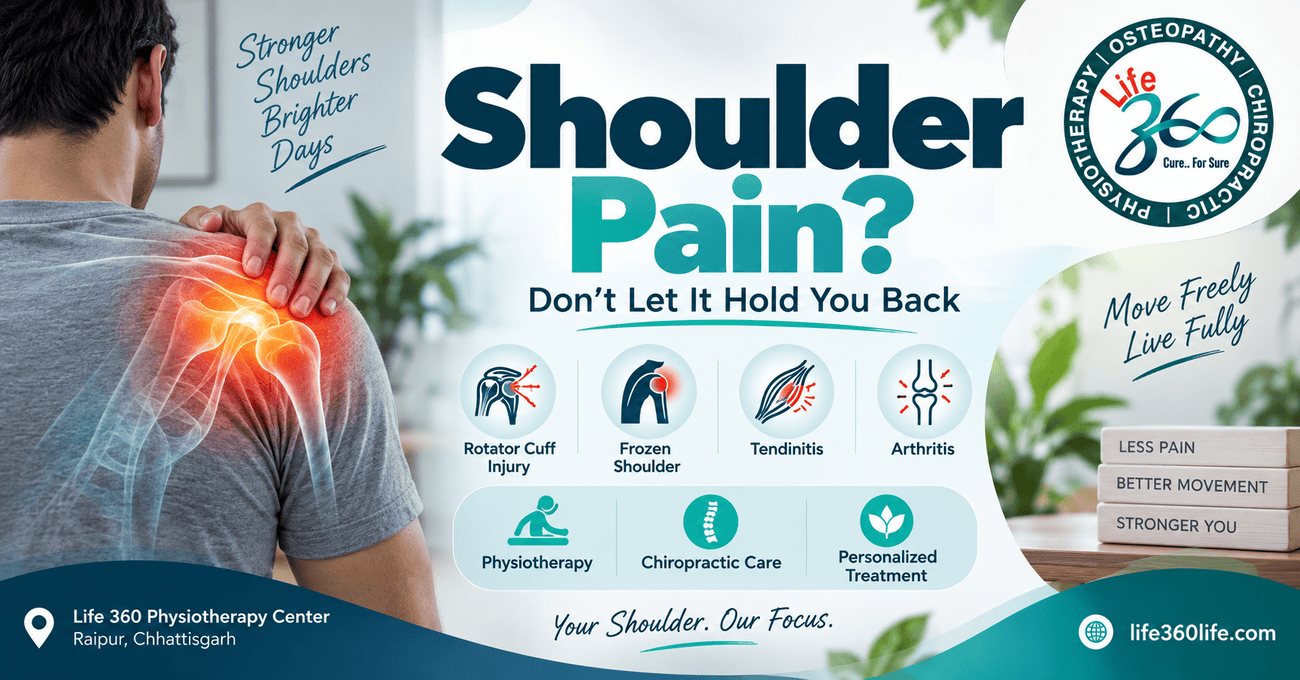
Then the same question I get every week. Do I need an operation? Usually not, and almost never on the strength of that piece of paper by itself. Most rotator cuff treatment in Raipur begins with someone holding a scan report they have read too many times. I understand why people ask. The word "tear" lands hard when you're reading it about your own body. Shoulders like this are among the most treatable things that come through my door. The treatment is mostly exercise, it's slow, and it works. What gets in the way is that people wait a year before they turn up, and by then they've read the report forty times and decided what it means.
How does rotator cuff pain usually start?
Slowly, and with no injury anybody can name. That is the whole trouble with this condition. A twinge reaching for something on a high shelf. Then combing your hair is awkward. Then you can't sleep on that side. Then reaching behind you to fasten a garment or drag the seatbelt across makes you wince, and by that point it's been eight or ten months and you've spent every one of them assuming it would settle on its own. It doesn't settle on its own. Not often. Overhead shoulder pain that has lasted more than a few weeks needs examining rather than waiting out.
What the cuff is actually for
The shoulder is the most mobile joint you own, and it pays for that mobility with stability. The ball of the humerus sits against a socket that barely deserves the name. A golf ball on a tee is the comparison everybody uses and it's a fair one. Four muscles make up the rotator cuff. Supraspinatus, infraspinatus, teres minor, subscapularis. Their tendons wrap around the joint and blend into the capsule. They aren't there to move your arm. The big muscles do that. The cuff's job is to hold the ball centred in the socket while the big muscles swing it about, and it does this continuously through every movement you make, without you ever noticing. When the cuff can't do that job, through weakness or fatigue or change in the tendon itself, the ball drifts upward as you lift. The space between the top of the humerus and the bony arch above it gets narrower. The tendon and the bursa sitting in that space get squeezed. That squeezing, along with whatever has already changed in the tendon, is what people mean when they say impingement. A short aside on that word. Impingement sounds like something has caught, like a mechanical fault you could file down. What's really going on underneath is a tendon that has stopped tolerating the load it's being asked to carry, in a space that got tighter because the movement went wrong. I'd have picked a different word. Anyway.
The shoulder blade nobody looked at
This is the part that gets skipped. Your shoulder blade has to rotate upward and tilt backward as your arm goes up. That movement is what creates the room the tendons need to pass through. If the blade doesn't move properly, because the muscles controlling it are weak or because your mid-back is too stiff to allow it, the space narrows no matter how strong your cuff is. So treating the shoulder by treating only the shoulder fails a lot of the time. A stiff thoracic spine is one of the most common things I find in people who've had shoulder pain for months. Shoulder impingement treatment in Raipur that never examines the mid-back is treating half the problem. It's also why posture keeps coming up in these conversations. Rounded shoulders park the blade in a position that has already reduced the available space before you've raised your arm an inch.
How people end up here
Repetitive overhead work does it. Painting, plastering, stacking shelves, ceiling fan work, overhead pressing at the gym. Overhead sport does it too. Cricket bowling and throwing, badminton smashes, swimming, volleyball. Plenty of the shoulder pain physiotherapy Raipur players need starts on a cricket ground rather than at a desk. Posture contributes. Rounded shoulders and a forward head from a desk and a phone. A sudden jump in load is a big one. A weekend of painting the house after a year of sitting down for a living. A new gym programme with heavy overhead pressing from week one. Age changes the tendon. Partial-thickness change in the cuff becomes common past fifty, and a great deal of the time it causes no pain at all. Weakness after a stretch of inactivity, illness, or an arm kept in a sling. And trauma. A fall onto an outstretched hand, or a sudden heavy pull, can tear the cuff outright.
Does a tear on my MRI mean I need surgery?
No. Tears show up on scans of shoulders that have never hurt, and the older the shoulder the more of them turn up. Scan a shoulder that has never hurt a day in its life and you'll still find things in it. Abnormal cuff tendons. Partial tears. Sometimes full-thickness tears, in people with no symptoms whatsoever. A tear on your MRI is not automatically the cause of your pain, and it is not automatically a reason to operate. What decides things clinically is your symptoms, your strength when I test each cuff muscle on its own, what you can and can't do with the arm, and how the shoulder responds over the first few weeks of treatment. The wording of a report doesn't decide it. People arrive frightened by the words degeneration and tendinosis. Those words describe tissue that has aged. Enormous numbers of shoulders have aged and never once hurt. Shoulder tendinopathy in Raipur patients over fifty is common, and most of it responds to loading rather than to a knife. I'll be honest that I can't always tell which finding matters. If the report says partial-thickness supraspinatus tear and the examination shows real weakness in that exact muscle, I take it seriously. Supraspinatus tear treatment then starts with that muscle specifically. If the report says the same thing and the muscle tests strong, I largely set it aside and treat what I found with my hands. That's a judgement call. I've been wrong in both directions and I expect I will be again.
What it feels like
Pain on the outer upper arm, often running down towards the elbow but rarely below it
A painful arc, where the middle range of lifting hurts and the top of the movement eases off
Pain reaching overhead, reaching behind your back, or reaching across your body
Night pain, especially lying on that side. This is one of the most characteristic features of the whole condition
Weakness, especially lifting or holding the arm out away from you
Trouble with ordinary things: combing hair, fastening clothing, reaching the seatbelt, putting a bag into an overhead rack
Is this a rotator cuff problem or a frozen shoulder?
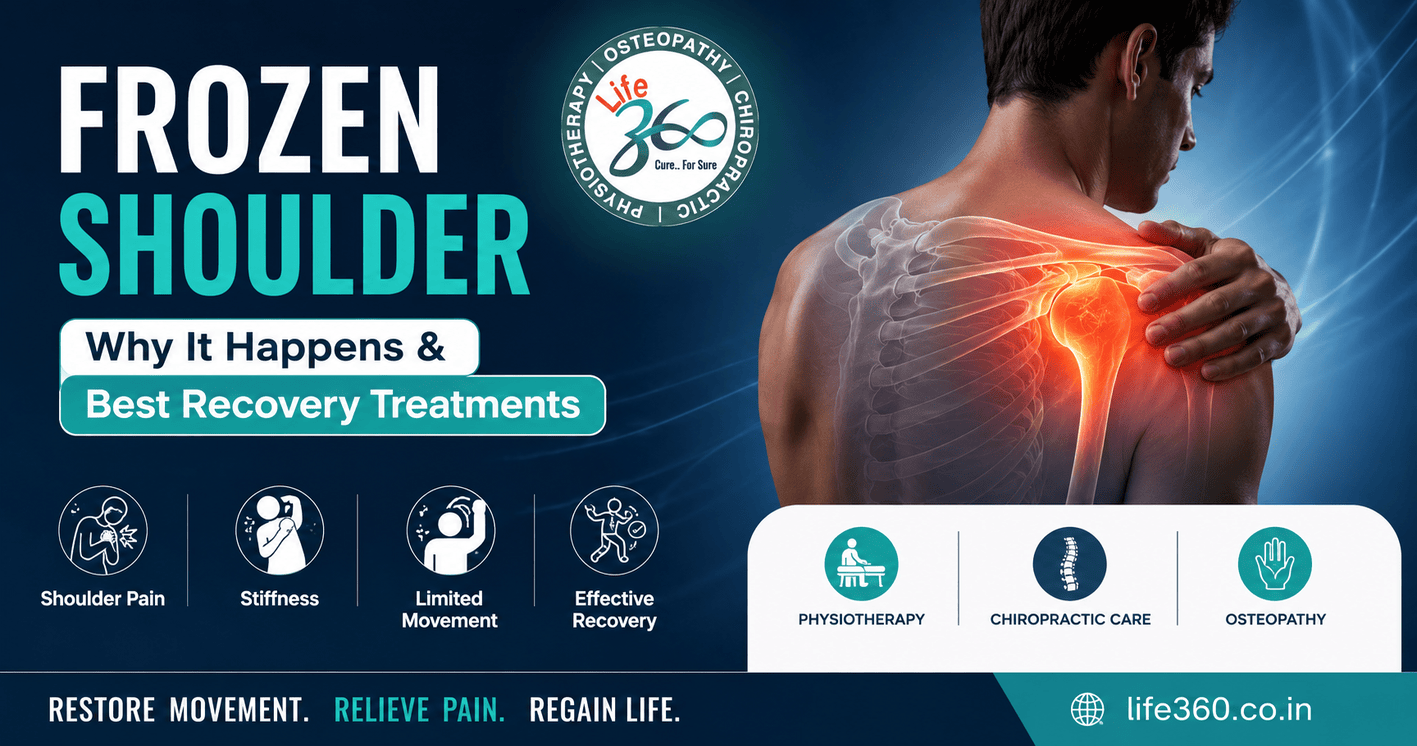
If someone else can lift your arm through most of its range while you stay relaxed, it is a cuff problem. If the arm physically will not go, it is a frozen shoulder. These two get confused constantly and then treated identically, which serves nobody. With a rotator cuff problem, movement is limited by pain, but the passive range is largely intact. Weakness is part of the picture. With a frozen shoulder, the range is genuinely gone regardless of who moves the arm, and external rotation goes first and goes worst. It's a problem of the capsule and it runs through its own phases on its own schedule. The test is simple in principle. With the patient properly relaxed, does passive movement show me a joint that moves but hurts, or a joint that physically will not go? I've seen people put through weeks of aggressive stretching for a shoulder that needed loading, and weeks of loading for a shoulder that was genuinely frozen. Both were wasted months, and both started with nobody checking passive range.
When shoulder pain needs a doctor, not a physio
Get medical assessment for any of these:
Inability to lift the arm at all after a fall or a sudden injury, which can mean a significant tear or a fracture
Visible deformity of the shoulder
A sudden bulge appearing in the upper arm, which can suggest a biceps tendon rupture
Shoulder pain together with chest discomfort, breathlessness or sweating. That needs urgent assessment, not a physiotherapy appointment
Fever with a hot, swollen joint
Unexplained weight loss, or night pain that has nothing to do with what position you're lying in
What I check
Movement, active and then passive, because that's what separates a stiff joint from a painful one. Strength of each cuff muscle individually, since which muscle is weak changes what I prescribe. The specific impingement and cuff tests, read together as a group rather than one at a time. No single one of them is worth much alone. The shoulder blade. Where it sits at rest, and how it controls itself while you raise the arm, watched from behind with the shirt off. Thoracic spine mobility, which is restricted in almost every chronic case I see. A screen of the neck, because cervical problems refer pain straight into the shoulder region and get treated as shoulder problems for months. And the actual activities that hurt. If it's the bowling action, I want to watch the bowling action.
What treatment actually works for a rotator cuff problem?
Progressive strengthening of the rotator cuff, done for months rather than weeks. It carries more evidence behind it than anything else we do for this, and for a lot of impingement and non-traumatic cuff presentations, exercise gets results comparable to surgery. Scapular control training sits alongside it. Serratus anterior and lower trapezius, the muscles that put the blade where it needs to be. In cases that have stalled, this is often the piece that gets things moving again. Thoracic spine mobilisation to restore extension and rotation in the mid-back. Patients are frequently startled by this one, because their overhead reach improves within minutes of treatment that happened nowhere near the shoulder. Manual therapy and joint mobilisation at the glenohumeral joint itself, where accessory movement is restricted. Dry needling and soft tissue work for the upper trapezius, levator scapulae, pectorals and the cuff muscles themselves, which build trigger points that refer pain down the arm and confuse everyone. Posture correction, aimed at the rounded shoulder and forward head position that has narrowed the space before you even move. Load modification, which means cutting the provocative overhead work back for a while and building capacity underneath it, then putting the overhead work back in stages. Cutting it out altogether just makes the tendon weaker. And sleep position. Stay off that side. When you lie on the other side, put a pillow under the affected arm so the shoulder doesn't fall forward across your body all night. Here's where I'll say something plenty of clinicians would argue with. I start loading early, before the pain has gone, and I ask people to work into a level of ache they can tolerate rather than waiting for a pain-free shoulder. Some colleagues wait. I've watched too many shoulders get weaker while everyone waited politely for the pain to disappear. What tires me out is heat. Ten sessions of hot packs and ultrasound on a shoulder that needed a resistance band and someone counting reps. It feels like treatment. It isn't.
How long does rotator cuff treatment in Raipur take?
Pain and night symptoms usually ease in three to four weeks. Real strength change takes eight to twelve weeks, and a full return to overhead sport or heavy overhead work commonly takes three to six months. Tendons adapt slowly, and being straight about the timeline stops people quitting halfway. The people who stop at week four because it stopped hurting are the people I see again in six months with the same shoulder. Nobody wants to hear that the exercises continue after the pain has gone. They do.
When I send someone to a surgeon
A surgical opinion makes sense for acute traumatic full-thickness tears, especially in younger and active people. For significant weakness where the arm won't lift. And for cases that haven't responded to a genuine, properly executed course of exercise-based rehab lasting at least three months. That word genuine is doing work in that sentence. Six half-hearted weeks with a printed sheet isn't a failed course of rehab. Degenerative partial tears in older patients very often do well without an operation. A tear on imaging, on its own, isn't an indication for surgery.
Where can I get rotator cuff treatment in Raipur?
Dr. Nitu Verma (PT) treats shoulders at Life 360 Physiotherapy Center in Shankar Nagar, Raipur. I work from a physiotherapy base with further training in chiropractic and osteopathy. Shoulder assessment here takes in the shoulder blade, the thoracic spine and the neck, because in long-standing shoulder pain the limiting factor is often not at the shoulder at all. Anyone comparing clinics for the best physiotherapy for rotator cuff Raipur offers should ask whether the mid-back and the shoulder blade get examined at the first visit. People also leave understanding what their MRI report does and doesn't mean. For a lot of them that turns out to be the most useful twenty minutes of the visit.
Book a shoulder assessment
If reaching overhead hurts, if you can't sleep on that side, or if a scan report has left you worried about a tear, come and get examined properly. Life 360 Physiotherapy Center HIG-16, Sector 1, Shankar Nagar, Raipur, Chhattisgarh 492007 Also at Life360 Chiropractic Centre, Smriti Nagar, Bhilai Bring any X-ray, ultrasound or MRI reports. Dr. Nitu Verma (PT) sees shoulder patients at Life 360 Physiotherapy Center, Shankar Nagar, Raipur.
Questions patients ask
Does a rotator cuff tear always need surgery? No. Many degenerative partial tears do well with exercise-based rehabilitation. Surgery is more commonly indicated for acute traumatic full-thickness tears, marked weakness, or failure of a thorough conservative programme. Why does my shoulder hurt more at night? Lying down reduces the space in the joint and takes away the small movements that keep circulation going to the tendon. Night pain is one of the most characteristic features of cuff problems. What is shoulder impingement? Compression of the rotator cuff tendons and the bursa in the space beneath the bony arch of the shoulder. It's usually about how the humeral head and shoulder blade are moving rather than about the shape of the bone alone. Is a tear on my MRI the cause of my pain? Not necessarily. Cuff abnormalities including tears turn up in large numbers of people with no shoulder pain at all, and they get commoner with age. The findings have to be read alongside your symptoms and your examination. How is this different from frozen shoulder? With a cuff problem, someone else can move your arm through most of its range even though it hurts. With frozen shoulder the movement is physically restricted, especially rotating the arm outwards. Can I keep exercising with shoulder pain? Usually yes, with modification. Complete rest weakens the tendon. We cut back the overhead movements that provoke pain for a while, build strength underneath, then bring them back. Which rotator cuff exercises should I start with? Usually external and internal rotation against light resistance with the elbow at the side, plus scapular control work for serratus anterior and lower trapezius. The resistance has to keep going up over the weeks. Rotator cuff exercises picked off a video and never progressed are why so many shoulders stall at the same point. Why is my physiotherapist treating my mid-back for a shoulder problem? Because the shoulder blade has to rotate on the rib cage for the arm to lift properly, and a stiff thoracic spine stops that happening. Restoring mid-back mobility often improves overhead reach straight away. Where do I find a shoulder pain doctor in Raipur? Look for a clinician who tests each cuff muscle separately, checks passive range to rule out a frozen shoulder, and examines the shoulder blade and thoracic spine. Dr. Nitu Verma (PT) provides rotator cuff treatment in Raipur from Life 360 Physiotherapy Center in Shankar Nagar. How long does rotator cuff rehabilitation take? Pain often improves inside three to four weeks. Tendon and strength adaptation takes eight to twelve weeks or more, and return to heavy overhead activity commonly three to six months.