Life 360 Physiotherapy Center, HIG-16, Sector 1, Shankar Nagar, Raipur, Chhattisgarh 492007
-
For Appointment: 09115719395 , 07000784644 , 07714908010
-

At Life 360 Physiotherapy Center, led by Dr. Nitu Verma, India’s first lady chiropractor, we are dedicated to delivering top-quality chiropractic and physiotherapy care. Recognized as the best chiropractor in India, Dr. Verma specializes in holistic treatments for pain relief, spinal alignment, and sports injury rehabilitation. Our clinic in Raipur provides personalized care designed to address the root causes of discomfort and restore balance to your body, helping you achieve long-term health and wellness. Experience relief and recovery with India’s leading chiropractic expert at Life 360 Physiotherapy Center.
For Appointment: 09115719395 , 07000784644 , 07714908010
-poster-074623.png)
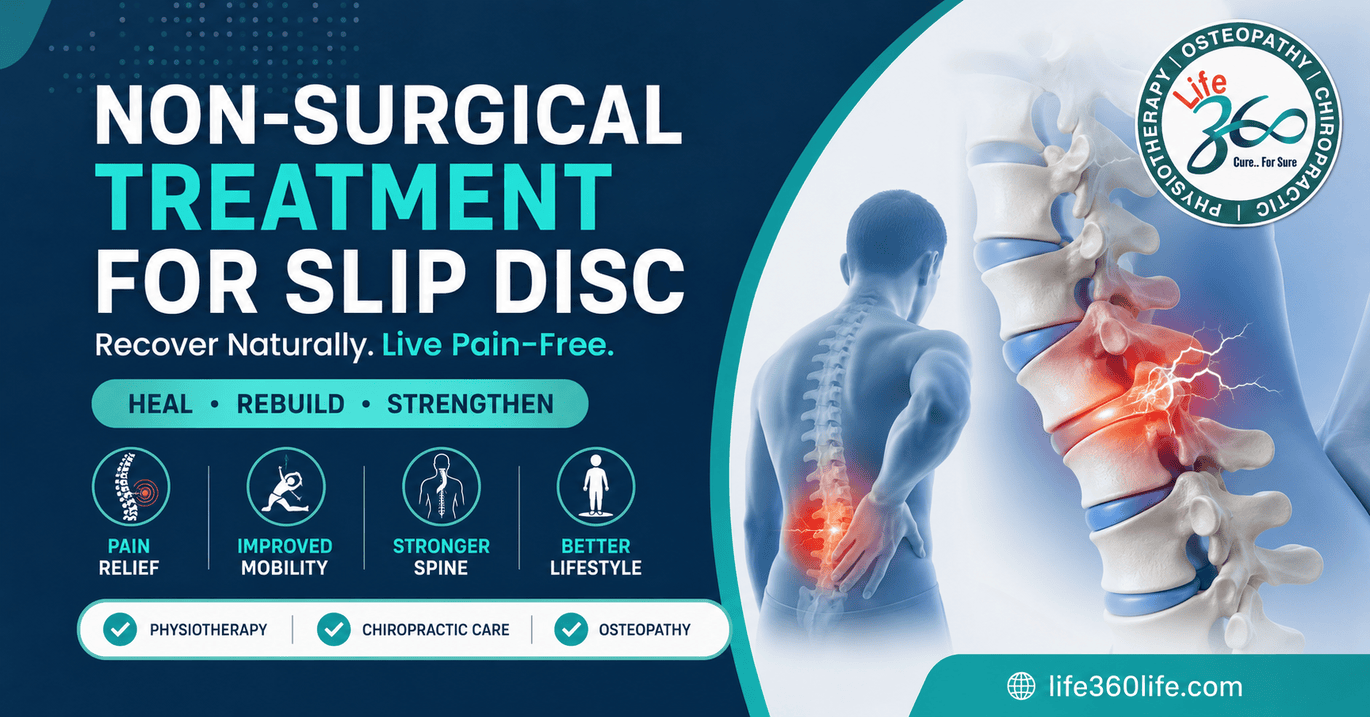
Quick Answer: A slipped disc does not actually "slip" — its soft core bulges or leaks through the outer ring and presses on a nerve. The crucial fact: around 90% of slipped discs heal without surgery, and research shows herniated disc material frequently shrinks and reabsorbs naturally when supported by correct treatment. In Bhilai, Chhattisgarh, Life360 Chiropractic Centre in Smriti Nagar — using the protocols of Dr. Nitu Verma, India's first lady chiropractor — specializes in non-surgical disc recovery. Call 08819801000.
Few words frighten a working family like an MRI report reading "disc herniation at L4-L5." In Bhilai's industrial households — where the earning member often lifts, bends, and stands for a living — the fear doubles: surgery, expenses, months off work. Before those fears take over, read this guide. The biology of disc healing is far kinder than most patients are ever told.
Direct Answer: Each disc is a cushion with a jelly-like core inside a tough fibrous ring. Years of load — or one bad lift — can tear the ring, letting the core bulge or leak out and press on the adjacent spinal nerve. Depending on how far it goes, doctors call it a bulge, protrusion, extrusion, or sequestration — a severity ladder, not a life sentence.
|
MRI Term |
Meaning |
Non-Surgical Recovery Outlook |
|---|---|---|
|
Disc bulge |
Ring intact, disc protrudes slightly |
Excellent |
|
Protrusion / herniation |
Core pushes through a ring tear |
Very good |
|
Extrusion |
Core material leaks beyond the disc |
Good — these often reabsorb the most |
|
Sequestration |
Free fragment in the canal |
Case-by-case; specialist input |
Lower back pain that worsens on sitting, bending, coughing, and sneezing
Sciatica — radiating leg pain, often the dominant complaint
Tingling, numbness, or weakness in the leg or foot
Neck disc cases: arm pain with tingling fingers
Relief on lying down, worst after long sitting — the classic disc rhythm
Direct Answer: Follow-up MRI studies document spontaneous disc resorption — the body gradually shrinking and absorbing herniated material over weeks to months, with larger extrusions often reabsorbing the most. The disc is not a punctured tyre; it is living tissue with a repair process. Treatment's job is to create the mechanical conditions — decompression, alignment, movement, core support — under which that repair completes and the nerve is freed.
Does your scan finding actually explain your symptoms? (Pain-free people commonly have bulges on MRI.) We match examination to imaging before treating — and screen for the rare red flags that genuinely need a surgeon.
Restoring segment alignment and mobility to reduce mechanical stress on the injured disc — gentle, graded, stage-appropriate.
Controlled unloading that lowers pressure inside the disc and encourages the bulge to retract away from the nerve — a core evidence-supported element for disc-related leg and arm pain.
Movements matched to your specific disc behavior that centralize pain out of the limb — your daily self-treatment between sessions.
Training the spine's internal belt (transversus abdominis, multifidus) to protect the healing disc — the recurrence-prevention step most relapsing patients never received.
Lifting technique for plant and warehouse workers, sitting protocols for desk staff, riding posture for commuters — because the disc heals in your daily life, not just in our clinic.
Direct Answer: Forward bending to lift, sit-ups and toe-touches, prolonged sitting beyond 30 minutes, sudden twisting, heavy overhead lifting, soft sagging mattresses, and long two-wheeler journeys during the acute phase.
Direct Answer: Loss of bladder/bowel control with saddle numbness (emergency — hospital now), progressive muscle weakness or foot drop, or disabling symptoms that have truly failed 6–12 weeks of quality conservative treatment. Everyone else — the vast majority — deserves the conservative path first. Many of our Bhilai patients cancelled scheduled surgeries after completing it.
Bring your MRI. Leave with an honest, examination-based plan.
Address: Opp: Dream Homes, 42A, Cross Street 1, Smriti Nagar, Bhilai, Chhattisgarh 490020
Phone: 08819801000
Website: https://life360.co.in
Q1. Where can I get slipped disc treatment without surgery in Bhilai?
Life360 Chiropractic Centre, Smriti Nagar, Bhilai — chiropractic correction, decompression therapy, and structured rehabilitation under Dr. Nitu Verma's protocols.
Q2. My MRI shows disc herniation. Is surgery compulsory?
No — the image alone never decides surgery. Around 90% of herniations recover conservatively, and many shrink naturally. Red-flag neurological signs, not scan words, define the surgical minority.
Q3. How long does a slipped disc take to heal without surgery?
Significant improvement typically within 4–6 weeks; substantial recovery by 8–12 weeks. Severe cases may need 3–6 months. Pain relief usually begins within the first two weeks of correct treatment.
Q4. Can the disc go back to its place with treatment?
More accurately: the bulged material retracts and reabsorbs while the tear heals — decompression, correct movement, and time do this. "Pushing the disc back" in one session is a myth; guided biology is the reality.
Q5. Is walking safe with a slipped disc?
Yes — short, frequent, level-ground walks nourish the disc and speed healing. Avoid jogging and uneven terrain during recovery.
Q6. Which exercises are dangerous with a disc problem?
Toe-touching, sit-ups, crunches, heavy squats and deadlifts — until specifically cleared. Wrong exercises can push disc material further onto the nerve.
Q7. Can plant workers and heavy lifters return to full duty after a disc injury?
Most do — with completed rehabilitation, restored core strength, and corrected lifting technique. We plan graded return-to-work as part of treatment.
Q8. What is the difference between disc bulge and herniation?
A bulge protrudes with the ring intact; a herniation breaks through the ring. Bulges generally settle faster — both usually recover without surgery.
Q9. How should I sit during disc recovery?
Upright with lumbar support, hips slightly above knees, breaks every 30 minutes. We set up your exact work-seat and vehicle position during treatment.
Q10. Do painkillers and bed rest cure a disc problem?
No — painkillers mask the signal and prolonged bed rest weakens the spine's support. Active, structured treatment is what changes the outcome.
Q11. Can a healed disc problem come back?
It can if old habits return — which is why core strengthening and technique correction are permanent parts of our program, not optional extras.
Q12. Do you treat cervical (neck) disc problems too?
Yes — neck disc bulges causing arm pain and tingling follow the same non-surgical principles with cervical-specific techniques and traction.
Q13. Where is Life360 Chiropractic Centre located?
Opp: Dream Homes, 42A, Cross Street 1, Smriti Nagar, Bhilai, Chhattisgarh 490020. Phone: 08819801000.
Dec 05, 2024

:-early-warning-signs-you-should-never-ignore-icon-044150.png)
-icon-054426.png)
-icon-080621.png)
-icon-081941.png)
-icon-092359.png)
-icon-093248.png)
-icon-093852.png)
-icon-094609.png)
-icon-095238.png)
-icon-103429.png)
-icon-103224.png)
-icon-104305.png)
-icon-075551.png)
-icon-080620.png)
-icon-081325.png)
-icon-082141.png)
-icon-083016.png)
-icon-085607.png)
-icon-090354.png)
-icon-091256.png)
-icon-092441.png)
-icon-093257.png)
-icon-094048.png)
-icon-094827.png)
-icon-095622.png)
-icon-092325.jpg)
-icon-100332.png)
-icon-101125.png)
-icon-101922.png)