Life 360 Physiotherapy Center, HIG-16, Sector 1, Shankar Nagar, Raipur, Chhattisgarh 492007
-
For Appointment: 09115719395 , 07000784644 , 07714908010
-

At Life 360 Physiotherapy Center, led by Dr. Nitu Verma, India’s first lady chiropractor, we are dedicated to delivering top-quality chiropractic and physiotherapy care. Recognized as the best chiropractor in India, Dr. Verma specializes in holistic treatments for pain relief, spinal alignment, and sports injury rehabilitation. Our clinic in Raipur provides personalized care designed to address the root causes of discomfort and restore balance to your body, helping you achieve long-term health and wellness. Experience relief and recovery with India’s leading chiropractic expert at Life 360 Physiotherapy Center.
For Appointment: 09115719395 , 07000784644 , 07714908010
-poster-103224.png)
Quick Answer: Recovery after stroke or paralysis is possible — the brain can rewire itself through a property called neuroplasticity, but only with early, intensive, structured rehabilitation. The first 3–6 months are the golden window. In Raipur, Chhattisgarh, Life 360 Physiotherapy Center in Shankar Nagar provides expert neuro rehabilitation — helping stroke and paralysis patients regain movement, balance, walking, and independence. Call 09115719395.
A stroke changes life in a single moment — for the patient and the entire family. One day everything is normal; the next, a hand won't move, a leg won't bear weight, speech is slurred, and simple tasks need help. If your loved one has suffered a stroke or paralysis in Raipur or anywhere in Chhattisgarh, the most important message in this article is this: the medical treatment saved the life — rehabilitation rebuilds it. And the earlier it starts, the better the recovery.
Direct Answer: A stroke occurs when blood supply to part of the brain is blocked (ischemic stroke, ~85% of cases) or a vessel bursts (hemorrhagic stroke). Brain cells in that area die, and the body functions they controlled — movement, speech, balance, sensation — are impaired. When one side of the body is weakened or paralyzed, it is called hemiplegia (complete) or hemiparesis (partial).
Direct Answer: Yes — meaningful recovery is possible in most patients. The brain physically rewires itself: healthy areas can take over the functions of damaged areas. But this rewiring happens only in response to repeated, task-specific practice. Movement that is not practiced is not recovered. This is why structured rehabilitation — not just waiting — determines the outcome.
Key facts every family should know:
The first 3–6 months after stroke are the period of fastest recovery — the golden window
Recovery continues for years with the right training — it slows, but never fully stops
Even patients starting rehab late can improve — late is better than never
Doing nothing leads to complications: frozen shoulder, muscle contractures, falls, and permanent dependence
We evaluate muscle tone, strength, balance, walking pattern, hand function, and daily activity level — then build a stage-appropriate recovery plan with measurable goals.
Rolling, sitting, standing, transferring, reaching, gripping — practiced in the exact patterns the brain needs to relearn. Hundreds of quality repetitions drive neuroplasticity.
Progressive walking re-education — weight shifting, stepping patterns, balance control, and stair training — with the goal of safe, independent walking, with or without support.
Post-stroke muscle tightness (spasticity) is managed with positioning, sustained stretching, weight-bearing techniques, and tone-normalizing exercises to prevent painful contractures.
The hand is often the slowest to recover and the easiest to give up on. Our targeted upper-limb program — reaching, grasping, object manipulation — fights "learned non-use" of the affected arm.
Falls are the biggest danger after stroke. We systematically train static and dynamic balance to make home life safe.
Recovery happens 24 hours a day, not just in the session. We train family members in correct positioning, safe transfers, and daily home exercises — a structured plan the whole family can follow.
Facial palsy / Bell's palsy — facial muscle re-training and stimulation
GBS (Guillain-Barré Syndrome) — graded strengthening during recovery phase
Spinal cord injury — mobility, transfers, and independence training
Parkinson's disease — balance, gait, and mobility maintenance
Myelopathy and neuropathy — balance and strength rehabilitation
Direct Answer: Rehabilitation is measured in months, not sessions. Most patients need 3–6 months of regular therapy for major functional gains — sitting, standing, walking — followed by a maintenance program. Hand recovery may continue improving for 12–18 months. Frequency matters: 4–6 sessions weekly in early months produces far better outcomes than once-weekly therapy.
|
Recovery Milestone |
Typical Timeline (with regular rehab) |
|---|---|
|
Sitting balance |
2–6 weeks |
|
Standing with support |
4–10 weeks |
|
Walking with support |
2–4 months |
|
Independent walking (many patients) |
3–6 months |
|
Useful hand function |
3–12+ months |
Every stroke is different — timelines vary with stroke severity, age, and rehab intensity. These are typical ranges, not promises.
Direct Answer: Within weeks of inactivity, muscles shorten into contractures, the shoulder can subluxate and freeze, and the brain "learns" not to use the affected side. Starting rehabilitation early — often within days of medical stability — prevents these complications and captures the brain's peak rewiring period.
If your family member has had a stroke or is living with paralysis — whether it happened last week or last year — a structured assessment is the first step toward recovery.
Address: HIG-16, Sector 1, Shankar Nagar, Raipur, Chhattisgarh 492007
Phone: 09115719395 | 07714908010 | 07000784644
Timing: 11:00 AM – 6:00 PM
Website: https://life360.co.in
Q1. Where can I get the best stroke rehabilitation in Raipur?
Life 360 Physiotherapy Center, Shankar Nagar, Raipur provides structured neuro rehabilitation for stroke and paralysis patients — movement re-education, gait training, hand recovery, and family training. Patients come from across Chhattisgarh.
Q2. Can a paralyzed person walk again?
Many do. With early, intensive rehabilitation, a large proportion of stroke patients regain independent or assisted walking within 3–6 months. Outcomes depend on stroke severity and rehab consistency.
Q3. When should physiotherapy start after a stroke?
As soon as the patient is medically stable — often within 24–72 hours in hospital, continuing intensively after discharge. Early start prevents complications and speeds recovery.
Q4. My relative had a stroke 1–2 years ago. Is it too late for physiotherapy?
No. While early rehab is ideal, research shows improvement is possible even years after stroke with intensive task-specific training. An assessment will identify realistic goals.
Q5. How many days a week is neuro physiotherapy needed?
In the first months, 4–6 days weekly gives the best results. As independence grows, frequency reduces and the home program takes over.
Q6. Why is the affected hand recovering slower than the leg?
Hand control uses a larger, more specialized brain area, so it recovers slower. Dedicated upper-limb training is essential — many patients neglect the hand and lose recoverable function.
Q7. What is spasticity and can it be treated?
Spasticity is involuntary muscle tightness after stroke — a clenched fist, bent elbow, or stiff leg. Positioning, stretching, and tone-management techniques control it and prevent permanent contractures.
Q8. Why does the stroke patient's shoulder hurt?
The weak shoulder can partially dislocate (subluxation) under the arm's weight, and careless pulling during transfers injures it. Proper handling and support prevent this — we train families in correct technique.
Q9. Can home physiotherapy alone rehabilitate a stroke patient?
A supervised clinic program with equipment produces better outcomes, supplemented by a structured daily home program. We combine both and train family members.
Q10. What can the family do to speed up recovery?
Encourage use of the affected side in daily tasks, follow the home exercise plan daily, position correctly, prevent falls, and maintain patience and encouragement — motivation strongly influences outcome.
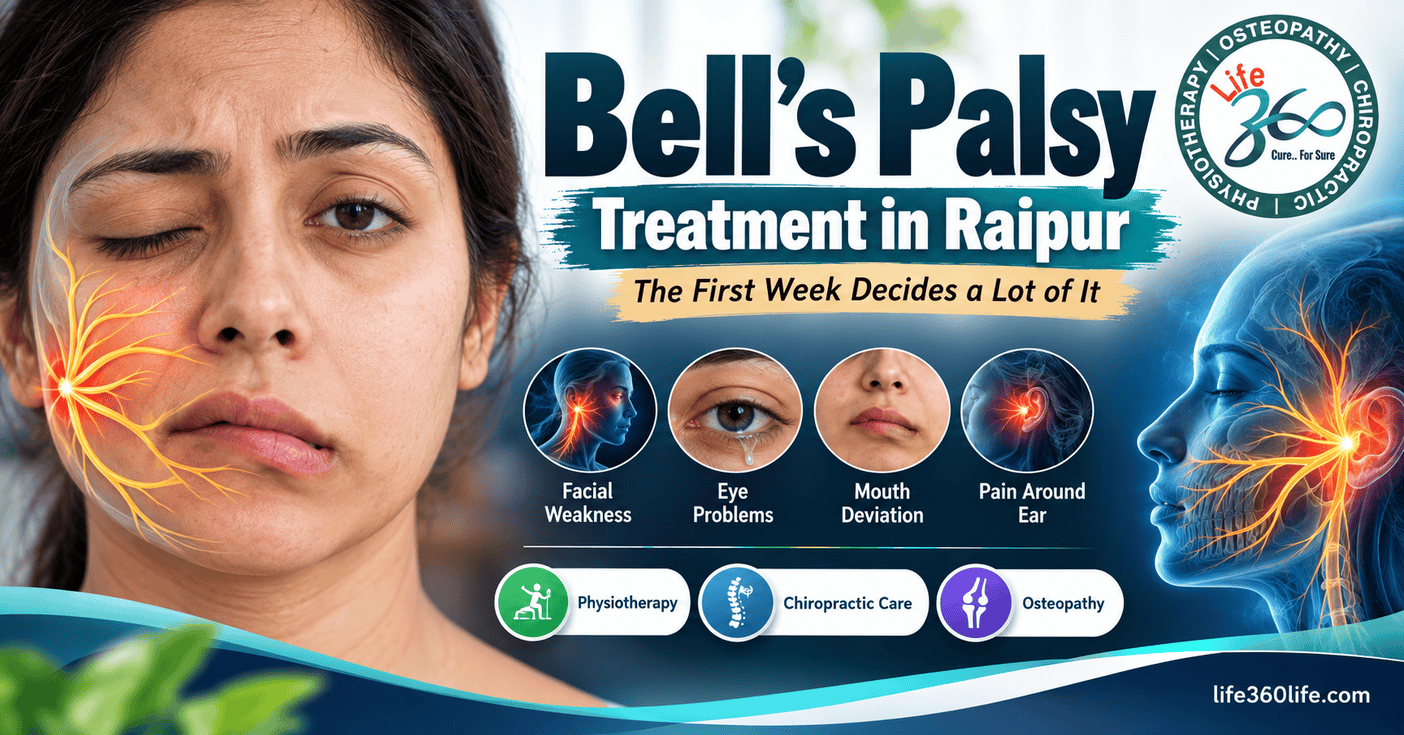
Q11. Does paralysis physiotherapy help in facial palsy (Bell's palsy)?
Yes. Facial exercises, stimulation, and re-training restore facial symmetry in most Bell's palsy cases, especially when started early.
Q12. How do we prevent a second stroke?
Strictly control blood pressure, diabetes, and cholesterol; take prescribed medications; stop smoking; stay active. Rehabilitation itself supports cardiovascular health — but medical follow-up with your physician is essential.
Q13. Where is Life 360 Physiotherapy Center located?
HIG-16, Sector 1, Shankar Nagar, Raipur, Chhattisgarh 492007. Open 11 AM – 6 PM. Phone: 09115719395 / 07714908010.
Dec 05, 2024

:-early-warning-signs-you-should-never-ignore-icon-044150.png)
-icon-054426.png)
-icon-080621.png)
-icon-081941.png)
-icon-092359.png)
-icon-093248.png)
-icon-093852.png)
-icon-094609.png)
-icon-095238.png)
-icon-103429.png)
-icon-104305.png)
-icon-074623.png)
-icon-075551.png)
-icon-080620.png)
-icon-081325.png)
-icon-082141.png)
-icon-083016.png)
-icon-085607.png)
-icon-090354.png)
-icon-091256.png)
-icon-092441.png)
-icon-093257.png)
-icon-094048.png)
-icon-094827.png)
-icon-095622.png)
-icon-092325.jpg)
-icon-100332.png)
-icon-101125.png)
-icon-101922.png)