Life 360 Physiotherapy Center, HIG-16, Sector 1, Shankar Nagar, Raipur, Chhattisgarh 492007
-
For Appointment: 09115719395 , 07000784644 , 07714908010
-

At Life 360 Physiotherapy Center, led by Dr. Nitu Verma, India’s first lady chiropractor, we are dedicated to delivering top-quality chiropractic and physiotherapy care. Recognized as the best chiropractor in India, Dr. Verma specializes in holistic treatments for pain relief, spinal alignment, and sports injury rehabilitation. Our clinic in Raipur provides personalized care designed to address the root causes of discomfort and restore balance to your body, helping you achieve long-term health and wellness. Experience relief and recovery with India’s leading chiropractic expert at Life 360 Physiotherapy Center.
For Appointment: 09115719395 , 07000784644 , 07714908010
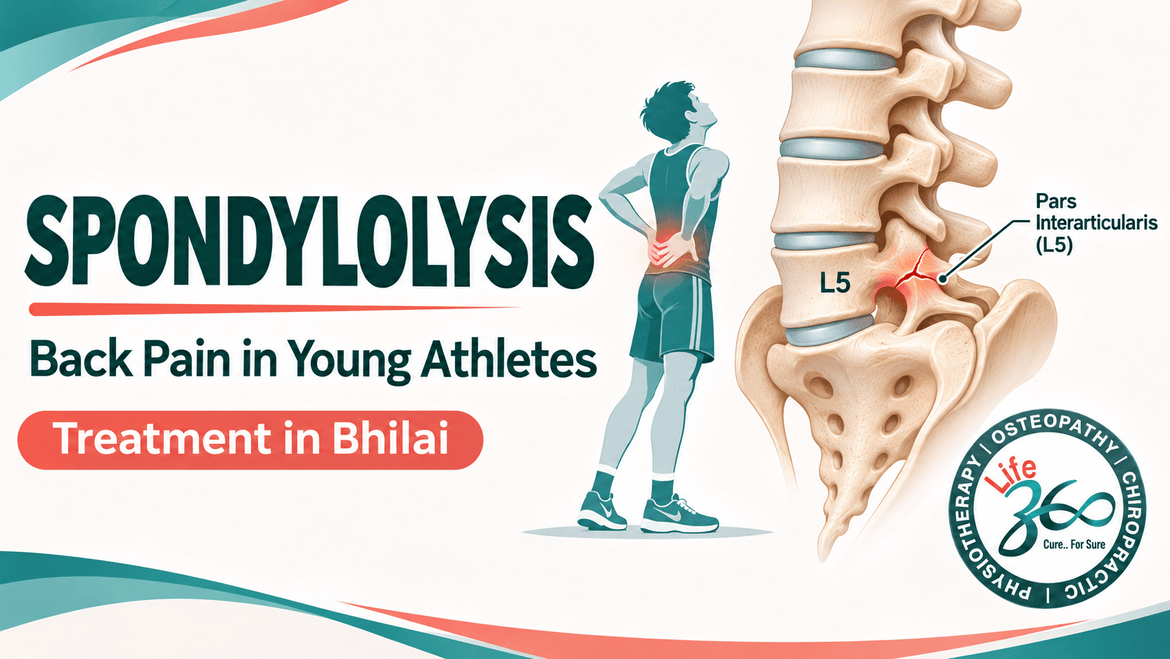
Quick answer: Spondylolysis is a stress fracture through a thin bridge of bone behind a vertebra, almost always L5, caused by repeated arching and twisting in a growing spine. In a teenage athlete whose one-sided back pain has lasted beyond two weeks, suspect it rather than treating a muscle pull. Early lesions can heal with managed rest.
How long has he had that back pain, and what has anybody actually done about it?
A 15-year-old Class 10 student from Civic Centre came in with his father after six weeks of right-sided low back pain. He is a kabaddi raider, training six days a week since the school tournaments began. The pain came on during raids, switched off within minutes of sitting, and never travelled into his legs.
He had been given a spray, a lumbar belt and a painkiller before matches. He had played every fixture.
I asked him to stand on his right leg and arch backwards. He came straight up and put his hand on the exact spot.
His X-ray was reported normal. His MRI, requested with the right sequences, was not.
Because a growing skeleton is the one thing that cannot be trained harder.
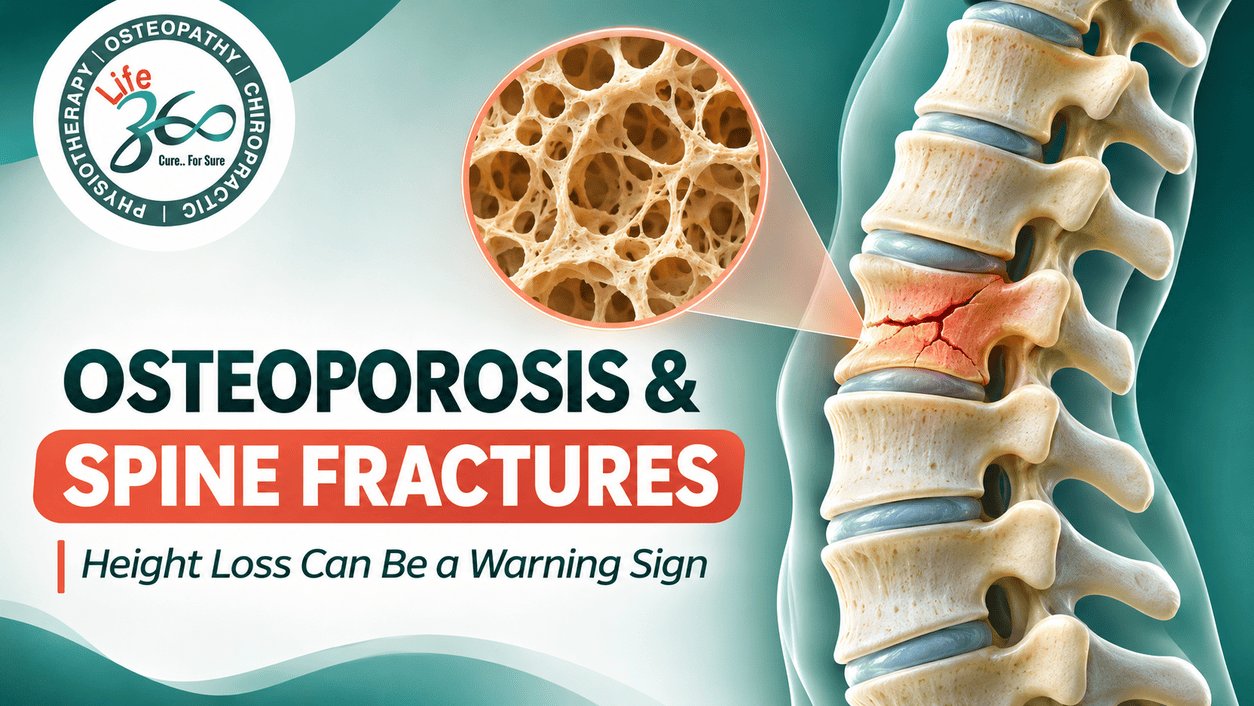
The pars interarticularis is a narrow strut of bone linking the upper and lower joints behind each vertebra. Arching and rotating under load drives force straight through it, and in 85 to 95% of cases the one that fails is L5.
The vulnerable window sits around the adolescent growth spurt, roughly twelve to fifteen in boys and earlier in girls. Bone is lengthening fast, and training volume in school and academy sport tends to rise in exactly those years.
Bone fails like any other overloaded material. It does not care that the child is talented.
Five features move me towards a pars lesion, and I go through them in order.
One-sided pain at or just above the belt line, pointed to with a single finger. Pain brought on by arching and twisting rather than bending forward. Pain that switches off within a minute of rest and returns at the same point in the session. An athlete between twelve and nineteen. A history longer than two weeks despite treatment.
What points away: pain worse sitting, pain below the knee, an adult with a desk job.
Base rates matter. In adults a pars lesion explains a small minority of back pain; in adolescent athletes with pain past two weeks, published series put it behind a substantial share. Treating both groups alike is how six weeks of spray and belt happens.
Kabaddi and volleyball lead my list, with gym work close behind.
A kabaddi raid is repeated hyperextension with rotation under an opponent's load, often finishing in a twisting dive. A volleyball spike arches the back in the air and lands it under compression. Add teenagers doing heavy overhead pressing in local gyms without coaching, plus fast bowling, gymnastics and classical dance, and the mechanism repeats.
A plain X-ray is not the test. A normal film in a young athlete with this history means very little, and I have seen that report used to send a boy back onto the mat.
MRI with fat-suppressed or STIR sequences is the sensible first investigation, since it shows marrow oedema in the pars before any crack appears and uses no radiation. Write "query spondylolysis, L5 pars" on the request form yourself, because a routine protocol can read as normal.
One-finger localisation of the pain, standing.
Single-leg hyperextension, the stork test, each leg separately. It reproduces the pain in most pars lesions without being specific enough to diagnose alone.
Repeated extension versus repeated flexion, recording which provokes and which relieves.
Full neurological screen of both legs, with the straight leg raise angle written down.
Hamstring and hip flexor length, both sides.
Hip and thoracic rotation range, measured. An athlete short of rotation there borrows it from the lumbar spine on every turn.
Timed trunk endurance, side plank and prone holds, compared side to side.
Training load written out over eight weeks: sessions, matches, gym work, school PT. That number caused this and that number is what we manage, and a recent growth spurt changes the plan again.
Yes, considerably, and I will not promise a union to any family.
A stress reaction, where MRI shows oedema in the pars but no fracture line, has a reasonable chance of healing with managed rest, often in about three months. An incomplete fracture heals less often. A complete defect with sclerotic edges rarely unites. One-sided lesions do better than bilateral ones.
The part that surprises parents: union and outcome are not the same thing. Plenty of athletes with an unhealed defect return to sport without pain. What predicts return to play is pain resolution plus trunk and hip capacity.
No test confirms a spine is ready. We find out by graded exposure, which is slower and more honest than a repeat scan.
No, and this is where I disagree most sharply with what gets advised around school sport.
A painkiller before a match removes the only warning a growing spine has. Load continues, the lesion progresses from a stress reaction towards a complete fracture, and the chance of bony healing falls with it. I have seen a three-month problem turned into a career-shaping one over one tournament.
Vitamin D, calcium and simply eating enough matter here too. Under-fuelled, deficient adolescents heal bone stress injuries poorly, and both are common in Chhattisgarh, so we check them.
If a lesion is found in September, this season is unlikely. Saying so in week two is kinder than saying it in January after two failed comebacks.
The provoking load stops for a minimum of four to six weeks, often eight to twelve.
Everything else continues. Relative rest means removing arching and twisting, not sending a fifteen-year-old to bed. Cycling, swimming where comfortable, upper body work and a trunk programme all start in week one, and pain should be gone from daily activity by the end of that block.
He can still attend training, keep his place in the group and do rehabilitation courtside. Isolation damages a teenager as much as the injury.
Weeks 0–4, offload. No raiding, spiking, jumping or overhead lifting. Deep abdominal and multifidus activation, glute bridges, hamstring and hip flexor work, cycling for fitness.
Weeks 4–8, build. Dead bug, side plank progressions, bird dog, hip thrusts, split squats, anti-rotation press, thoracic rotation. Straight-line running once the stork test has gone quiet.
Weeks 8–12, load and rotate. Medicine ball throws, cable rotation, loaded hinge and squat patterns, and sport drills with the arching removed: footwork, approach steps, and in kabaddi the hand touch without the dive.
Weeks 12–20, return by numbers. Contact and jumping in agreed doses, 48 hours between sessions, with one hard rule: any return of the original pain and we drop back a stage. Full match load usually lands between weeks sixteen and twenty-four.
A usual course here is fourteen to twenty sessions over four to five months. Longer with a bilateral lesion, a complete fracture, an active growth spurt, or training load nobody can control.
Do not accept a normal X-ray as proof that nothing is wrong. It is the commonest mistake with this injury.
Do not use complete bed rest. It wastes the trunk muscles the recovery depends on, and it is still advised in plenty of places.
Do not restart because the pain has gone. Pain disappears well before capacity returns, and a second lesion settles harder than the first.
Do not let anyone perform a high-velocity manipulation at that segment while the lesion is active.
Do not renegotiate the session limit mid-tournament. I write it down and give the coach a copy, which is the only version that survives a semi-final.
Night pain that wakes the child and settles in no position
Fever, night sweats or weight loss with back pain
Weakness, numbness (sunnpan) or tingling (jhunjhuni) in either leg, or a dragging foot
Any bladder or bowel change
Back pain in a child under ten, or pain after a significant fall
Pain that is constant, severe and unrelated to activity
A new spinal curve alongside the pain
Spinal tuberculosis, infection and bone tumours occur in this age group in India, and in a child they are excluded before sports rehabilitation starts.
Can an adult have a pars defect and never know?
Yes, and many do. Pars defects are present in roughly four to six per cent of the population, most of them silent and found incidentally on films taken for something else. A defect seen in a pain-free adult needs no treatment.
Can physiotherapy make the fracture heal?
Exercise does not knit bone. What managed load does is remove the force keeping the fracture open, which is what allows healing to happen, and build the trunk and hip capacity that keeps the athlete out of trouble afterwards.
My daughter does classical dance, not sport. Can she get this?
Yes. Repeated deep back arching in Bharatanatyam and Kathak loads the pars exactly as a kabaddi raid does, and dancers often train more hours per week than school athletes. The mechanism is arching plus rotation, not the activity's name.
When can he go back to the gym?
Modified trunk and lower body work starts in week one. Barbell overhead pressing, heavy back squats and any arching lift wait until the stork test is quiet and the programme reaches week eight. Coaching comes before load.
Will this mean back pain at forty?
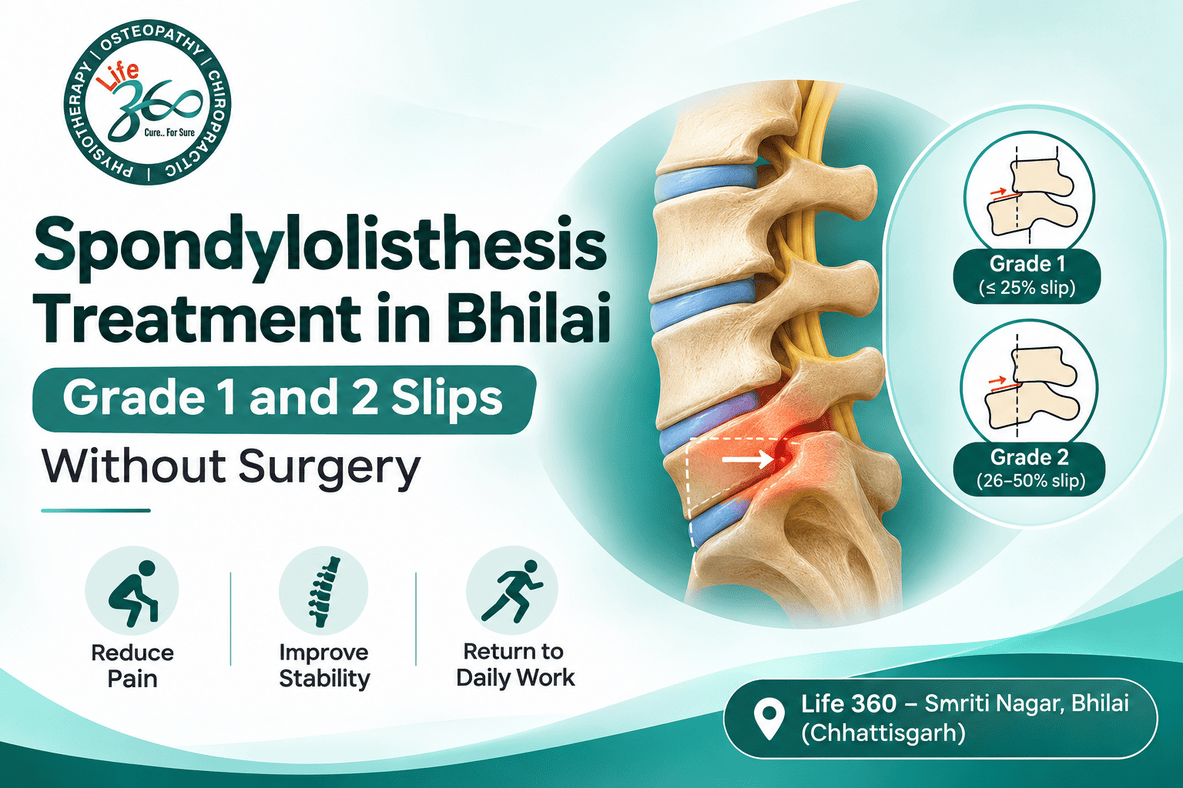
Not necessarily. Adults carrying old pars defects report back pain at rates not dramatically different from everyone else, and strength is the best protective factor we know. The one to watch is a bilateral defect during growth, since that is the group where a vertebra can slip forward.
Bring your child in if a young athlete has had one-sided low back pain for over two weeks, if arching on one leg reproduces it, if a muscle pull has been treated for a month with no change, or if a scan shows a pars lesion and nobody has written a return-to-play plan. Spondylolysis treatment in Bhilai works when training load is managed, not when pain is silenced.
Life 360 — Smriti Nagar, Bhilai, Chhattisgarh
Phone: 0771 490 8010 · 70007 84644
Hours: 11:00 am – 6:00 pm · Email: [email protected]
Main centre: HIG-16, Sector 1, Shankar Nagar, Raipur 492007
Bring with you: all films and reports, a written record of training load, and recent vitamin D and calcium results if you have them.
Dr. Nitu Verma (P.T.) is the founder and clinical director of Life 360 Physiotherapy Center, Shankar Nagar, Raipur, and of Life 360 at Smriti Nagar, Bhilai. She is widely recognised as India's first female chiropractor, and has more than fifteen years in clinical practice with over 50,000 patient consultations behind her.
Her training: Master of Physiotherapy (Sports) · Master Diploma in Chiropractic, Ackerman Institute, Sweden · Diploma in Osteopathy and DO Certification, Canada · Fellowship in Orthopaedic Manual Therapy (FOMT), Australia · Cranio-Sacral Therapy, USA · Pelvic Floor Osteopathy, Madrid School · Certified Pilates Instructor, Ireland.
She received the Nari Shakti Award 2026, and appeared on Doordarshan in a national discussion titled "Breaking the Myth About Chiropractic".
She treats spine and joint conditions non-surgically across Raipur, Bhilai, Durg and the wider Chhattisgarh region.
Clinics: HIG-16, Sector 1, Shankar Nagar, Raipur 492007 · Smriti Nagar, Bhilai
Appointments: 0771 490 8010 · 70007 84644 · [email protected]
Dr. Nitu Verma (P.T.) — Chiropractor and Physiotherapist, Life 360, Raipur and Bhilai.
General information only.A young athlete with persistent back pain needs an individual examination.