Life 360 Physiotherapy Center, HIG-16, Sector 1, Shankar Nagar, Raipur, Chhattisgarh 492007
-
For Appointment: 09115719395 , 07000784644 , 07714908010
-

At Life 360 Physiotherapy Center, led by Dr. Nitu Verma, India’s first lady chiropractor, we are dedicated to delivering top-quality chiropractic and physiotherapy care. Recognized as the best chiropractor in India, Dr. Verma specializes in holistic treatments for pain relief, spinal alignment, and sports injury rehabilitation. Our clinic in Raipur provides personalized care designed to address the root causes of discomfort and restore balance to your body, helping you achieve long-term health and wellness. Experience relief and recovery with India’s leading chiropractic expert at Life 360 Physiotherapy Center.
For Appointment: 09115719395 , 07000784644 , 07714908010
Quick answer: Spondylolisthesis means one vertebra has slid forward on the one below it, graded I to V by how far. Grade I and II slips are the large majority and are usually managed without surgery, using trunk and hip strengthening with controlled loading. Surgery belongs to progressive weakness, nerve pain that will not settle, or a high-grade slip.
Two reports, the same five words on them, two different plans.
One belonged to a 62-year-old woman whose walking distance had shrunk to 200 metres. The other belonged to a 31-year-old loader from Sector 10 who unloads cement and tiles from trucks on daily wages, and whose back hurt most when he stood still waiting for the next consignment. Both said "grade II spondylolisthesis, L5-S1".
He had been told by two people, neither of them clinicians, that he must never lift again. His income is lifting.
His hamstrings were rigid, he walked with a slight crouch, and his legs were neurologically clean. Standing in a queue was agony; bending to tie his shoes was a relief. Eleven weeks later he was back on the truck with a changed technique and a 90 kg trap bar deadlift behind him.
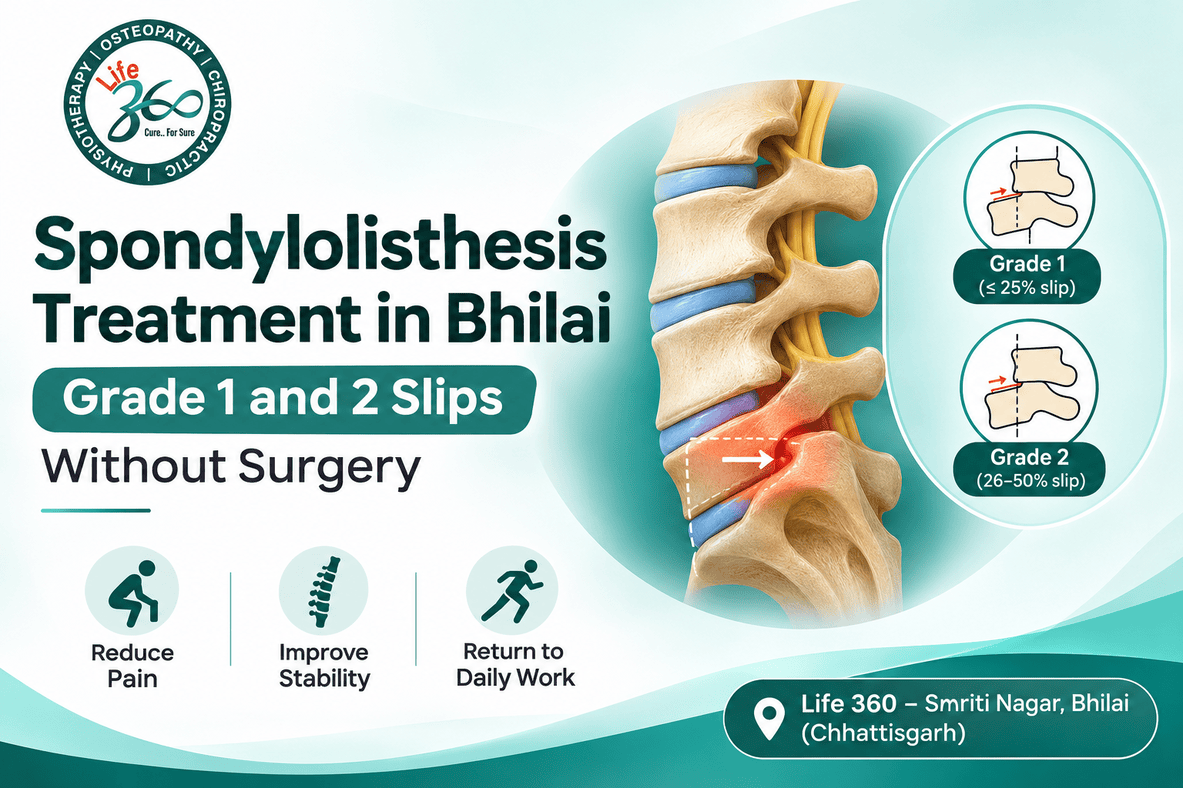
The slip is measured as a percentage of the width of the bone underneath, using the Meyerding scale.
Grade I is up to 25 per cent, grade II 26 to 50, grade III 51 to 75, grade IV above 75, and grade V a complete slip off the front.
Grades I and II are almost everything I see, and they behave very differently from grades III and above, which belong with a spine surgeon from the outset. What the grade does not do is predict pain: I have treated grade II slips in people with no symptoms and grade I slips in people who cannot stand through a family function.
Surgeons also measure pelvic tilt and sacral slope on standing films. Those numbers guide operations, not exercise.
Your age and the level on the report usually answer this before the film does.
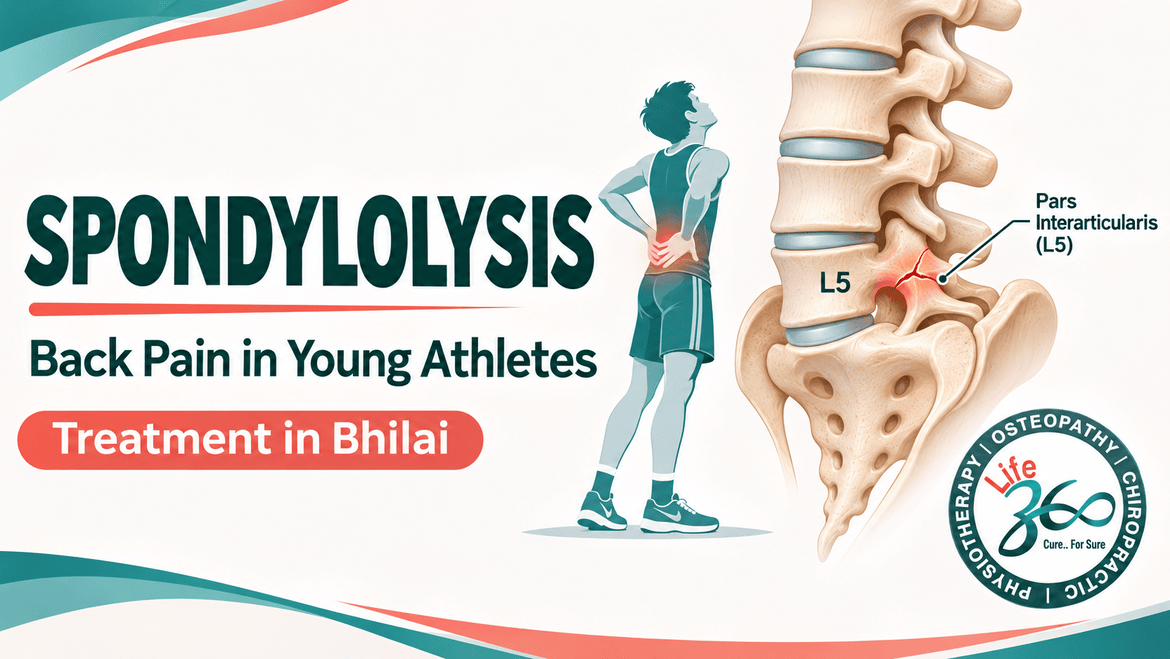
Isthmic slips follow a stress fracture through the pars interarticularis, the narrow bridge of bone behind each vertebra. That fracture nearly always happens in the teenage years from repeated arching and twisting, and the slip shows up at L5-S1 in the twenties or thirties, with tight hamstrings and a slightly crouched walk. The loader above is a textbook example.
Degenerative slips appear after fifty, usually at L4-L5, and considerably more often in women. The pars is intact; the slip comes from facet wear and loss of disc height. This is the group that goes on to develop canal narrowing, with heavy legs after a set walking distance.
Dysplastic and traumatic slips are rare.
No, and I say that as a practising chiropractor.
No manual technique repositions a vertebra that has slipped forward. Anybody claiming to have pushed a grade II back to grade zero is describing something that did not happen. What you feel during a manipulation is a joint gapping by a millimetre or two: useful for stiffness, useless for bone position.
A safety point comes attached. I do not thrust directly at a mobile, symptomatic slipped segment, particularly with a pars defect. Mobilising the stiff segments above and below is a different matter and often helps. If someone offers to "set the bone", ask what they expect the X-ray to show afterwards.
Standing tolerance and walking distance, in minutes and metres. These are the numbers we re-measure, not a pain score.
Which direction provokes. Repeated extension, then repeated flexion, with the response written down.
A palpable step at the spinous processes, sometimes felt at the slipped level.
Prone instability test, comparing pain with the legs supported and dangling.
Full neurological screen, with the straight leg raise angle recorded.
Hamstring length, which is tight in a large share of isthmic slips and a reliable marker of change.
Hip extension and rotation range. A hip that cannot extend drives extension into the slipped segment at every stride.
Timed side plank and bridge holds, both sides, as a baseline for trunk endurance.
The lift your job demands, performed with a light load while I watch.
This question decides whether you are a physiotherapy case or a surgical conversation.
Back-dominant symptoms mean pain across the lower back, worse standing and arching, better sitting or bending, with no neurological loss. This responds well to loading, and most grade I and II isthmic slips sit here.
Leg-dominant symptoms mean pain, tingling (jhunjhuni) or heaviness travelling into one or both legs, often with a walking distance shrinking month by month. That is usually a crowded nerve, and in degenerative slips it is the pattern that does well with decompression when exercise has not moved it.
A walking distance that keeps falling is information no scan provides.
By changing how you lift, then building the capacity to do it, rather than by stopping.
Three edits do most of the work. Keep the load close to the body, so the lever arm stays short. Hinge at the hips with a neutral spine instead of arching backwards as the load comes up. Break long static standing with a foot on a low ledge, swapping sides every few minutes.
For the first three to four weeks we negotiate lighter consignments or shorter spells, with a written review date. After that the load rises in the clinic before it rises at work.
I will not pretend this is always possible on daily wages. Where it is not, we plan around the shifts you cannot change and accept slower progress.
Weeks 0–3, settle and teach. Position of ease, deep abdominal and multifidus activation in lying, glute bridges, hamstring work where tight, and standing broken every 15 to 20 minutes.
Weeks 3–8, control under load. Dead bug, side plank progressions, bird dog, hip thrusts, split squats, anti-rotation holds, and a coached hinge at bodyweight. Low-level pain during exercise is allowed; pain climbing week on week is not.
Weeks 8–14, load it properly. Trap bar or kettlebell hinge, squat patterns, loaded carries, step-ups, and rehearsal of the work task. Lifting capacity is the outcome I chase in isthmic slips; standing and walking tolerance in degenerative ones.
Beyond 14 weeks. Two maintenance sessions a week. Gains fade within roughly two months of stopping.
A realistic course at our Smriti Nagar centre is twelve to sixteen sessions over eight to ten weeks. Recovery is slower with a high-grade slip, coexisting stenosis, very tight hamstrings, or no scope to reduce daily load.
Specific stabilisation training has the best supporting evidence here. The long-term comparisons against general strength work are thinner than the enthusiasm for them suggests.
Do not let anyone thrust-manipulate the slipped level itself, however good it feels afterwards.
Do not do loaded back extensions, cobra repetitions or the gym extension machine while an isthmic slip is symptomatic. General back-pain articles recommend extension work constantly; for this group it drives the exact movement that hurts.
Do not give up kabaddi or volleyball permanently on the strength of a report. Blanket sport bans are handed out routinely here, and most grade I and stable grade II slips return to recreational sport once trunk and hip strength are adequate.
Do not get an X-ray every six months to watch the percentage. In adults, low-grade slips rarely progress, and the film changes nothing while your legs are strong.
When nerves are involved, when function is sliding, or when the slip is high-grade.
The clear indications are progressive leg weakness, any bladder or bowel change, severe nerve pain or claudication unmoved by three months of loading-based treatment, a documented increase in the slip, and grade III or above. A young patient with a high-grade slip belongs with a surgeon early.
For leg-dominant symptoms from a degenerative slip with stenosis, decompression with or without fusion does well in selected patients, and I say so rather than talking people out of it. For back-dominant pain with clean neurology, results are far less predictable, and exercise deserves a real run first: three months of loading, not six sessions of ultrasound.
Difficulty passing urine, or loss of bladder or bowel control
Numbness (sunnpan) over the inner thighs, buttocks or genitals
Weakness in one or both legs, or a foot that drags
Symptoms in both legs together, with walking distance falling week by week
Fever with back pain, or unexplained weight loss
Night pain that wakes you and eases in no position
The first two are cauda equina syndrome: a hospital within hours.
Does heavy work make the slip worse?
In skeletally mature adults, low-grade slips rarely increase, whatever the work. Heavy work changes symptoms rather than the slip, and poor technique with a long lever arm provokes them reliably. Strength plus a closer load position usually lets people keep the same job.
Can I play volleyball or kabaddi with a grade 1 slip?
Usually yes, once standing tolerance is normal and trunk and hip strength are symmetrical, which takes eight to twelve weeks. Spiking and jumping come back last, in small doses. Pain lingering into the next day means the dose was too high.
Why are my hamstrings so tight?
Marked hamstring tightness is a recognised feature of isthmic slips, more a protective response around the segment and pelvis than genuinely short tissue. It eases as the segment settles, and it is one measurement I use to judge whether treatment is working.
Do I need an MRI as well as X-rays?
Standing X-rays show the slip under load and whether the segment moves between flexion and extension. An MRI is added when there are leg symptoms, since it shows the nerve root and canal. With back pain alone and clean neurology, films are usually enough.
Will a lumbar belt stop the slip increasing?
No. A belt gives short-term comfort and some feedback during a heavy task. It does not restrain bone, and worn all day for months it weakens the trunk muscles that matter. Use it for the heaviest lift of the day, then take it off.
Come in if standing hurts more than sitting, if a report says grade I or II and nobody explained what to do next, if your walking distance is falling, or if you were told to stop lifting and your work is lifting. Spondylolisthesis treatment in Bhilai should finish with you loading something safely.
Life 360 — Smriti Nagar, Bhilai, Chhattisgarh
Phone: 0771 490 8010 · 70007 84644
Hours: 11:00 am – 6:00 pm · Email: [email protected]
Main centre: HIG-16, Sector 1, Shankar Nagar, Raipur 492007
Bring with you: standing lateral X-rays, any MRI, and how many minutes you can stand still.
Dr. Nitu Verma (P.T.) is the founder and clinical director of Life 360 Physiotherapy Center, Shankar Nagar, Raipur, and of Life 360 at Smriti Nagar, Bhilai. She is widely recognised as India's first female chiropractor, and has more than fifteen years in clinical practice with over 50,000 patient consultations behind her.
Her training: Master of Physiotherapy (Sports) · Master Diploma in Chiropractic, Ackerman Institute, Sweden · Diploma in Osteopathy and DO Certification, Canada · Fellowship in Orthopaedic Manual Therapy (FOMT), Australia · Cranio-Sacral Therapy, USA · Pelvic Floor Osteopathy, Madrid School · Certified Pilates Instructor, Ireland.
She received the Nari Shakti Award 2026, and appeared on Doordarshan in a national discussion titled "Breaking the Myth About Chiropractic".
She treats spine and joint conditions non-surgically across Raipur, Bhilai, Durg and the wider Chhattisgarh region.
Clinics: HIG-16, Sector 1, Shankar Nagar, Raipur 492007 · Smriti Nagar, Bhilai
Appointments: 0771 490 8010 · 70007 84644 · [email protected]
Dr. Nitu Verma (P.T.) — Chiropractor and Physiotherapist, Life 360, Raipur and Bhilai.
General information only, and no substitute for an in-person examination.