Life 360 Physiotherapy Center, HIG-16, Sector 1, Shankar Nagar, Raipur, Chhattisgarh 492007
-
For Appointment: 09115719395 , 07000784644 , 07714908010
-

At Life 360 Physiotherapy Center, led by Dr. Nitu Verma, India’s first lady chiropractor, we are dedicated to delivering top-quality chiropractic and physiotherapy care. Recognized as the best chiropractor in India, Dr. Verma specializes in holistic treatments for pain relief, spinal alignment, and sports injury rehabilitation. Our clinic in Raipur provides personalized care designed to address the root causes of discomfort and restore balance to your body, helping you achieve long-term health and wellness. Experience relief and recovery with India’s leading chiropractic expert at Life 360 Physiotherapy Center.
For Appointment: 09115719395 , 07000784644 , 07714908010
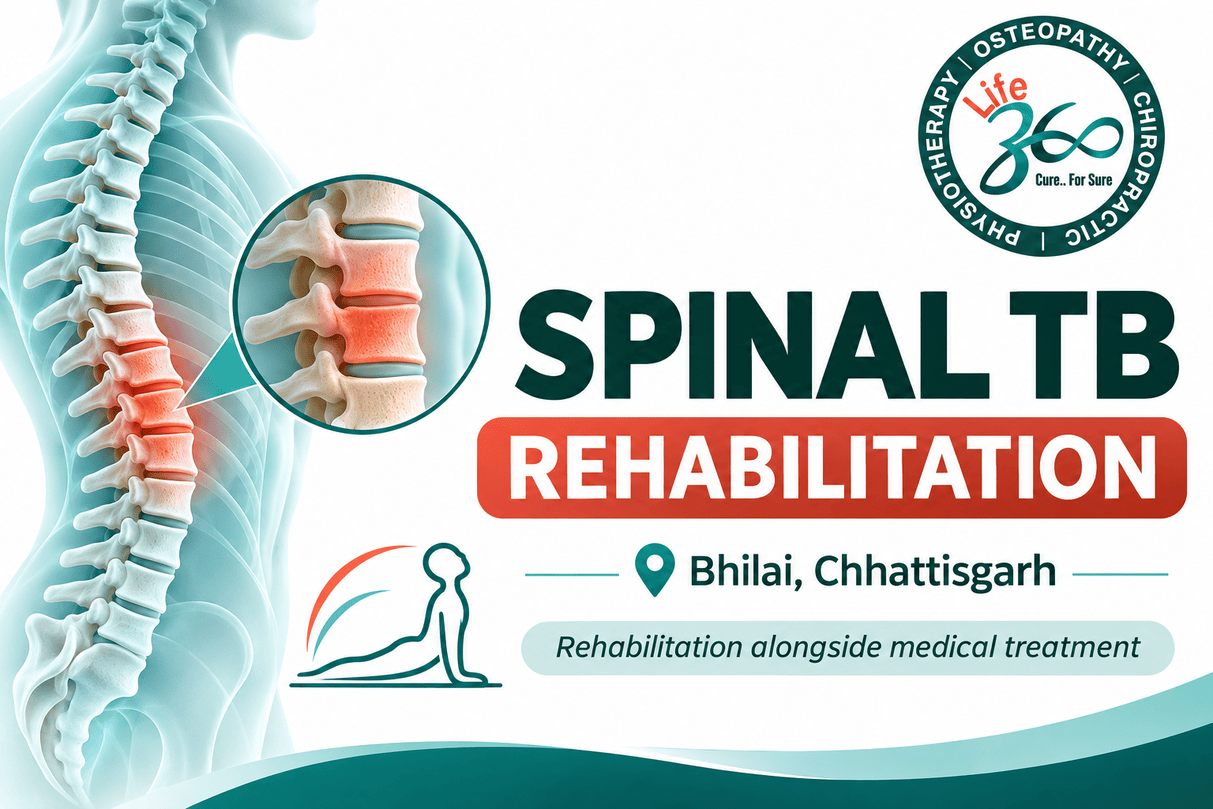
Quick answer: Spinal tuberculosis is a bacterial infection of the vertebrae, cured by anti-tubercular drugs taken for twelve to eighteen months under a doctor, with surgery in selected cases. Physiotherapy treats none of that. Spinal TB rehabilitation in Bhilai runs alongside the drugs and afterwards, protecting the spine, caring for the chest, preventing contracture and deformity, and rebuilding walking and work capacity.
No amount of physiotherapy kills a single tuberculosis bacterium. Nothing further down this page changes that sentence.
I put it first because Chhattisgarh carries a real tuberculosis burden, spinal disease accounts for a large share of skeletal tuberculosis, and it imitates ordinary back pain for months. Physiotherapy clinics are one of the places where the delay happens.
A 34-year-old loader from Khursipar came to the Smriti Nagar centre nine weeks after starting treatment, in a belt from a medical shop that ended two inches below the affected level. He had been operated on for cord compression at D11–D12 and walked with a frame. His first question was whether he would get back into the plant. His second was whether he could stop the tablets, because the pain had gone.
The answer to the first was yes, probably, in about a year. The answer to the second was no, and it mattered more.
Spinal TB treatment in Bhilai means anti-tubercular drugs prescribed by a physician, a chest specialist or a spine surgeon. Not physiotherapy. Any clinic offering to treat spinal tuberculosis itself should be walked out of.
Anti-tubercular therapy is a drug combination, typically twelve to eighteen months for spinal disease, four drugs in the intensive phase. Treatment and drugs are free under the national tuberculosis programme, and the district tuberculosis unit at Durg covers the Bhilai–Durg area, with nutrition support registered through Ni-kshay.
Surgery is considered for cord compression with neurological deficit, progressing or severe kyphosis, instability, a large abscess needing drainage, or when no tissue diagnosis can be obtained otherwise. It sits beside the drugs.
Five. Any single one of them moves your back pain out of the mechanical category.
Night pain that wakes you and does not ease whatever position you try. Mechanical back pain almost always finds a position of relief.
Fever, often low-grade, often in the evening, sometimes with night sweats.
Unexplained weight loss with loss of appetite over weeks or months.
Progressive neurological change — heavy legs, tripping, a changed walk, numbness (sunnpan) or tingling (jhunjhuni) below the level of the pain, and above all difficulty passing urine.
A gibbus deformity, a sharp angular hump you or your family can feel, rather than a smooth rounded back.
Add to those: constant rather than movement-dependent pain, a household contact with tuberculosis, and back pain in anyone whose immunity is lowered by diabetes, HIV or long-term steroids. Diabetes is common enough in the Bhilai–Durg belt that I ask about sugars every time.
What confirms it is a whole-spine MRI, blood tests, and tissue: a CT-guided biopsy with culture and a molecular test such as GeneXpert, which also shows whether the strain is drug-resistant.
Five jobs, none of them antibacterial.
Protecting the spine while it heals. A correctly fitted brace, and safe ways to roll, transfer and stand that do not load the destroyed segment.
Respiratory care. Thoracic involvement, long periods lying down and spinal surgery all cut lung expansion. Breathing exercises, incentive spirometry and secretion clearance prevent the chest complications that do real harm over a year-long illness.
Preventing contracture and deformity. Hips, knees and ankles stiffen quickly in bed. Positioning, passive range and night splinting keep joints usable for the day walking resumes.
Managing neurological involvement. Pressure area care, bed mobility, a bladder and bowel programme agreed with the medical team, then standing, then gait work.
Graded return to function, started only when the doctor confirms the spine is stable. For a steel plant loader that means floor-to-waist lifting, carrying and tolerating an eight-hour shift.
The diagnosis on paper. Levels, organism, drug sensitivity, start date, who is supervising, and whether doses are being taken. Suspected but unconfirmed disease makes referral the whole session.
Neurological grading. Power in every lower limb muscle group, reflexes, plantar response, clonus, a sensory level, and a direct question about urine.
Chest expansion in centimetres, cough strength, and oxygen saturation at rest.
Kyphosis angle and the gibbus, measured and photographed with consent, so progression is detected rather than argued about.
The brace. Type, whether it spans levels above and below, hours worn, skin underneath, and whether anybody has reviewed the fit.
Pain character. Still constant and nocturnal, or now movement-related? That shift is an early sign the drugs are working.
Functional baseline: rolling, sitting up unaided, standing, walking distance, stairs, toilet transfer.
Weight at every visit. A weight curve climbing again is among the better signs of response.
Skin over the sacrum and heels in anyone lying down for weeks.
Nothing here moves because a calendar says so. It moves when the doctor agrees.
Weeks 0–6, drugs already started. Rest from provocative load, not absolute bed rest. Brace for upright activity. Breathing work three or four times daily. Isometric abdominal, gluteal and quadriceps work with no spinal movement. Sitting out of bed, then short indoor walking.
Weeks 6–12. Walking distance built in metres rather than impressions. Gentle active movement inside the brace, avoiding flexion and rotation at the involved level. Where there is weakness, gait re-education begins here.
Months 3–6. Brace weaned on medical advice as imaging allows. Progressive extensor and abdominal strengthening, balance work, stairs. Many patients return to light duties.
Months 6–18. Load built toward the actual job: graded lifting, carrying and endurance, rehearsed here before the shop floor.
A course here usually runs weekly to fortnightly over six to twelve months. Patients travelling from Jamul or Kumhari often pair the visit with their monthly drug collection, which keeps both appointments happening.
Where I cannot give you a number: whether weakness present for over three months will fully reverse. Earlier treatment, younger age and a shorter deficit all point the right way, and the published series disagree on individual prediction. I report what I measure at each review instead of forecasting.
I disagree with how bracing is often handled here, and it is the practical point of this page.
A soft lumbar belt from a medical shop does not immobilise a destroyed thoracic segment. It gives a comfortable squeeze around the waist while the collapsing level keeps moving. Significant vertebral destruction needs a properly fitted rigid or semi-rigid thoracolumbar orthosis spanning levels above and below, adjusted to the patient and reviewed as weight changes. Weight does change over a year of treatment.
Two patients last year arrived in belts that stopped well below the involved vertebra. Both thought they were protected.
No spinal manipulation. No high-velocity thrust, no cracking, no forceful mobilisation at or near an infected, structurally weakened segment. This one has no exceptions.
No traction, which is still offered widely for back pain in this region and has no place in a collapsing spine.
No extension exercises or bhujangasana, which almost every back pain page and many well-meaning relatives recommend. Loading a vertebra that is being eaten away is a bad idea in any direction.
Do not stop the drugs when the pain stops. Pain commonly settles in four to eight weeks while the infection is very much alive. Stopping early is how drug resistance is manufactured.
New or worsening leg weakness, or a walk that has become unsteady
Difficulty passing urine, loss of bladder or bowel control, saddle numbness
A hump that is visibly increasing, or a sudden jump in pain
Fever returning after it had settled, or weight falling again
Breathlessness, or blood in the sputum
A new swelling in the groin, flank or neck, which can be an abscess tracking
Vision change, tingling in the feet or jaundice, which can come from the drugs
Any of these means the treating doctor the same day. Not the next physiotherapy appointment.
Is it safe to start physiotherapy while I am still on the tablets?
Yes, and it usually should start early, provided the treating doctor confirms the spine is stable and says what is permitted. Breathing work, positioning and isometric exercise carry little risk and prevent chest infection, contracture and muscle loss. Loaded movement at the involved level waits for clearance.
I have felt well for ten weeks. Why continue the medicines?
Because feeling well reflects reduced inflammation, not an eradicated infection. Sterilisation of the lesion and bone healing take many months longer than symptom relief, which is why the course runs twelve to eighteen months. Stopping once you feel normal is the commonest route to relapse and resistance.
Does my family need testing?
Household contacts should be screened, arranged through the treating doctor or the local TB unit rather than through me. Spinal disease itself does not pass person to person, but some patients have active lung involvement alongside, and children in the household are the priority.
Can I sit on the floor to eat while I am in a brace?
Not during the braced phase. Getting down and up from the floor demands exactly the flexion and rotation the brace exists to prevent, and most braces ride up or gap in that position. A chair and table for a few months, then we reintroduce floor transfers deliberately.
Why am I being given breathing exercises for a back problem?
Because thoracic involvement, weeks of lying down and spinal surgery all reduce how fully the lungs inflate, and a poorly ventilated chest collects secretions. Breathing work and incentive spirometry are among the few parts of this programme with an immediate measurable effect, tracked as chest expansion in centimetres.
My repeat MRI at six months still looks abnormal. Has treatment failed?
Usually not. Imaging lags clinical recovery considerably in spinal tuberculosis, and signal change persists long after the infection is controlled. Clinical progress, blood markers and weight matter more at that stage, and your doctor reads the film against those rather than alone.
Come in once your diagnosis is confirmed and anti-tubercular therapy has begun, after spinal surgery for TB, or if a completed course has left you with stiffness (akdan), deformity, weakness or a reduced walking distance. If the warning signs above describe you, see a physician first — ring us and we will point you to the right place.
We handle the rehabilitation half of spinal TB treatment in Bhilai, never the drugs.
Life 360 — Smriti Nagar, Bhilai, Chhattisgarh
Phone: 0771 490 8010 · 70007 84644
Hours: 11:00 am – 6:00 pm
Email: [email protected]
Main centre: HIG-16, Sector 1, Shankar Nagar, Raipur 492007
Bring with you: MRI films and report, the biopsy or GeneXpert result, your drug chart with the start date, the operation note if you were operated, and the brace itself.
Dr. Nitu Verma (P.T.) is the founder and clinical director of Life 360 Physiotherapy Center, Shankar Nagar, Raipur, and of Life 360 at Smriti Nagar, Bhilai. She is widely recognised as India's first female chiropractor, and has more than fifteen years in clinical practice with over 50,000 patient consultations behind her.
Her training: Master of Physiotherapy (Sports) · Master Diploma in Chiropractic, Ackerman Institute, Sweden · Diploma in Osteopathy and DO Certification, Canada · Fellowship in Orthopaedic Manual Therapy (FOMT), Australia · Cranio-Sacral Therapy, USA · Pelvic Floor Osteopathy, Madrid School · Certified Pilates Instructor, Ireland.
She received the Nari Shakti Award 2026, and appeared on Doordarshan in a national discussion titled "Breaking the Myth About Chiropractic".
She treats spine and joint conditions non-surgically across Raipur, Bhilai, Durg and the wider Chhattisgarh region.
Clinics: HIG-16, Sector 1, Shankar Nagar, Raipur 492007 · Smriti Nagar, Bhilai
Appointments: 0771 490 8010 · 70007 84644 · [email protected]
Dr. Nitu Verma (P.T.) — Chiropractor and Physiotherapist, Life 360, Raipur and Bhilai.
General information about rehabilitation only. It is not a substitute for medical diagnosis or treatment of tuberculosis, which must be managed by a doctor.