Life 360 Physiotherapy Center, HIG-16, Sector 1, Shankar Nagar, Raipur, Chhattisgarh 492007
-
For Appointment: 09115719395 , 07000784644 , 07714908010
-

At Life 360 Physiotherapy Center, led by Dr. Nitu Verma, India’s first lady chiropractor, we are dedicated to delivering top-quality chiropractic and physiotherapy care. Recognized as the best chiropractor in India, Dr. Verma specializes in holistic treatments for pain relief, spinal alignment, and sports injury rehabilitation. Our clinic in Raipur provides personalized care designed to address the root causes of discomfort and restore balance to your body, helping you achieve long-term health and wellness. Experience relief and recovery with India’s leading chiropractic expert at Life 360 Physiotherapy Center.
For Appointment: 09115719395 , 07000784644 , 07714908010
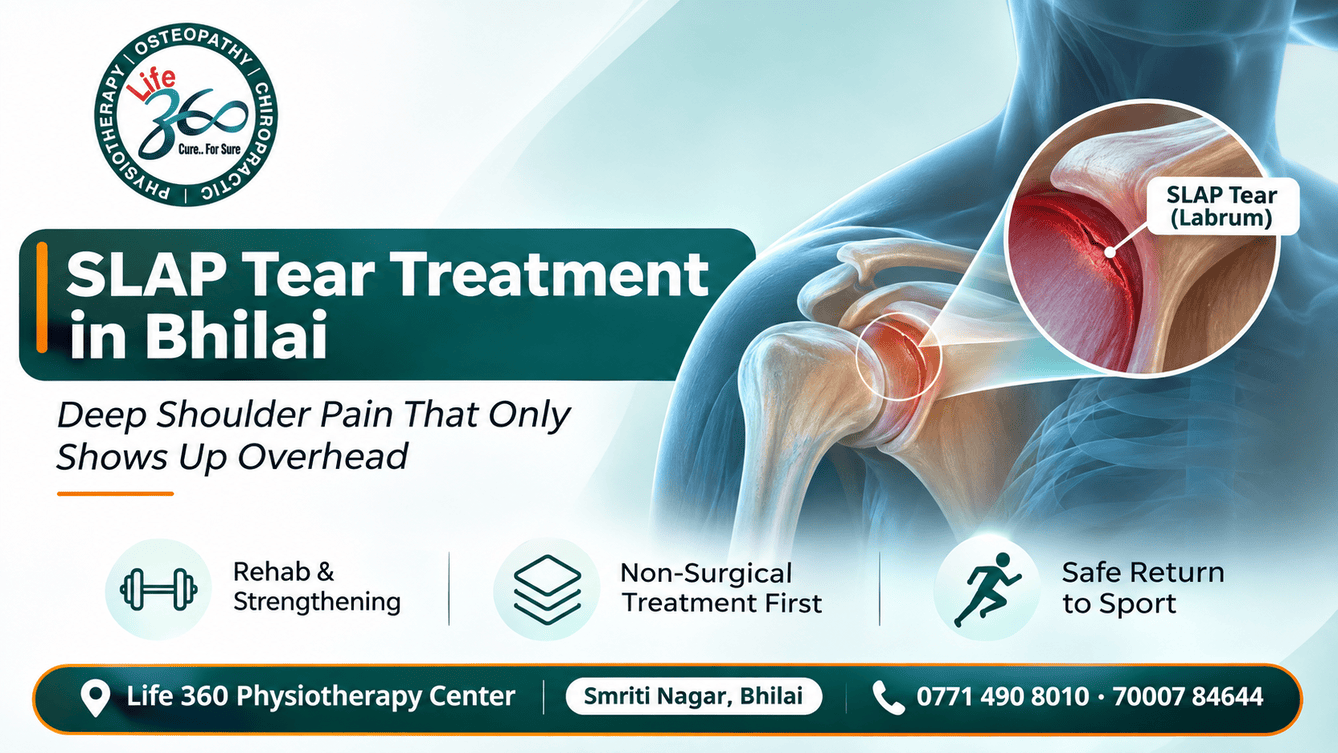
Quick answer: SLAP tear treatment in Bhilai starts conservatively for almost everyone: twelve to twenty weeks of cuff and scapular loading, with the overhead position rebuilt gradually. A SLAP lesion is a tear of the labrum at the top of the shoulder socket where the biceps tendon anchors. Repair is mainly for young throwing athletes; results in patients over about forty are mixed.
"Superior labral signal change extending anteriorly, suggestive of a Type II SLAP lesion. Mild biceps anchor irregularity."
That is the sentence that brings most people to this page. It arrives on an MRI arthrogram report, usually after months of a shoulder that felt wrong without ever quite failing, and it sounds far more decisive than it is.
A 29-year-old fast bowler who works in a private firm near Risali brought me exactly that report. His complaint was oddly specific: deep pain inside the shoulder, not on the surface, only when his arm was cocked back behind his head. Everything else was fine. Bench press fine. Daily work fine. But at the top of his bowling action the shoulder felt as though something was catching, and he had lost about six kilometres an hour off his pace over two seasons.
Nothing visible. No weakness. Just a shoulder that stopped cooperating in one position.
The shoulder socket is shallow — roughly a quarter of the ball sits in it. Around its edge runs the labrum, a rim of fibrous cartilage that deepens the socket and anchors the capsule and ligaments.
SLAP stands for Superior Labrum, Anterior to Posterior: a tear of the labrum at the top of the socket, running front to back, where the long head of the biceps tendon anchors into the rim.
There are several types. Type II, with the biceps anchor detached from bone, is the one most often reported and most argued about. By contrast, Type I is simple fraying, a normal finding with age. The distinction matters because a Type I report can be nothing at all.
Because no physical test for it is reliable enough to trust on its own, and the tests contradict each other in the same patient regularly.
O'Brien's active compression test, the crank test, Speed's, the biceps load tests — I perform several and interpret them as a cluster. Individually their accuracy is poor. A positive O'Brien's can come from an acromioclavicular joint just as easily as from a labrum.
Imaging is not a clean answer either. Plain MRI misses labral tears. MR arthrogram, with contrast injected into the joint, is better, and it over-calls too: labral changes show up in shoulders with no symptoms, especially past thirty-five and especially in throwers.
So the honest statement is this. We diagnose SLAP tears on a characteristic history, a cluster of tests, imaging, and the response to treatment. Sometimes we only find out at arthroscopy. I would rather say that than pretend my hands can see inside your shoulder.
A very specific combination, and daily life is usually spared.
Deep, inside-the-joint pain (kandhe ka andar ka dard) rather than pain you can point to with one finger
Symptoms almost exclusively in the overhead, externally rotated position: the bowling cock-back, the volleyball spike, a behind-the-neck press
Clicking, catching or a sense of the shoulder "slipping" without ever dislocating
Loss of throwing or serving velocity before loss of comfort
A shoulder that passes every clinic strength test and still fails on the field
That is what delays diagnosis for months.
Active and passive range in both rotations, measured at 90 degrees of abduction. Internal rotation loss on the throwing side above about 18–20 degrees compared with the other arm is a finding I act on.
Total rotational range, both sides added up. A deficit of more than 5 degrees on the dominant side matters more than internal rotation alone.
The test cluster: O'Brien's, biceps load II, dynamic labral shear, resisted supination with the elbow flexed. I record which reproduce the deep pain and which do not.
Apprehension and relocation testing, to separate a labral problem from underlying anterior instability. Many throwing shoulders have both.
Scapular control in the cocked position. A scapula that tips forward during late cock-back loads the anterior labrum hard.
Cuff strength in the cocked position, rather than at the side. Testing at the side misses the deficit that matters for throwing.
Thoracic and hip rotation. Bowling and spiking are chain movements; a stiff trunk forces the shoulder to make up the difference.
Your actual action, filmed. I ask patients to bowl or mime the spike slowly, and we watch it together on the phone.
For most patients, yes. Conservative treatment is the first choice for the large majority, and it works often enough that I rarely send a patient straight to a surgeon.
Weeks 0–3, unload the position, restore rotation. We stop the provoking overhead action for three to four weeks. Sleeper stretch or cross-body work for the posterior capsule, carefully dosed. Isometric cuff holds. Scapular setting.
Weeks 3–8, rebuild the cuff and the scapula. Posterior cuff loading at 45 and then 90 degrees of abduction. Serratus and lower trapezius work. Rhythmic stabilisation drills with the arm progressively higher, training the shoulder to hold itself centred where it is most vulnerable.
Weeks 8–14, load the overhead position deliberately. Controlled work into external rotation at 90 degrees, plyometric ball drops, deceleration training, trunk and hip integration. The eccentric phase is where throwing shoulders fail and where most programmes stop short.
Weeks 14–20, return to sport, staged. An interval throwing or hitting programme built on distance and volume rather than intensity, usually across six to eight weeks. For cricketers in Bhilai this means starting in the nets at Sector 10 at half run-up and holding there longer than the player wants.
Expect twelve to eighteen sessions across three to five months. A desk-based patient with no overhead sport often needs fewer.
Surgery becomes reasonable when a well-run programme of at least three to four months has failed and the overhead position is still unusable.
Two operations exist. SLAP repair, where the labrum and biceps anchor are reattached with anchors. And biceps tenodesis, where the biceps tendon is detached from the labrum and refixed lower down the humerus, removing the pull on the torn rim.
Here is the uncomfortable part. SLAP repair in overhead athletes returns somewhere between half and three-quarters of them to their previous level, and fewer among professional throwers. In patients over about forty, repair has performed worse than tenodesis in several studies: stiffness is commoner and satisfaction lower. Many surgeons now prefer tenodesis or debridement in that age group.
Which means a Type II SLAP on a 48-year-old's report is often not the reason their shoulder hurts, and operating on it can leave them stiffer than they started.
Do not spend three months on biceps curls and "biceps tendon strengthening". It is recommended on plenty of sites because the biceps anchor is involved. Loading the biceps in flexion and supination pulls directly on the torn anchor. We load it later, differently, and never at the centre of the programme.
Do not test the shoulder repeatedly to see if it is better. Patients bowl one ball a week at full pace to check. That ball resets the irritation and makes the week's work invisible.
Do not stretch into the apprehension position if your shoulder also has instability. Extra anterior range is the last thing that shoulder needs.
An acutely dislocated shoulder: deformed, arm held away from the body, movement blocked. That needs reduction in hospital, immediately.
No active elevation at all after a fall, which raises fracture, a large cuff tear or nerve injury.
A hot, swollen shoulder with fever, which may be joint infection and is urgent.
Night pain with weight loss, or a mass near the shoulder or collarbone.
Weakness into the hand with persistent tingling (jhunjhuni).
Can a SLAP tear heal without surgery?
The torn rim does not usually reattach. What changes is tolerance: with the cuff and scapula strong and the overhead position retrained, many shoulders become symptom-free despite the tear remaining on imaging. That is a legitimate outcome, not a consolation prize.
Why does my shoulder only hurt in one position?
Because the torn part of the labrum is loaded almost exclusively there. The cocked-back, externally rotated arm places peak tension on the superior labrum and biceps anchor. Lower the arm and the tension goes, which is why your bench press feels normal and your bowling does not.
My report says Type I SLAP. Should I worry?
Usually not. Type I is fraying of the labral edge and is a common age-related finding in shoulders with no symptoms at all. If your pain pattern does not match a labral problem, a Type I report is unlikely to be your diagnosis. It is worth re-examining the shoulder rather than treating the paper.
How long after SLAP repair before I can bowl?
Sling for three to four weeks, no external rotation past neutral for about six, gym work from around three months, and an interval throwing programme usually starting between four and six months. Full competitive bowling is commonly nine to twelve months out. Your surgeon's protocol overrides any general timeline.
Could this be something else entirely?
Frequently. Posterior cuff tendinopathy, internal impingement, anterior instability, an acromioclavicular problem and C5 nerve irritation all produce overlapping pictures. This is why I reassess at six weeks rather than committing to a label on day one.
Is a chiropractic adjustment useful for a labral tear?
Not for the labrum itself. Where it helps is the stiff thoracic spine and ribs so many throwers carry, which gives back rotation the shoulder would otherwise have to find alone. I use it alongside the loading programme, never instead of it.
Come in if you have deep pain inside the shoulder that appears only with your arm cocked overhead, if you are losing throwing or serving pace, if the shoulder clicks or feels like it slips without dislocating, or if you are holding an arthrogram report and want SLAP tear treatment in Bhilai assessed against what your shoulder can actually do.
Life 360 — Smriti Nagar, Bhilai, Chhattisgarh
Phone: 0771 490 8010 · 70007 84644
Hours: 11:00 am – 6:00 pm
Email: [email protected]
Main centre: HIG-16, Sector 1, Shankar Nagar, Raipur 492007
Bring with you: the MRI or arthrogram films and report, any arthroscopy notes, and a short phone video of your bowling, serving or spiking action if you have one.
Dr. Nitu Verma (P.T.) is the founder and clinical director of Life 360 Physiotherapy Center, Shankar Nagar, Raipur, and of Life 360 at Smriti Nagar, Bhilai. She is widely recognised as India's first female chiropractor, and has more than fifteen years in clinical practice with over 50,000 patient consultations behind her.
Her training: Master of Physiotherapy (Sports) · Master Diploma in Chiropractic, Ackerman Institute, Sweden · Diploma in Osteopathy and DO Certification, Canada · Fellowship in Orthopaedic Manual Therapy (FOMT), Australia · Cranio-Sacral Therapy, USA · Pelvic Floor Osteopathy, Madrid School · Certified Pilates Instructor, Ireland.
She received the Nari Shakti Award 2026, and appeared on Doordarshan in a national discussion titled "Breaking the Myth About Chiropractic".
She treats spine and joint conditions non-surgically across Raipur, Bhilai, Durg and the wider Chhattisgarh region.
Clinics: HIG-16, Sector 1, Shankar Nagar, Raipur 492007 · Smriti Nagar, Bhilai
Appointments: 0771 490 8010 · 70007 84644 · [email protected]
Dr. Nitu Verma (P.T.) — Chiropractor and Physiotherapist, Life 360, Raipur and Bhilai.
General information only. It is not a substitute for examination in person.