Life 360 Physiotherapy Center, HIG-16, Sector 1, Shankar Nagar, Raipur, Chhattisgarh 492007
-
For Appointment: 09115719395 , 07000784644 , 07714908010
-

At Life 360 Physiotherapy Center, led by Dr. Nitu Verma, India’s first lady chiropractor, we are dedicated to delivering top-quality chiropractic and physiotherapy care. Recognized as the best chiropractor in India, Dr. Verma specializes in holistic treatments for pain relief, spinal alignment, and sports injury rehabilitation. Our clinic in Raipur provides personalized care designed to address the root causes of discomfort and restore balance to your body, helping you achieve long-term health and wellness. Experience relief and recovery with India’s leading chiropractic expert at Life 360 Physiotherapy Center.
For Appointment: 09115719395 , 07000784644 , 07714908010
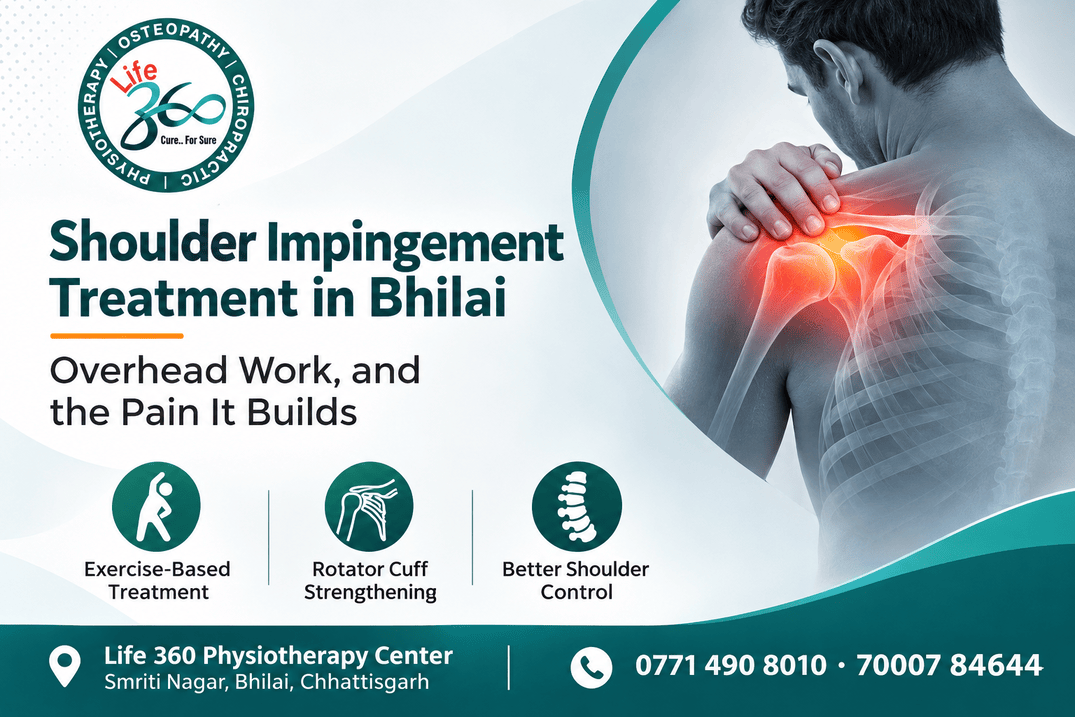
Quick answer: Shoulder impingement treatment in Bhilai is almost always exercise-based: restoring scapular control, loading the rotator cuff progressively, and changing how much overhead work the shoulder does each day. Most patients improve over eight to sixteen weeks. Surgical decompression has performed no better than placebo surgery in several trials, which is why the diagnosis itself is being rethought.
The bone is not pinching your tendon. That is the part of this diagnosis most people get told and most clinicians now doubt.
For decades the story was simple: the acromion, the bony roof of the shoulder, catches the cuff tendon underneath it when you lift your arm, and shaving the bone fixes it. Then surgeons ran the operation against a sham procedure. The results came back almost identical, which tells us the mechanical pinching story was never the whole explanation.
So I still use the word impingement, because that is what is written on your referral and what you typed into Google. I just do not treat it as a carpentry problem.
A 38-year-old welder from Nehru Nagar sat down and demonstrated it better than any textbook. He worked overhead on structural repairs, four to five hours of arm elevation a day. No fall, no single injury. The shoulder pain (kandhe ka dard) started as an ache after shifts about seven months ago, then moved into the shift itself, then into his sleep. He raised his arm for me: fine to about 60 degrees, pain from 70 to 120, fine again above that. Then down through the same band, hurting again.
That band is the painful arc. It is the signature of this problem.
Because it names a cause that the evidence does not support, and because the name pushes people towards surgery.
Three things changed clinical thinking. Placebo-controlled trials of decompression showed no advantage over sham. Imaging found the space under the acromion does not reliably narrow in people with the pain. And acromion shape turned out to predict symptoms poorly.
Many clinicians now say subacromial pain syndrome or rotator cuff related shoulder pain instead. Clumsier, but it does not claim to know the mechanism. I will admit the honest position: we do not fully know why these shoulders hurt. Tendon overload, bursal irritation, poor load tolerance and altered movement control all contribute, in proportions we cannot measure in a single patient.
What we can measure is what the shoulder tolerates. That is enough to treat it.
Pain between roughly 60 and 120 degrees of elevation, with the top and bottom of the range comfortable, means the tissue in the subacromial space is being compressed and loaded most in that band.
Pain at the very top of the range, with a cramped feeling deep inside, usually points elsewhere — the acromioclavicular joint or the labrum.
Pain everywhere, in every direction, with the arm refusing to be moved even by me, is a frozen shoulder and this page is not about it.
Arm elevation is expensive. Hold the arm at 90 degrees and the cuff works continuously to keep the ball centred, while blood flow through the supraspinatus tendon actually drops in that position.
Now add a tool. A welding torch or a grinder adds a kilogram or two at the end of a long lever. Add a shift pattern that gives the tendon no recovery day. Then a 40-minute two-wheeler commute from Risali with the arms forward and the shoulders rolled in.
The tendon is not injured. It is under-recovered.
This is why I spend as much of the first session on the week's schedule as on the shoulder itself. A programme that adds three exercises without removing two hours of elevation is a programme that fails.
Active elevation, measured, and the exact degrees where pain starts and stops. I write both numbers. At review, the band narrowing is the first sign of progress.
The same movement with the scapula assisted. I lift and rotate the shoulder blade by hand while you raise the arm. If the pain drops, scapular control is a treatment target.
Hawkins-Kennedy and Neer tests. Both have modest accuracy on their own, and I use them as part of a cluster, never as a verdict.
Cuff strength in rotation and elevation, graded both sides. Weakness changes the plan from "control" to "load".
Thoracic extension and rotation. A stiff mid-back steals the last 30 degrees of shoulder elevation, and the shoulder pays for it.
Pectoral and latissimus length. A tight lat drags the arm into internal rotation on the way up.
Neck screen, including the upper cervical joints. Referred pain over the deltoid from C4 and C5 is a frequent impostor.
Daily elevation load. How many minutes a day is your hand above shoulder height? Most patients have never been asked and the answer is usually higher than they guess.
Progressive loading, scapular retraining, and a temporary cut in overhead exposure. In that order of importance.
Weeks 0–3, settle and re-set. Isometric cuff holds, 5 sets of 30 to 45 seconds at an effort that does not provoke pain. Scapular setting against a wall. Thoracic extension over a rolled towel. Elevation kept below the painful arc, which usually means working to about 60 degrees. Painkillers if the orthopaedic doctor has prescribed them, for sleep rather than for exercise.
Weeks 3–8, load through range. Band and dumbbell external rotation at the side, then at 45 degrees of abduction. Rows, prone Ys and Ts, serratus punches and wall slides. We start taking the arm into the lower part of the painful band deliberately, at loads that leave the shoulder no worse the next morning.
Weeks 8–16, overhead and endurance. Press patterns from supported positions, then standing. Overhead holds with light load, building from 20 seconds to 90 seconds, because a welder needs stamina rather than strength. Return to full shift elevation staged across three to four weeks, not in one day.
Typical course here: twelve sessions over eight weeks, usually two a week to begin with. Patients on rotating shifts often schedule around the general shift, and the 11:00 am to 6:00 pm clinic window suits the night-shift group better than they expect.
It buys you a window of about four to eight weeks of reduced pain, which is useful if pain is blocking sleep and exercise entirely. That is not a repair.
The mistake I see weekly is an injection followed by an immediate return to full overhead duty. Capacity has not changed; only the alarm has been silenced. Repeated injections into the same shoulder are worth avoiding, since tendon quality can suffer.
Here is where I part company with most of the advice online.
Do not stretch the back of your shoulder aggressively with the arm pulled across your chest. It is recommended everywhere. In an irritable subacromial shoulder it pushes the humeral head forward and upward against exactly the tissue that is hurting. Posterior capsule work has a place, later, in a specific position I will show you.
Do not do shoulder pulley exercises up to full elevation in the first fortnight. Grinding the arm repeatedly through a painful arc is not desensitisation, it is irritation.
And do not sleep with the arm overhead or tucked under the pillow. Many patients drift into that position because it feels better briefly, then wake with the shoulder worse.
A hot, swollen shoulder with fever. Possible joint infection, and it is an emergency.
No active lift of the arm at all after a fall or a blow, which raises the question of fracture, a large cuff tear, or a nerve injury.
An obviously deformed shoulder after trauma, arm held out from the side — a dislocation that needs reduction in hospital.
Night pain plus unexplained weight loss, or a firm mass around the shoulder or collarbone.
Pain spreading into the chest or jaw, or coming on with exertion and easing with rest. Left shoulder pain can be cardiac. That gets checked first.
Why does my shoulder hurt more at night than at work?
Lying down removes the small amount of downward traction that gravity provides when you stand, so the subacromial space is loaded differently, and an irritated bursa swells with inactivity. There is also less distraction. Sleeping semi-reclined with a cushion under the upper arm helps many patients within a week.
Can I keep doing overhead work while I recover?
Usually some, rarely all of it. I aim to cut daily elevation time by about half for four to six weeks, then rebuild it. Full avoidance is neither practical for contract labour nor good for the tendon, which needs load to adapt.
Is it my posture?
Partly, and less than you have been told. Slouching reduces available elevation and makes the arc tighter, which matters. But people with textbook posture still get this, and straightening up alone does not fix a tendon that lacks capacity. Posture is one variable, not the diagnosis.
How is this different from a cuff tear?
Impingement-type pain hurts in a band and leaves strength largely intact. A significant cuff tear leaves the arm weak, often with a lag between what I can lift and what you can. If your arm sinks when I let go of it, we are talking about a tear.
Will it come back?
It can, particularly if the job does not change. The patients who stay well are the ones who keep two rotation exercises and one overhead carry in their week after discharge, and who notice the early ache after a shift instead of ignoring it for seven months.
My X-ray showed a hooked acromion. Does that mean surgery?
Not by itself. Acromion shape correlates poorly with symptoms, and shaving bone has not outperformed sham surgery in good trials. A hooked acromion on film with a shoulder that responds to loading is a shoulder that gets loaded.
Come in if lifting your arm sideways hurts in a band and then eases above it, if the ache has moved from after your shift into your shift, if sleeping on that side has stopped being possible, or if you want shoulder impingement treatment in Bhilai that starts with your arm's actual tolerance rather than an X-ray report.
Life 360 — Smriti Nagar, Bhilai, Chhattisgarh
Phone: 0771 490 8010 · 70007 84644
Hours: 11:00 am – 6:00 pm
Email: [email protected]
Main centre: HIG-16, Sector 1, Shankar Nagar, Raipur 492007
Bring with you: X-ray, ultrasound or MRI reports, details of any injection you have had and when, and a rough estimate of how many hours a day your hands work above shoulder height.
Dr. Nitu Verma (P.T.) is the founder and clinical director of Life 360 Physiotherapy Center, Shankar Nagar, Raipur, and of Life 360 at Smriti Nagar, Bhilai. She is widely recognised as India's first female chiropractor, and has more than fifteen years in clinical practice with over 50,000 patient consultations behind her.
Her training: Master of Physiotherapy (Sports) · Master Diploma in Chiropractic, Ackerman Institute, Sweden · Diploma in Osteopathy and DO Certification, Canada · Fellowship in Orthopaedic Manual Therapy (FOMT), Australia · Cranio-Sacral Therapy, USA · Pelvic Floor Osteopathy, Madrid School · Certified Pilates Instructor, Ireland.
She received the Nari Shakti Award 2026, and appeared on Doordarshan in a national discussion titled "Breaking the Myth About Chiropractic".
She treats spine and joint conditions non-surgically across Raipur, Bhilai, Durg and the wider Chhattisgarh region.
Clinics: HIG-16, Sector 1, Shankar Nagar, Raipur 492007 · Smriti Nagar, Bhilai
Appointments: 0771 490 8010 · 70007 84644 · [email protected]
Dr. Nitu Verma (P.T.) — Chiropractor and Physiotherapist, Life 360, Raipur and Bhilai.
This page is general information and does not replace an in-person assessment.