Life 360 Physiotherapy Center, HIG-16, Sector 1, Shankar Nagar, Raipur, Chhattisgarh 492007
-
For Appointment: 09115719395 , 07000784644 , 07714908010
-

At Life 360 Physiotherapy Center, led by Dr. Nitu Verma, India’s first lady chiropractor, we are dedicated to delivering top-quality chiropractic and physiotherapy care. Recognized as the best chiropractor in India, Dr. Verma specializes in holistic treatments for pain relief, spinal alignment, and sports injury rehabilitation. Our clinic in Raipur provides personalized care designed to address the root causes of discomfort and restore balance to your body, helping you achieve long-term health and wellness. Experience relief and recovery with India’s leading chiropractic expert at Life 360 Physiotherapy Center.
For Appointment: 09115719395 , 07000784644 , 07714908010
Quick answer: Shoulder dislocation treatment in Bhilai begins with reduction in hospital, then three to four weeks of relative rest, then twelve to twenty weeks of staged strengthening. Recurrence is the real problem: in patients under twenty who return to contact sport, it runs above 70%. Over forty, recurrence is uncommon but a rotator cuff tear is likely instead.
Ninety per cent.
That is roughly the proportion of first-time shoulder dislocations that come out forwards. It is also close to the recurrence rate reported in some series of teenage male athletes who return to collision sport without stabilisation surgery. Two different ninety per cents, both worth knowing.
A 19-year-old BCA student from Sector 10 dislocated his right shoulder diving for a ball in a gully cricket match. It was reduced at a hospital in Durg the same evening, he wore a sling three weeks, and he was back playing in six. By the time he reached me, nine months later, it had come out three more times — once while reaching behind for a bag on a shared auto, which frightened him more than the cricket had.
His shoulder was not weak. It was unstable. Those are different problems needing different treatment.
He did not need six more weeks of theraband. What he needed was a surgical opinion, and I said so.
One describes the event, one a partial event that corrects itself, and one the condition left behind.
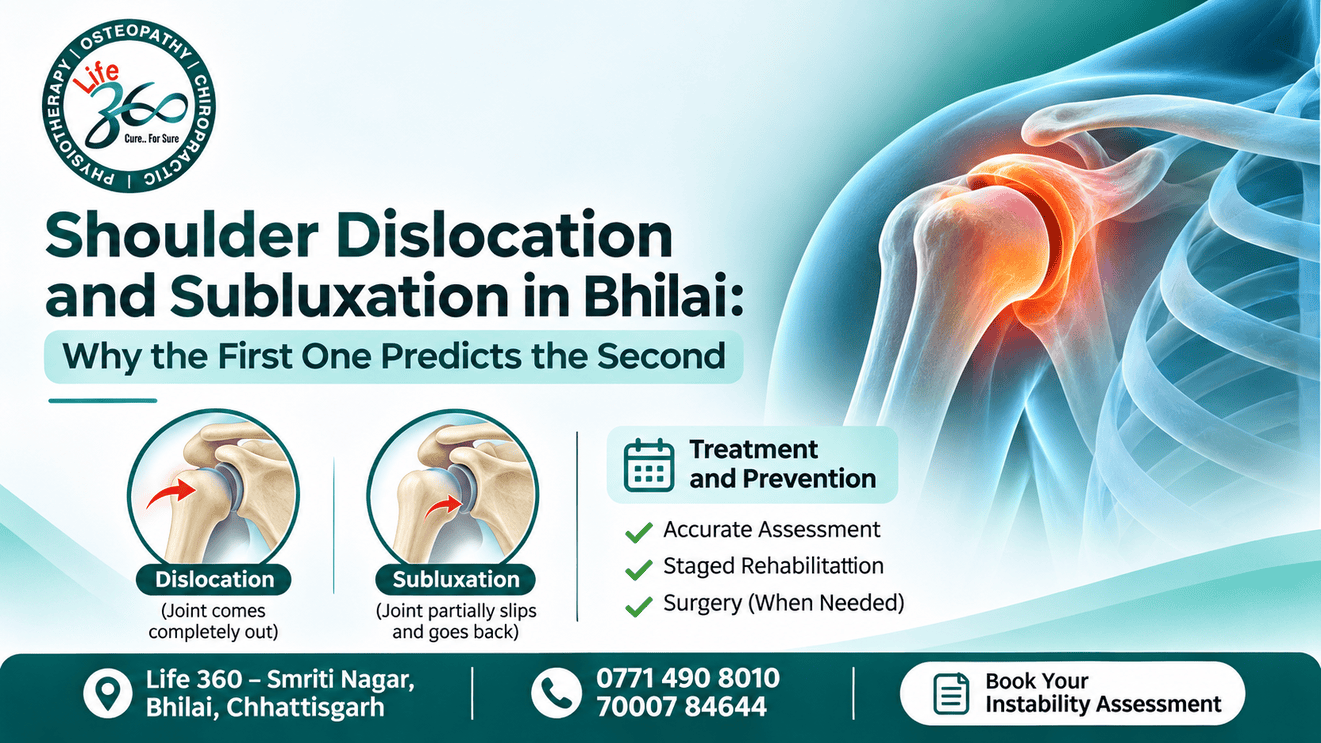
Dislocation (kandha utar gaya) means the ball has left the socket completely and will not go back without help. It is usually obvious: the shoulder looks wrong, the arm is held away from the body, and the person will not let you move it.
Subluxation means the ball slides partially out and returns by itself. Patients describe a dead feeling, a clunk, or the arm "going" for a second.
Instability is the shoulder no longer trusting certain positions, usually the arm raised and rotated outwards. Some people have it without ever having had a frank dislocation, particularly those with naturally loose joints.
A first dislocation is an event. Instability is what we treat.
Almost always the front rim of the labrum, and sometimes bone with it.
In a forward dislocation the ball tears the labrum off the front of the socket. That is a Bankart lesion, found in the large majority of first-time traumatic anterior dislocations in young patients.
If a piece of socket bone comes away with it, that is a bony Bankart. The ball can also dent itself against the socket edge on the way out, which is a Hill-Sachs lesion. Large bone loss on either side changes the surgical options, which is why a CT is sometimes requested after repeated dislocations.
The torn labrum does not usually reattach in the right place by itself. It heals somewhere, loosely, and the front of the shoulder stays slacker than before.
That is the mechanism behind "the first one predicts the second".
Age at first dislocation is the strongest predictor, and the numbers are stark.
Under 20, particularly male and returning to contact sport: recurrence reported from around 70% up to 90% in some series
20 to 30: broadly 40–60%
30 to 40: lower, often quoted under 30%
Over 40: recurrence is uncommon, but a rotator cuff tear accompanies the dislocation in a large share of cases, and that becomes the main issue
Other things that raise the risk: a bony Bankart, a large Hill-Sachs lesion, joint laxity, and a sport involving tackling or an overhead arm under load.
So a 19-year-old cricketer and a 58-year-old homemaker with the same dislocated shoulder are not facing the same problem. The teenager is likely to dislocate again. Her shoulder is likely to have a torn cuff.
Direction of instability. Anterior, posterior or multidirectional. Posterior instability behaves differently and is often missed.
Apprehension test, arm at 90 degrees abduction and rotated out. I watch the face, not the arm. The guarding is the finding.
Relocation test. Pressure on the front of the shoulder while repeating the above. If apprehension disappears, anterior instability is confirmed clinically.
Load and shift, grading how far the ball translates in the socket versus the other side.
Beighton score for generalised hypermobility, which changes the programme and the surgical conversation.
Rotator cuff strength, carefully, in anyone over forty. An older dislocated shoulder with weak external rotation is a cuff tear until proven otherwise.
Axillary nerve screen. Sensation over the outer shoulder, deltoid power. Nerve stretch injury happens with dislocation and is often missed in the emergency room.
Which positions you now avoid. Reaching back for a seatbelt, lifting a bag into a rack, hanging a bucket on a hook. These set the range we must win back.
Weeks 0–3, protect. Sling for comfort, generally no more than three weeks and shorter in older patients, where stiffness is the bigger enemy. Grip, elbow and wrist movement, scapular setting. Gentle rotation within limits set by the doctor. No external rotation past neutral in the first three weeks after an anterior dislocation.
Weeks 3–8, restore controlled movement. Rotation range rebuilt gradually. Isometric cuff work progressing to band resistance. Scapular control, serratus and lower trapezius. Closed-chain work with hands on a wall, which gives the joint compression and feedback.
Weeks 8–14, strength and proprioception. Rhythmic stabilisation at increasing elevation. Perturbation drills with a ball against a wall. Pressing and pulling at load. External rotation strength at 90 degrees of abduction, the position the shoulder must learn to trust again.
Weeks 14–24, sport and work specific. Plyometrics, falling and catching drills, sport rehearsal. Return to collision sport should not be considered before four to six months, and many surgeons say longer.
Twelve to twenty sessions across four to six months is the usual shape. Patients who stop at week eight because the pain has gone are the ones who dislocate again.
I will argue for an early surgical opinion rather than a long conservative trial in these situations.
First traumatic dislocation in an athlete under about 22 returning to contact or overhead sport. Randomised trials have shown markedly lower recurrence with early arthroscopic stabilisation than with rehabilitation alone in this group.
Two or more dislocations, at any age. The front of the shoulder will not tighten on its own.
A bony Bankart or significant glenoid bone loss, where a Latarjet procedure may be needed rather than a soft-tissue repair.
Dislocation with a rotator cuff tear over forty, where the cuff drives the decision.
An axillary nerve injury not recovering by three months.
Here is where I disagree with how this is often handled. The standard path after a first dislocation is a sling, some exercises, and "let us see". For a 19-year-old who plays cricket four days a week, that usually means three more dislocations and more bone loss, which makes the eventual operation bigger. Waiting is not neutral in that patient.
For a 45-year-old with one dislocation after a scooter fall, waiting is reasonable.
Do not keep the sling on for six weeks. It is still advised in places. Beyond about three weeks it adds stiffness without adding stability, and over fifty it can produce a frozen shoulder that takes longer to treat than the dislocation did.
Do not let anyone pull the shoulder back in at the ground. Not a friend, not a coach, not the man at the gym who has done it before. An unreduced dislocation can sit alongside a fracture, and forceful attempts can damage nerve and bone. It goes to hospital for X-ray and reduction.
Do not train bench press and chest flies as your rehabilitation. Patients do, because the shoulder feels supported there. Loading the front of an unstable shoulder in wide abduction and external rotation is the position we are trying to protect.
A shoulder that is out now: deformed, locked, arm held away from the body. Reduction today, under supervision, with an X-ray first.
Numbness over the outer shoulder or a dead deltoid after reduction, suggesting axillary nerve injury.
A cold, pale or pulseless hand, which is a vascular emergency.
No active arm elevation two to three weeks after reduction in someone over forty, pointing to a cuff tear needing imaging.
A hot, swollen joint with fever at any point.
Does a dislocated shoulder ever go back on its own?
Sometimes, particularly a subluxation, which slides out and returns within seconds. A true dislocation usually stays out and needs reduction. Either way the labrum and capsule are damaged by the time it is back in, so a shoulder that self-reduced still deserves assessment.
My shoulder has not come out again but I do not trust it. Is that normal?
Very. Apprehension often outlasts the physical instability, and sometimes it is all that is left. It is treated with graded exposure to the feared position under control, not with avoidance. Patients who avoid the position for a year stay afraid of it.
Can exercises tighten a torn labrum?
No. Exercise cannot reattach torn tissue to bone. What it does is make the muscles around the joint hold the ball centred well enough that the loose labrum stops mattering. For many patients that is sufficient. In a young contact athlete, often it is not, and that is an honest limit of what I can offer.
How long before I can ride my bike again?
Short local rides on smooth roads at about four weeks, once the sling is off and you can control the arm. Longer commutes and rough stretches, where a jolt or a hand off the bar matters, usually wait until six to eight weeks. A pillion passenger pulling that arm is worth warning about.
Do shoulder braces prevent dislocation in sport?
A sport brace limits extreme end-range positions and gives some players confidence. It does not restore the labrum, and the evidence for preventing recurrence is thin. I use them as a bridge, mostly for a season already underway, not as a substitute for a decision.
Come in if your shoulder has dislocated once and you are deciding what next, if it has come out more than once, if it subluxes when you reach behind you, or if you want shoulder dislocation treatment in Bhilai weighed against your age, your sport and the recurrence risk.
Life 360 — Smriti Nagar, Bhilai, Chhattisgarh
Phone: 0771 490 8010 · 70007 84644
Hours: 11:00 am – 6:00 pm
Email: [email protected]
Main centre: HIG-16, Sector 1, Shankar Nagar, Raipur 492007
Bring with you: X-rays from before and after reduction, any MRI or CT reports, the discharge note, and the dates of every dislocation you can remember.
Dr. Nitu Verma (P.T.) is the founder and clinical director of Life 360 Physiotherapy Center, Shankar Nagar, Raipur, and of Life 360 at Smriti Nagar, Bhilai. She is widely recognised as India's first female chiropractor, and has more than fifteen years in clinical practice with over 50,000 patient consultations behind her.
Her training: Master of Physiotherapy (Sports) · Master Diploma in Chiropractic, Ackerman Institute, Sweden · Diploma in Osteopathy and DO Certification, Canada · Fellowship in Orthopaedic Manual Therapy (FOMT), Australia · Cranio-Sacral Therapy, USA · Pelvic Floor Osteopathy, Madrid School · Certified Pilates Instructor, Ireland.
She received the Nari Shakti Award 2026, and appeared on Doordarshan in a national discussion titled "Breaking the Myth About Chiropractic".
She treats spine and joint conditions non-surgically across Raipur, Bhilai, Durg and the wider Chhattisgarh region.
Clinics: HIG-16, Sector 1, Shankar Nagar, Raipur 492007 · Smriti Nagar, Bhilai
Appointments: 0771 490 8010 · 70007 84644 · [email protected]
Dr. Nitu Verma (P.T.) — Chiropractor and Physiotherapist, Life 360, Raipur and Bhilai.
General information only, and not a replacement for examination in person.