Life 360 Physiotherapy Center, HIG-16, Sector 1, Shankar Nagar, Raipur, Chhattisgarh 492007
-
For Appointment: 09115719395 , 07000784644 , 07714908010
-

At Life 360 Physiotherapy Center, led by Dr. Nitu Verma, India’s first lady chiropractor, we are dedicated to delivering top-quality chiropractic and physiotherapy care. Recognized as the best chiropractor in India, Dr. Verma specializes in holistic treatments for pain relief, spinal alignment, and sports injury rehabilitation. Our clinic in Raipur provides personalized care designed to address the root causes of discomfort and restore balance to your body, helping you achieve long-term health and wellness. Experience relief and recovery with India’s leading chiropractic expert at Life 360 Physiotherapy Center.
For Appointment: 09115719395 , 07000784644 , 07714908010
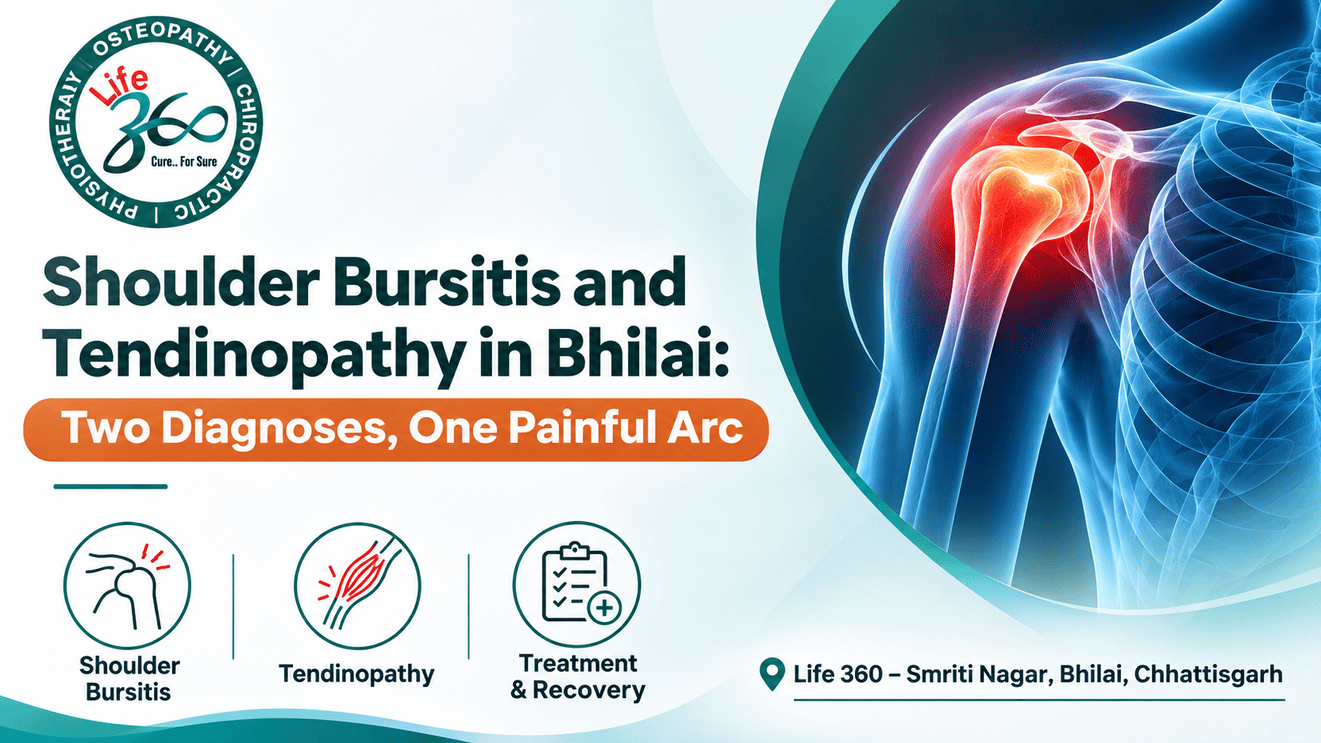
Quick answer: Shoulder bursitis treatment in Bhilai and tendinopathy treatment look different at the start and converge later. Bursitis is inflammation of the fluid-filled sac above the cuff and settles faster, often helped by one injection. Tendinopathy is a change in the tendon itself and needs eight to sixteen weeks of progressive loading. An injection alone rarely holds for either.
Does it matter which one you have?
For the first three weeks, yes. After that, much less than patients expect, because both end in the same place: a tendon that must carry more load than it currently can.
But those first three weeks are where treatment goes wrong, and the two conditions arrive on the same ultrasound report so often that patients are unsure what they are being treated for. "Subacromial bursitis with supraspinatus tendinosis" is one of the commonest lines I read here.
A 44-year-old auto-rickshaw mechanic from Khursipar came in with that exact report and two steroid injections behind him. The first had worked beautifully for about seven weeks. Its repeat barely touched it. He described a dull, heavy, hot pain over the outer shoulder that woke him when he rolled over, and a sharper catch when he reached for a spanner. No exercise had been given between the injections, because nobody offered any.
That is the pattern this page is about.
By how the pain behaves rather than by what the scan says: bursal pain is diffuse, hot and present at rest, while tendon pain is localised and appears with load.
The subacromial bursa is a thin, slippery sac between the cuff tendon and the bony roof above it. Its job is to let the tendon glide. When it becomes inflamed and thickened it hurts in a way that behaves differently from a tendon.
Points towards bursitis:
A diffuse, hot, heavy ache over the outer upper arm, hard to localise
Pain at rest and at night, rather than only with movement
Fairly sudden onset over days, often after one unusual bout of overhead work
Mid-arc pain, worse when the arm is compressed upward
Strong response to one steroid injection
Points towards tendinopathy:
Pain you can point to, at the front and outer edge of the shoulder
Pain with load rather than at rest, and warm-up that briefly improves it
Gradual onset across weeks, with an increase in training or overhead work behind it
Stiffness on waking (akdan) that eases in twenty minutes
Modest, short-lived response to injection
Most of my patients tick boxes in both columns. That is not a diagnostic failure. The bursa and the tendon sit against each other, and irritation in one irritates the other.
Partly. Ultrasound shows bursal thickening and fluid well, along with tendon thickening, hypoechoic change and calcification.
What it cannot do is tell you which finding is producing your pain. Bursal fluid appears in plenty of pain-free shoulders, and tendon changes are common after forty in people with no symptoms. I have seen a 6 mm bursa reported in a shoulder behaving perfectly, and a near-normal scan in one that could not lift a kettle.
The scan narrows the field. Your shoulder's behaviour decides the treatment.
The painful arc, in degrees, on the way up and down separately. Bursal pain is often worse on lowering.
Pain at rest, scored before I touch you. Resting pain shifts my thinking towards an inflammatory bursal picture.
Resisted isometrics of the cuff in neutral. Tendinopathy usually hurts and holds. Bursitis hurts less in isometric and more in movement.
Response to a short isometric trial. Forty-five seconds of a firm submaximal hold, then I retest the arc. If pain drops, I have a treatment and a diagnostic clue.
Palpation of the bursal region versus the tendon insertion, which sit a few centimetres apart and feel different.
Night pain history. Which side you sleep on, whether a cushion under the arm helps, how often you wake.
Calcification check on any X-ray you bring. Calcific tendinitis behaves differently and I treat it differently.
Load audit. What changed four to eight weeks before the pain started. There is almost always something, and patients rarely volunteer it.
A subacromial steroid injection is a diagnostic test as well as a treatment, and it is worth using as one.
If pain falls by 70% or more within a week and movement opens up, the bursa was a major pain source. Where relief is partial and fades inside three weeks, the tendon is doing most of the talking, and further injections will not change that.
Now the uncomfortable part. Injections do not change tendon capacity. They reduce pain, which creates an opportunity, and that opportunity closes in four to eight weeks. A patient who returns to full overhead shifts the day after an injection has spent the window and bought nothing.
There is also a cost to repeating them. Steroid can weaken tendon tissue, and most clinicians now limit subacromial injections to two or three in a shoulder, well spaced. If you have had three and the shoulder keeps returning, the next injection is not the answer.
My rule here is plain: an injection is worth having if, and only if, there is an exercise programme ready to use the window.
Weeks 0–2, reduce irritation without going quiet. Isometric cuff holds, five sets of 30 to 45 seconds, two or three times a day. Activity modified rather than stopped: overhead time cut by roughly half. Sleeping semi-reclined with a rolled towel under the upper arm. Ice has a modest role in a genuinely hot bursa, mainly for sleep.
Weeks 2–6, introduce load through range. Band and then dumbbell external rotation, internal rotation, rows, serratus wall slides. Elevation in the scapular plane to the height that stays quiet. Load goes up weekly. We are not chasing pain-free; we are chasing "no worse tomorrow morning".
Weeks 6–12, build real capacity. Heavier slow cuff work, two to three sessions a week, 8 to 12 repetitions at about 7 out of 10 effort. Overhead pressing from supported positions. Carries, which load the whole girdle in a way band work cannot.
Weeks 12–16, return to the job. Overhead hours reintroduced across three to four weeks. For mechanics and fitters we rehearse the posture with the actual tool, because a shoulder trained only with bands will not transfer.
A realistic course is ten to fourteen sessions over eight to twelve weeks. Patients coming from Durg or Jamul often do one clinic visit a week and three home sessions, which is fine provided load progresses.
No, and this is where I part company with most advice, which tells you to rest an inflamed bursa until the pain is gone and then start exercising.
Complete rest for three or four weeks produces a shoulder that is less painful and considerably weaker, and the pain returns within days of resuming work. Isometric loading can start in the first session, and it reduces pain during that session for many patients.
One more thing: do not use a shoulder pulley to force elevation during a painful bursal flare. It is handed out constantly. Dragging the arm through a compressed, inflamed arc forty times a day keeps the bursa angry.
That changes the picture, because calcific tendinitis does not follow the rules above.
If your X-ray shows a dense white deposit in the cuff tendon, that is calcific tendinitis, and it does not follow the rules above.
It can be extremely painful during the resorptive phase, and often resolves on its own over months as the body reabsorbs the deposit. Ultrasound-guided needling and lavage helps selected cases. Loading still matters, but the timeline differs and I say so rather than promising a twelve-week fix.
A hot, swollen, red shoulder with fever. Septic bursitis and joint infection are urgent and need medical care, not exercise.
No active lift of the arm after trauma. Fracture, major cuff tear or nerve injury need ruling out.
A deformed shoulder after a fall or a seizure, arm held away from the body. That is a dislocation needing hospital reduction.
Night pain with unexplained weight loss, a persistent mass, or a history of cancer.
Spreading redness up or down the arm, which needs same-day medical review.
My injection worked and then stopped. Did it fail?
It did its job and ran out. Steroid reduces inflammation for a limited period, usually four to eight weeks, without changing how much load the tendon can take. If nothing was rebuilt during those weeks, the shoulder returns to the capacity it had before. The injection was not wasted; the window was.
Can bursitis turn into a rotator cuff tear?
Not directly. They share causes, which is why they so often appear on the same report. A long-standing irritated, poorly loaded cuff is more vulnerable to tearing, so the association is real without the bursitis itself tearing anything. Strength work reduces that risk more than rest does.
Should I apply hot or cold?
Cold for a hot, throbbing, night-waking bursa, ten minutes at a time. Heat for a stiff, achy shoulder before exercise. Patients ask me to choose one forever, and that is the wrong question. Use whichever makes the next hour easier, then do the exercises.
Why does my shoulder hurt more when I lower my arm than when I lift it?
Pain on lowering is frequently bursal. The bursa gets compressed and then pinched as the arm comes down under eccentric control, with less muscular support than on the way up. It is one of the more useful things a patient can tell me.
How long until I can sleep on that side?
Commonly four to eight weeks for bursitis, longer for tendinopathy with significant night pain. Recovery usually runs in order: night pain, then pain with reaching, then pain with overhead load. Sleeping on that side again is a milestone worth tracking.
Come in if your outer shoulder aches at night and catches when you reach, if an injection helped then faded, if you were given rest and no exercises, or if you want shoulder bursitis treatment in Bhilai that separates bursa from tendon first.
Life 360 — Smriti Nagar, Bhilai, Chhattisgarh
Phone: 0771 490 8010 · 70007 84644
Hours: 11:00 am – 6:00 pm
Email: [email protected]
Main centre: HIG-16, Sector 1, Shankar Nagar, Raipur 492007
Bring with you: ultrasound and X-ray reports, the dates of any injections, and a loose vest so both shoulders can be compared.
Dr. Nitu Verma (P.T.) is the founder and clinical director of Life 360 Physiotherapy Center, Shankar Nagar, Raipur, and of Life 360 at Smriti Nagar, Bhilai. She is widely recognised as India's first female chiropractor, and has more than fifteen years in clinical practice with over 50,000 patient consultations behind her.
Her training: Master of Physiotherapy (Sports) · Master Diploma in Chiropractic, Ackerman Institute, Sweden · Diploma in Osteopathy and DO Certification, Canada · Fellowship in Orthopaedic Manual Therapy (FOMT), Australia · Cranio-Sacral Therapy, USA · Pelvic Floor Osteopathy, Madrid School · Certified Pilates Instructor, Ireland.
She received the Nari Shakti Award 2026, and appeared on Doordarshan in a national discussion titled "Breaking the Myth About Chiropractic".
She treats spine and joint conditions non-surgically across Raipur, Bhilai, Durg and the wider Chhattisgarh region.
Clinics: HIG-16, Sector 1, Shankar Nagar, Raipur 492007 · Smriti Nagar, Bhilai
Appointments: 0771 490 8010 · 70007 84644 · [email protected]
Dr. Nitu Verma (P.T.) — Chiropractor and Physiotherapist, Life 360, Raipur and Bhilai.
This article is general information and is not a substitute for an in-person examination.