Life 360 Physiotherapy Center, HIG-16, Sector 1, Shankar Nagar, Raipur, Chhattisgarh 492007
-
For Appointment: 09115719395 , 07000784644 , 07714908010
-

At Life 360 Physiotherapy Center, led by Dr. Nitu Verma, India’s first lady chiropractor, we are dedicated to delivering top-quality chiropractic and physiotherapy care. Recognized as the best chiropractor in India, Dr. Verma specializes in holistic treatments for pain relief, spinal alignment, and sports injury rehabilitation. Our clinic in Raipur provides personalized care designed to address the root causes of discomfort and restore balance to your body, helping you achieve long-term health and wellness. Experience relief and recovery with India’s leading chiropractic expert at Life 360 Physiotherapy Center.
For Appointment: 09115719395 , 07000784644 , 07714908010
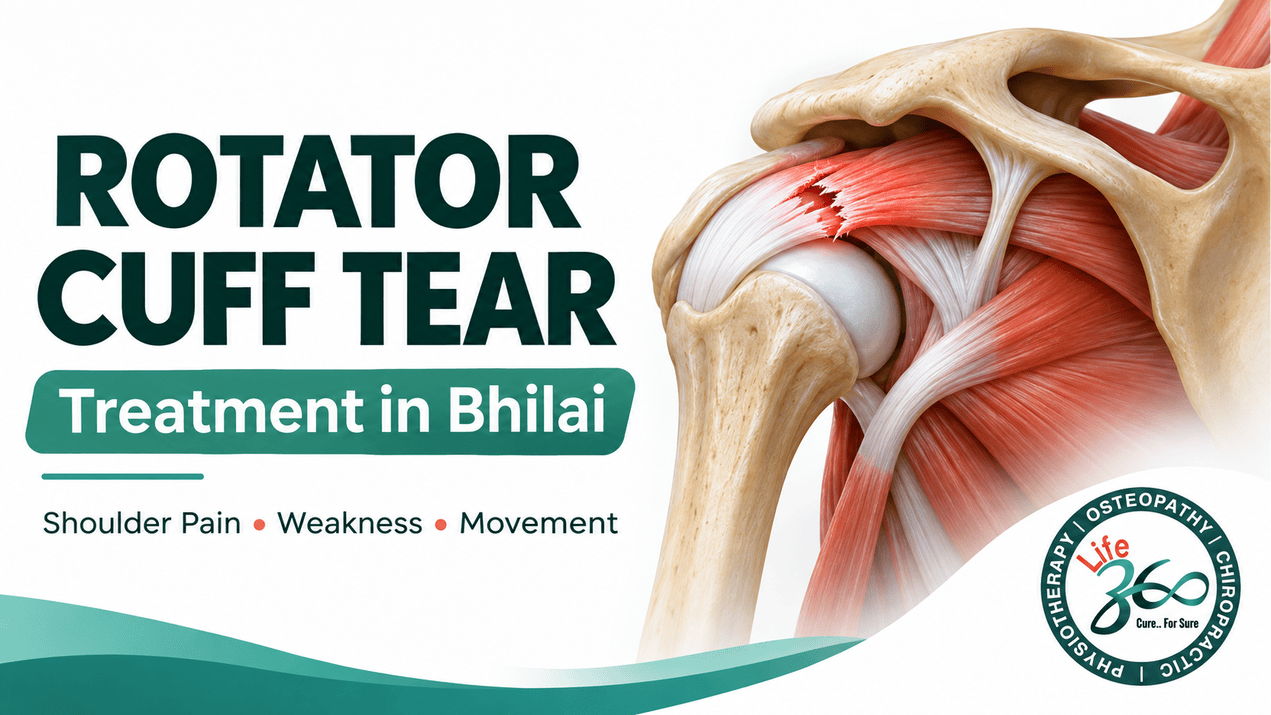
Quick answer: Rotator cuff tear treatment in Bhilai turns on two questions: how big the tear is, and what the arm can still do. Partial tears and degenerative full-thickness tears in older patients often respond well to a twelve- to sixteen-week strengthening programme. A traumatic full-thickness tear in someone under sixty needs a surgical opinion within weeks.
"Doctor, I can lift it with my other hand. On its own it won't go."
That was the first sentence from a 52-year-old maintenance fitter from Supela, and it told me more than the report he was holding. He had slipped on an oily step at work six weeks earlier, caught himself on an outstretched arm, and since then could not raise that arm past his chest. Put his good hand under the elbow and the arm went all the way up. Take the help away and it dropped.
That gap between what the arm can do with help and what it can do alone is the whole clinical story of a cuff tear. It is called lag, and it is measurable.
His MRI showed a full-thickness supraspinatus tear with about 2 cm of retraction. He was 52, the injury was traumatic, and the tendon was still mobile. I sent him for a surgical opinion that week and did not offer him a strengthening programme.
A partial tear thins the tendon; a full-thickness tear puts a hole through it, and that difference decides what the arm can still do far more than it decides how much it hurts.
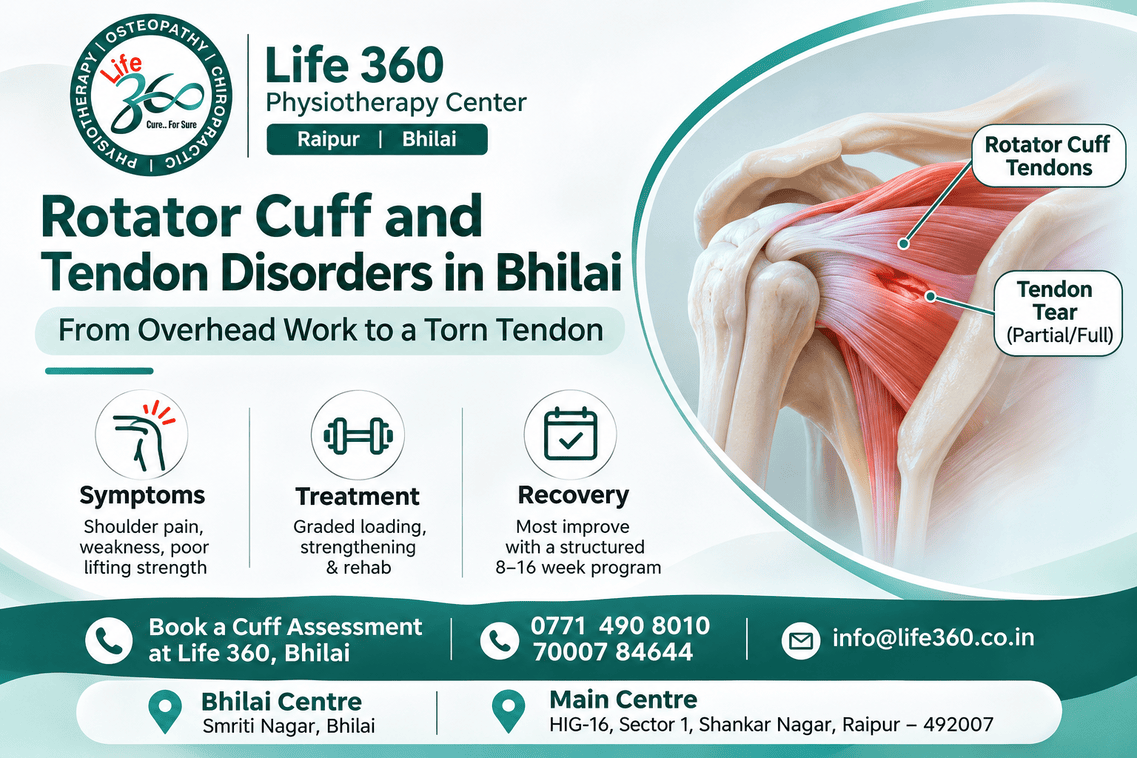
The rotator cuff is four muscles (supraspinatus, infraspinatus, subscapularis and teres minor) whose tendons wrap the ball of the shoulder like a cuff on a sleeve. They hold the ball centred while the big muscles lift it.
A partial-thickness tear means the tendon is damaged through part of its depth. The sleeve is frayed, not holed. Such a cuff still works, usually painfully.
A full-thickness tear means there is a hole through the tendon. The cuff has lost a cable.
Here is the part patients do not expect: plenty of people walk around with full-thickness tears and near-normal arms. The other three muscles compensate and function holds. Imaging has found full-thickness tears in a substantial minority of people over sixty who never complained of a shoulder.
So size alone does not decide treatment. Function does.
The clearest signal is weakness that does not improve when the pain is numbed, plus a lag between passive and active movement. Stiffness restricts both equally.
A frozen shoulder (akdan) will not let anyone move the arm — not you, not me, not under anaesthetic. With a torn cuff I can move the arm while you cannot. If I lift your arm to 90 degrees out to the side, let go, and the arm sinks, that is a drop sign and it points at the cuff.
Night pain lying on that side is common to both and tells us nothing useful.
Active versus passive elevation, measured in degrees, both compared. A 40-degree gap is a different problem from a 5-degree gap.
Drop arm test. Arm held at 90 degrees abduction, then released. Does it hold, or sink?
External rotation lag. Elbow at the side, arm rotated out to end range by me, then released. Lag here points at infraspinatus.
Belly press and lift-off. Subscapularis, which gets ignored because the front of the cuff is harder to test.
Jobe's test for supraspinatus strength, graded, both sides, and I write the grade down rather than saying "weak".
Scapular position and control through elevation and lowering. A cuff tear almost always sits on top of a scapula that has stopped doing its share.
Cervical screen. Neck-referred shoulder pain is common in two-wheeler commuters, and I have seen a C5 radiculopathy labelled a cuff tear more than once.
What you can do at home. Reaching the top shelf of an almirah, fastening a sari or shirt behind you, lifting a filled bucket. These are what I re-test at week six.
Three situations where I do not experiment with exercise first.
A traumatic full-thickness tear in a patient under about sixty. The tendon retracts and the muscle fills with fat over months, and that change does not reverse. A repair done at eight weeks has a better chance than the same repair at eight months.
Subscapularis tears, which tolerate delay badly.
A pseudoparalytic shoulder: active elevation under 60–70 degrees with full passive range and no stiffness. That arm will not be rebuilt with theraband.
Everything outside those three has room to try conservative care, and most of what I see falls outside them.
No. Torn tendon does not knit back to bone without surgical fixation, and some tears enlarge slowly over years.
That is not the same as saying the shoulder cannot get better. Pain settles, the remaining cuff and the deltoid take over, and plenty of patients return to full overhead function with a hole still on the film. We are treating a shoulder, not a scan.
Where the research is genuinely unsettled is which degenerative tears enlarge and which stay put. We cannot predict that for an individual yet, so I re-measure strength at three and six months instead of guessing.
Four stages across roughly twenty weeks, built on progressive loading of the remaining cuff and the scapula rather than on rest.
Weeks 0–2, settle the irritable shoulder. Pendulums, scapular setting, isometric holds of the cuff at 10–20% effort in a pain-free position. Sleep set-up matters more than anything in these two weeks: a folded towel under the upper arm when lying on the back stops the arm falling backwards and pulling on the tear.
Weeks 2–6, rebuild the cuff and the scapula together. Band rotation at the side, inward and outward, with load progressing weekly. Prone rows, low rows, serratus work against a wall. Elevation in the plane of the scapula to whatever height stays quiet, not to a target.
Weeks 6–12, load and raise the arm. Overhead work begins once the arm holds 90 degrees against gentle resistance without sinking. Supported dumbbell presses, carries, pulling patterns. For plant workers this is where we rehearse the overhead posture the job demands, with a tool in hand.
Weeks 12–20, job specific. Welders and fitters need endurance at height, not a one-rep max. We work in repeated holds of 20 to 30 seconds, because that is what the shift asks for.
Realistic course: two sessions a week for six weeks, then weekly review, with daily home work. Patients travelling in from Durg or Kumhari often prefer one clinic session a week plus a tighter home programme, and that works provided the loading actually progresses.
Most sites will tell you to rest the shoulder and wear a sling until the pain settles. I think that is wrong for the majority of degenerative tears.
A cuff that is not loaded weakens fast, and the stiffness that follows is harder to treat than the tear. Unless there is a fresh traumatic tear awaiting surgery, or a surgeon has asked for immobilisation, I want the arm moving within the first week — gently, below the painful arc, several times a day.
Also: do not chase a full overhead stretch in the first month. Forcing elevation through a painful arc with a pulley is a common reason a shoulder arrives here angrier than it started.
The shoulder is hot, swollen and you have fever. That is a possible joint infection, and it is urgent.
You cannot actively lift the arm at all after a fall, especially if the arm feels numb or the hand is weak. A fracture or a nerve injury must be ruled out.
The shoulder is visibly deformed after trauma, with the arm held away from the body. A dislocation needs reduction in a hospital, not physiotherapy.
Night pain with unexplained weight loss, or a lump over the shoulder girdle.
Progressive hand weakness with tingling (jhunjhuni) into the fingers.
Will physiotherapy make my tear bigger?
A graded programme has not been shown to enlarge tears. What aggravates a cuff is sudden heavy overhead load, falling onto the arm, and hanging from it. Controlled rotation and rowing at moderate load is the opposite, and it is what the remaining tendon needs.
My surgeon said repair, another doctor said exercise first. Who is right?
Both can be, depending on your age, how the tear happened, and whether the arm still lifts. Bring both opinions in. If the tear is traumatic, full-thickness and you are under sixty, delay costs you options. Where it is degenerative and the arm works, a three-month trial costs little.
How long after a rotator cuff repair before I can work?
Light desk work around four to six weeks, a two-wheeler at eight to ten, overhead manual work rarely before five to six months. Plant shift work with sustained arm elevation often takes longer, and the surgeon's protocol sets the pace.
Does ultrasound therapy help a cuff tear?
There is little convincing evidence it changes the tendon. I use it occasionally for short-term comfort in a very irritable shoulder, never as the treatment itself. If someone has given you ten sessions of ultrasound and no exercise, you have paid for a warm feeling.
Can I still go to the gym?
Yes, with substitutions. Pulling and rowing continue almost immediately. Overhead press, behind-the-neck work, upright rows and deep dips come out for a few months. Most gyms in Smriti Nagar have a landmine or incline setup that will do the job meanwhile.
Why is my arm weak but not very painful?
That combination usually means a larger tear, not a smaller one. Pain comes from irritated tissue; weakness comes from a missing cable. A quiet, weak shoulder over sixty is often a long-standing full-thickness tear the body has settled around.
Come in if you cannot lift your arm to a shelf without help, if the arm sinks when you let go, if the shoulder has been weak for over three weeks after a fall, or if you want rotator cuff tear treatment in Bhilai measured against what your arm can still do.
Life 360 — Smriti Nagar, Bhilai, Chhattisgarh
Phone: 0771 490 8010 · 70007 84644
Hours: 11:00 am – 6:00 pm
Email: [email protected]
Main centre: HIG-16, Sector 1, Shankar Nagar, Raipur 492007
Bring with you: MRI or ultrasound films and reports, the surgeon's note if you have one, and a sleeveless vest or loose top so both shoulders can be seen.
Dr. Nitu Verma (P.T.) is the founder and clinical director of Life 360 Physiotherapy Center, Shankar Nagar, Raipur, and of Life 360 at Smriti Nagar, Bhilai. She is widely recognised as India's first female chiropractor, and has more than fifteen years in clinical practice with over 50,000 patient consultations behind her.
Her training: Master of Physiotherapy (Sports) · Master Diploma in Chiropractic, Ackerman Institute, Sweden · Diploma in Osteopathy and DO Certification, Canada · Fellowship in Orthopaedic Manual Therapy (FOMT), Australia · Cranio-Sacral Therapy, USA · Pelvic Floor Osteopathy, Madrid School · Certified Pilates Instructor, Ireland.
She received the Nari Shakti Award 2026, and appeared on Doordarshan in a national discussion titled "Breaking the Myth About Chiropractic".
She treats spine and joint conditions non-surgically across Raipur, Bhilai, Durg and the wider Chhattisgarh region.
Clinics: HIG-16, Sector 1, Shankar Nagar, Raipur 492007 · Smriti Nagar, Bhilai
Appointments: 0771 490 8010 · 70007 84644 · [email protected]
Dr. Nitu Verma (P.T.) — Chiropractor and Physiotherapist, Life 360, Raipur and Bhilai.
General information only, and no substitute for an in-person examination.