Life 360 Physiotherapy Center, HIG-16, Sector 1, Shankar Nagar, Raipur, Chhattisgarh 492007
-
For Appointment: 09115719395 , 07000784644 , 07714908010
-

At Life 360 Physiotherapy Center, led by Dr. Nitu Verma, India’s first lady chiropractor, we are dedicated to delivering top-quality chiropractic and physiotherapy care. Recognized as the best chiropractor in India, Dr. Verma specializes in holistic treatments for pain relief, spinal alignment, and sports injury rehabilitation. Our clinic in Raipur provides personalized care designed to address the root causes of discomfort and restore balance to your body, helping you achieve long-term health and wellness. Experience relief and recovery with India’s leading chiropractic expert at Life 360 Physiotherapy Center.
For Appointment: 09115719395 , 07000784644 , 07714908010
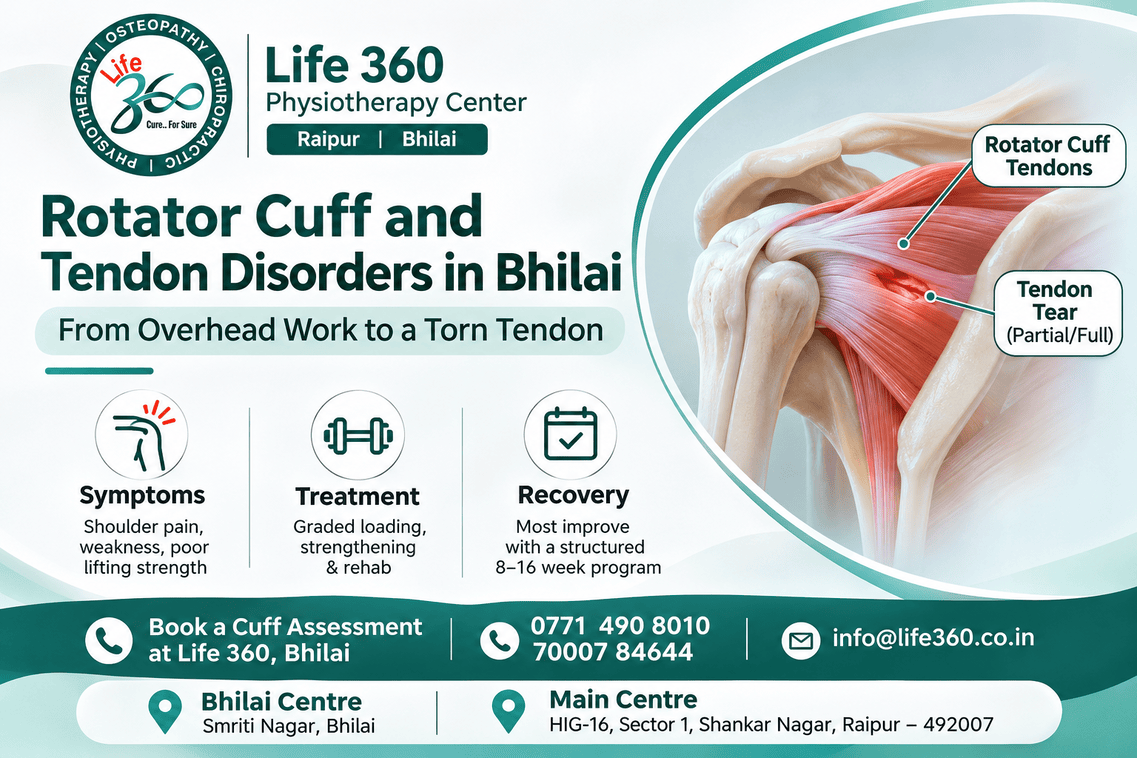
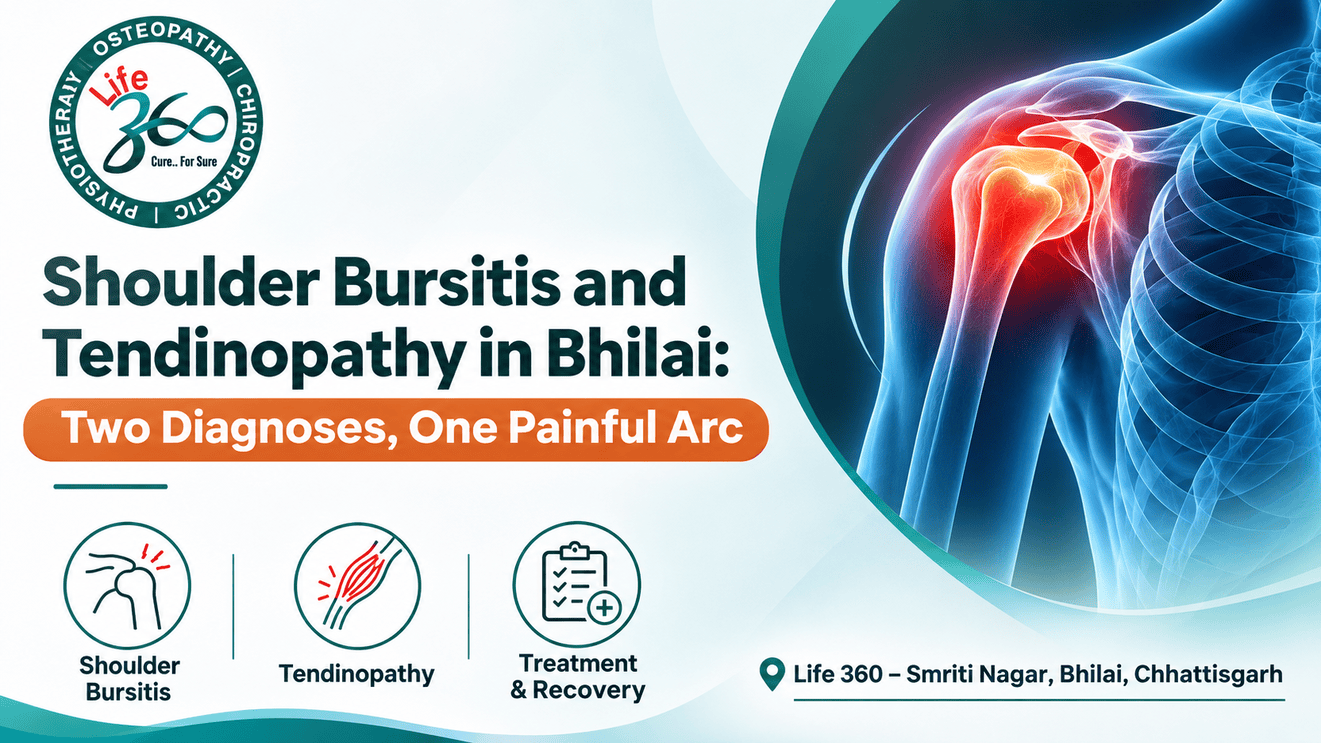
Quick answer: Rotator cuff disorders sit on a range, from an irritable under-conditioned tendon through partial tearing to a full-thickness tear. Most of that range answers progressive loading over eight to sixteen weeks. Full-thickness tears in younger patients, and tears after a definite injury, need a surgeon's opinion early. Rotator cuff treatment in Bhilai starts by placing you on that range.
Twenty-eight years of reaching above his head. He gave me the number with some pride.
A 46-year-old maintenance fitter attached to the Bhilai Steel Plant, living in Risali, right shoulder. Eleven months of outer upper arm pain, worse lifting a spanner above chest height, worst at two in the morning when he rolled onto it. He could lift the arm fully. He could not hold a four-kilogram tool at arm's length for a few seconds before the shoulder sagged.
He had been given rest, tablets, and a diagnosis of "frozen shoulder" that was never going to fit a shoulder with full passive range.
What he needed was the opposite of rest.
Twelve weeks later he was on the same work with a tendon that could hold load. The ultrasound still showed a partial tear. Tendons frequently do.
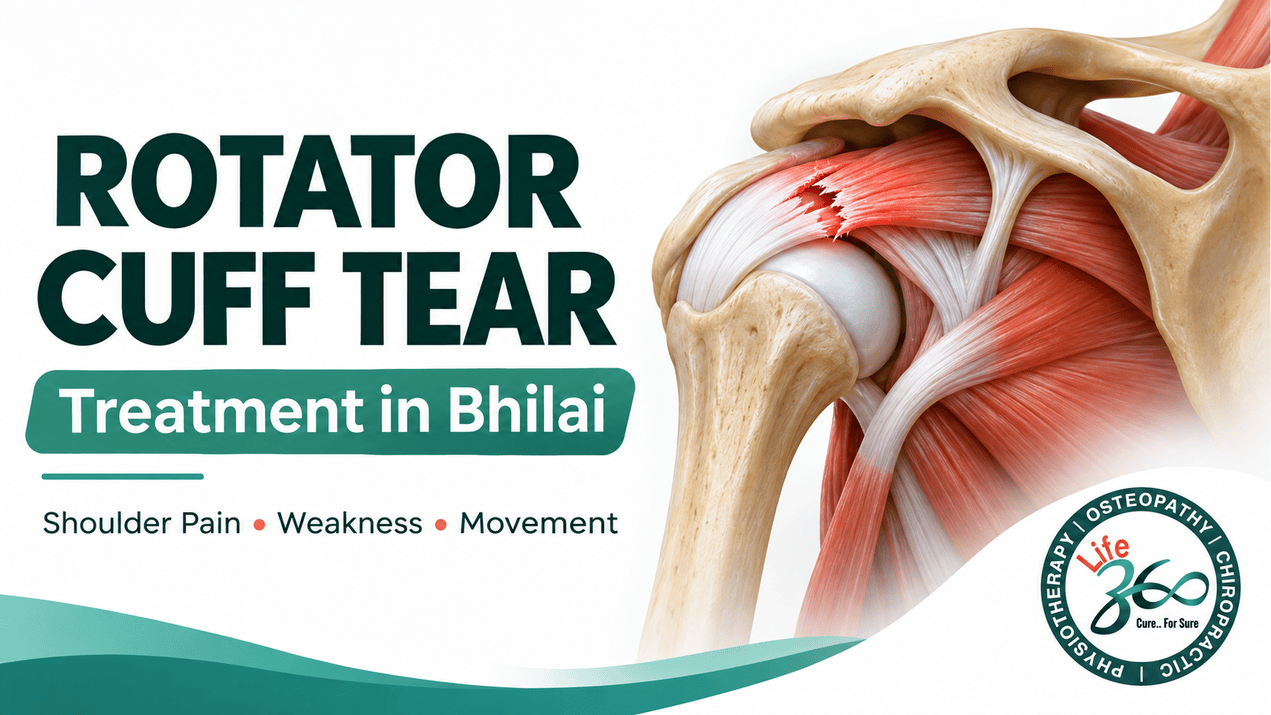
Four tendons wrap the ball of the shoulder and hold it centred in a shallow socket while the big muscles move the arm. Supraspinatus runs over the top and lifts the arm away from the body. Infraspinatus and teres minor sit behind and turn it outward. Subscapularis sits in front and turns it inward.
The socket is about a quarter the size of the ball, so without those four working in sequence the shoulder has almost no bony security. Reaching overhead also narrows the space the tendons pass through.
Do that thirty times an hour for three decades and the tendon takes a load no stretching will undo. The answer is capacity, not flexibility.
The dose is enormous and nobody counts it.
In plant maintenance, workshop and electrical work, painting and construction, the arm spends hours at or above shoulder height holding a two to five kilogram tool at the end of a long lever that is your own arm. Add grinder vibration, shift work that wrecks sleep, and the slow loss of strength through the forties, and capacity drops below demand.
That is the whole mechanism. Demand above capacity, repeated.
So the fix raises capacity rather than dropping demand to zero. I almost never take a plant worker off work entirely. Change the height, the duration and the tool weight, then build the shoulder underneath it. Patients who stop for two months come back weaker and relapse faster.
|
Stage |
What you notice |
Examination |
Usual plan |
|---|---|---|---|
|
Reactive tendinopathy |
Pain after unusual overhead work, settles in days |
Resisted tests sore, strength normal |
Load management, 4–6 weeks |
|
Persistent tendinopathy |
Months of outer arm pain, worse overhead and at night |
Painful arc, mild weakness |
Graded loading, 8–12 weeks |
|
Bursitis with tendinopathy |
Sharper pain, bad nights, cannot lie on it |
Pinpoint tenderness under the acromion |
Loading, sometimes one injection |
|
Partial-thickness tear |
Pain plus loss of power overhead |
Weak but intact resisted tests |
Loading, 12–16 weeks |
|
Full-thickness tear |
Cannot hold the arm out; weakness over pain |
Positive drop-arm, clear weakness |
Surgical opinion, especially under 60 |
|
Massive retracted tear |
Arm rises only by shrugging |
Marked weakness, altered pattern |
Depends on age and tissue quality |
|
Calcific tendinitis |
Sudden severe pain, no injury |
Exquisite tenderness, guarded |
Settles over months; needling in some |
Where you sit on that table matters more than how much it hurts. Severe pain sits at both ends of it.
Active and passive range in degrees, both shoulders. Full passive range rules out a frozen shoulder, whatever the referral letter says.
External rotation at the side, recorded as a number.
Resisted testing of each tendon separately: abduction at 30 degrees for supraspinatus, external rotation for infraspinatus, belly press and lift-off for subscapularis.
Drop-arm test. I hold the arm out at 90 degrees and let go. An arm that falls means something very different from an arm that hurts.
Load holding time. Seconds you can hold two kilograms out in front, and the angle at which it drops. The number I retest most.
Painful arc, up and down.
Scapular movement from behind over ten slow raises, for early shrugging.
Cervical screen, because C5 weakness and cuff weakness feel identical to a patient: cervical radiculopathy treatment in Bhilai.
Work simulation. The actual reach, tool weight and duration.
By weakness rather than pain, and by a scan only when the answer changes something.
Pain tells you a tendon is irritated. Weakness tells you it may be structurally compromised. A patient who holds the arm out against firm resistance has an intact enough tendon for loading, whatever the report says. An arm that drops when released is a different conversation: rotator cuff tear treatment in Bhilai.
One finding surprises people. Partial and even full-thickness tears are common in shoulders with no pain at all, and the proportion rises after 60. A tear on your report is not automatically your problem.
It changes the timeline and little else.
Calcific tendinitis produces some of the worst shoulder pain I see, arriving over a day or two with no injury, sometimes bad enough that the arm cannot be moved. The deposit forms, sits, and then in most people the body resorbs it, which is the painful phase. Resolution over months to a couple of years is usual.
During resorption, loading is poorly tolerated and honest treatment is pain relief, gentle range work and time. Ultrasound-guided needling and lavage helps selected patients, worth discussing with a radiologist when pain is severe and prolonged. Shockwave therapy has some support here, more than for most tendon problems.
Weeks 0–2, isometrics. Holds rather than movements. Resisted external rotation and abduction held 30 to 45 seconds, five repetitions, two or three times a day, at an intensity that does not raise pain beyond mild. A pillow under the arm at night. Overhead work shortened, not abolished.
Weeks 2–6, controlled loading. Band and dumbbell work below shoulder height: external rotation, rows, scapular work, side-lying rotation. Two or three sessions a week, 3 sets of 10 to 12, weight up once the last repetition is easy. Nights improve first, strength second.
Weeks 6–10, overhead reintroduced. Progressive raises to and then above 90 degrees, loaded carries, press patterns from support. Work height restored in steps.
Weeks 10–16, capacity. Heavier loading, end-range holds, endurance matched to the shift, and sport if relevant: sports shoulder injuries in Bhilai.
Typical course: twice weekly for six weeks, then weekly, with review at week twelve. Fourteen to eighteen sessions over three to four months for a partial tear. Patients from Durg or Kumhari switch to fortnightly once the programme is stable, which works as long as the weights go up.
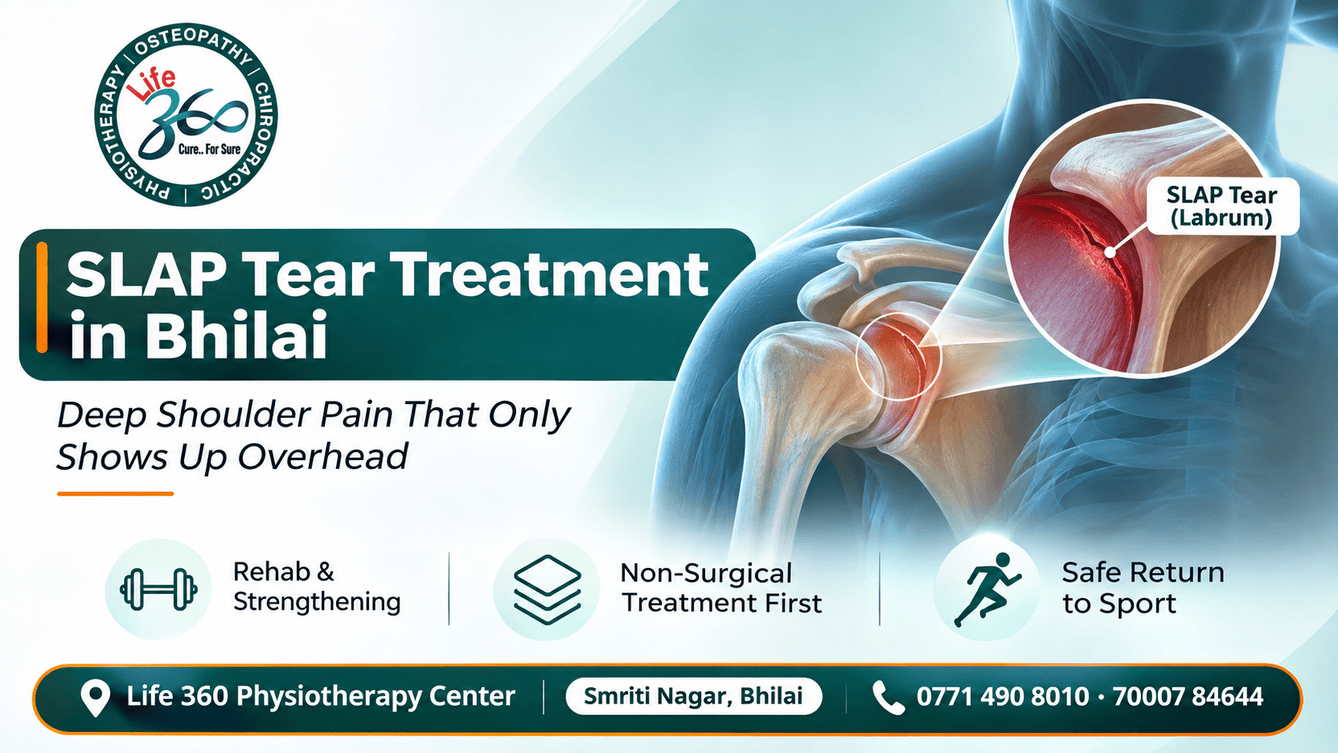
A surgical opinion is sensible for a full-thickness tear under 60, any tear after a clear injury in a working shoulder, worsening weakness, and a shoulder unchanged after a genuine three to four month loading programme.
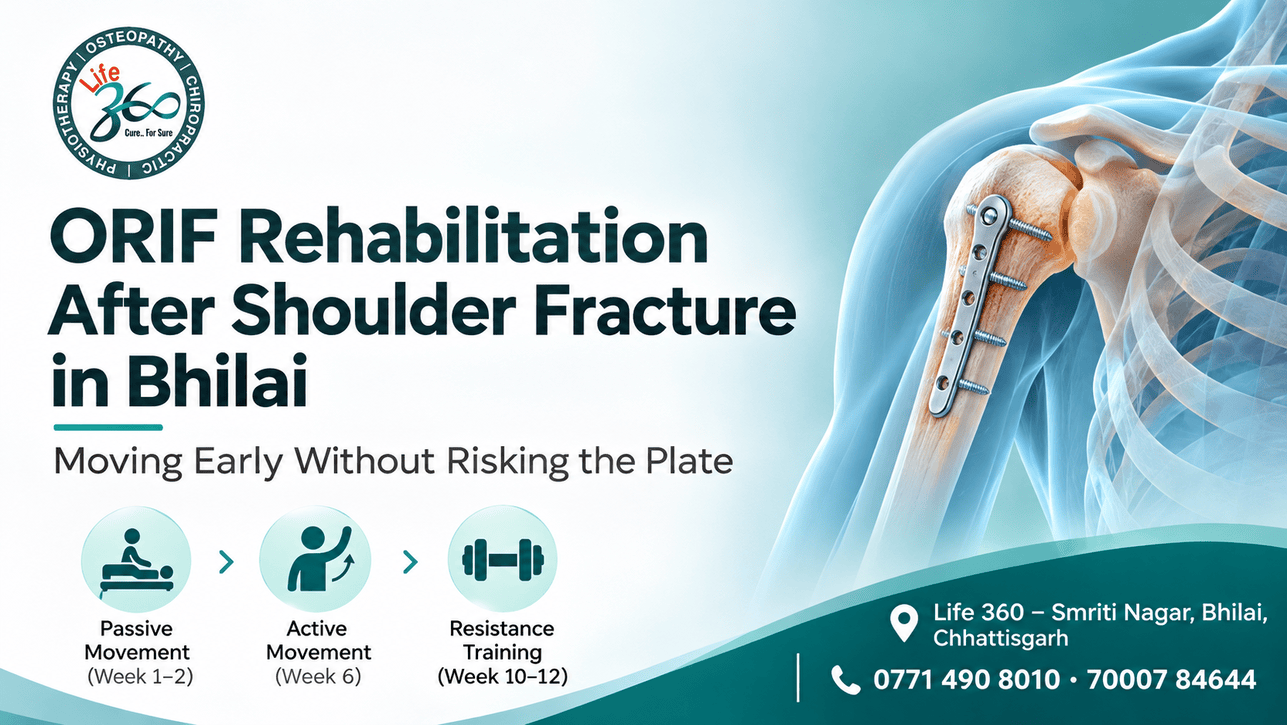
Age alone does not rule out repair; tissue quality does. A long-standing massive tear with muscle atrophy and fatty change on MRI repairs poorly, which is why delay matters in younger patients. For an irreparable tear the options are loading the remaining tendons and, in selected cases, a reverse replacement: shoulder reconstruction rehabilitation in Bhilai, or after plate fixation, ORIF rehabilitation after shoulder fracture in Bhilai.
Resting it. Where I disagree most sharply with what patients are told. An unloaded tendon loses capacity, and the pain returns the moment work resumes. Rest is for the first few days of a severe flare, not six weeks.
The overhead pulley. Dragging the arm repeatedly into the compressed position with no load control. I remove it in session one.
Stretching it hard. Cuff pain is rarely a flexibility problem, and end-range stretching of an irritable tendon stirs it up.
Three injections in a year. One well-timed bursal injection opens a window. Repeated steroid near a tendon is no substitute for strength.
Never increasing the weight. Progress is in the load, not the repetitions.
A hot, swollen shoulder with fever
Deformity or no movement after a fall, which needs an X-ray first
Sudden profound weakness with severe shoulder blade pain after a viral illness
Arm pain with chest tightness, breathlessness or sweating: cardiac assessment
Night pain every night with weight loss, or a past cancer diagnosis
Clumsiness in both hands with unsteady walking
Can I strengthen a tendon that is already torn?
Yes. Torn fibres do not knit together with exercise, but the remaining cuff, the deltoid and the scapular muscles can take over enough of the work for the shoulder to function well. Many people over 60 have a tear and a shoulder that does everything asked of it.
Why is the pain in my arm rather than my shoulder?
Because the cuff tendons and subacromial bursa refer pain down the outer upper arm, usually as far as the deltoid insertion. A referral pattern, not spread of damage. Pain past the elbow into the forearm or fingers shifts suspicion to the neck.
Does a steroid injection weaken the tendon?
Repeated injections near a tendon are linked with changes in tendon tissue, so the number should be limited with months in between. One well-placed bursal injection in a shoulder that cannot sleep is a fair trade if rehabilitation follows. The third and fourth concern me.
How much weight should I lift by week six?
There is no universal number, and anyone quoting one has not examined you. My marker is that the last repetition of twelve feels like real effort without raising pain beyond mild for a few hours. For most plant patients that is three to six kilograms.
Does smoking affect tendon healing?
Yes, and I raise it even though it is unwelcome. Smoking is consistently linked with higher rates of cuff tearing, poorer healing after repair and slower recovery. Diabetes does the same. Both stretch the timeline rather than stopping treatment working.
Come in if outer upper arm pain is worse overhead and at night, if the arm feels weak holding a tool out in front, if a scan mentions a cuff tear and nobody has tested your strength, or if rest and tablets have produced nothing.
Life 360 — Smriti Nagar, Bhilai
Phone: 0771 490 8010 · 70007 84644
Hours: 11:00 am – 6:00 pm
Email: [email protected]
Main centre: HIG-16, Sector 1, Shankar Nagar, Raipur 492007
Bring with you: any ultrasound, X-ray or MRI report, a recent HbA1c if diabetic, the tool you handle at work if portable, and a sleeveless vest.
Dr. Nitu Verma (P.T.) is the founder and clinical director of Life 360 Physiotherapy Center, Shankar Nagar, Raipur, and of Life 360 at Smriti Nagar, Bhilai. She is widely recognised as India's first female chiropractor, and has more than fifteen years in clinical practice with over 50,000 patient consultations behind her.
Her training: Master of Physiotherapy (Sports) · Master Diploma in Chiropractic, Ackerman Institute, Sweden · Diploma in Osteopathy and DO Certification, Canada · Fellowship in Orthopaedic Manual Therapy (FOMT), Australia · Cranio-Sacral Therapy, USA · Pelvic Floor Osteopathy, Madrid School · Certified Pilates Instructor, Ireland.
She received the Nari Shakti Award 2026, and appeared on Doordarshan in a national discussion titled "Breaking the Myth About Chiropractic".
She treats spine and joint conditions non-surgically across Raipur, Bhilai, Durg and the wider Chhattisgarh region.
Clinics: HIG-16, Sector 1, Shankar Nagar, Raipur 492007 · Smriti Nagar, Bhilai
Appointments: 0771 490 8010 · 70007 84644 · [email protected]
Dr. Nitu Verma (P.T.) — Chiropractor and Physiotherapist, Life 360, Raipur and Bhilai.
General information only, and no replacement for an in-person examination.