Life 360 Physiotherapy Center, HIG-16, Sector 1, Shankar Nagar, Raipur, Chhattisgarh 492007
-
For Appointment: 09115719395 , 07000784644 , 07714908010
-

At Life 360 Physiotherapy Center, led by Dr. Nitu Verma, India’s first lady chiropractor, we are dedicated to delivering top-quality chiropractic and physiotherapy care. Recognized as the best chiropractor in India, Dr. Verma specializes in holistic treatments for pain relief, spinal alignment, and sports injury rehabilitation. Our clinic in Raipur provides personalized care designed to address the root causes of discomfort and restore balance to your body, helping you achieve long-term health and wellness. Experience relief and recovery with India’s leading chiropractic expert at Life 360 Physiotherapy Center.
For Appointment: 09115719395 , 07000784644 , 07714908010
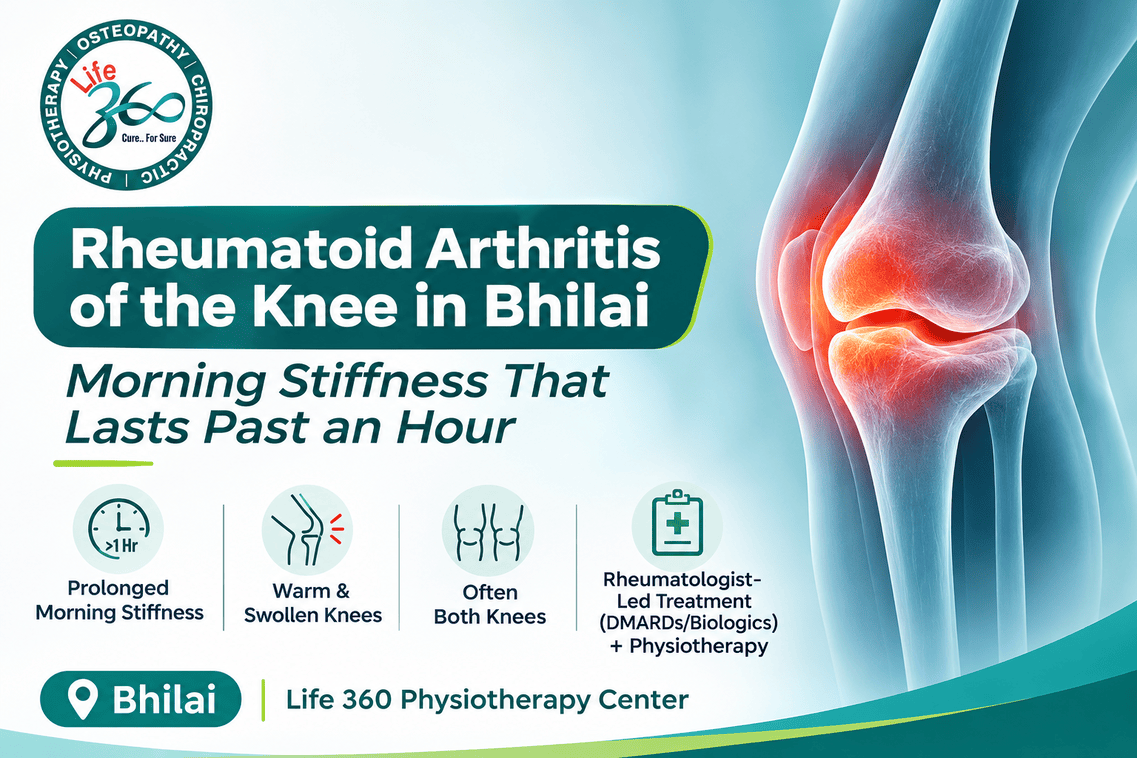
Quick answer: Rheumatoid arthritis of the knee is joint inflammation driven by an overactive immune system, not by wear. Stiffness lasting more than an hour each morning, warm boggy swelling and both knees behaving alike are the giveaways. A rheumatologist leads treatment with DMARDs or biologics. Physiotherapy protects range, strength and walking distance alongside that, never instead of it.
Ten minutes of morning stiffness is a worn joint. Ninety minutes is a different disease.
A 41-year-old primary school teacher from Nehru Nagar sat down and told me her knees were "getting old". She was forty-one. Both had been swelling for seven months, and mornings were costing her the first ninety minutes of the day. She had started asking her son to open the pressure cooker, because her knuckles would not grip until nearly lunch.
Both knees were warm, and both felt doughy rather than bony around the joint line. Her second and third knuckles were puffy on both hands.
She did not need a physiotherapist first. She needed blood tests and a rheumatologist that week. We arranged both, and began exercise in parallel.
No, and the difference changes the whole plan.
Osteoarthritis is mechanical. Cartilage thins over decades, the knee hurts more the more you use it, stiffness after rest clears in ten to twenty minutes, and one knee is usually worse than the other.
Rheumatoid arthritis is immune. The joint lining thickens and pours out inflammatory fluid, which is why the swelling feels soft and warm instead of hard. Stiffness runs past an hour, eases with movement rather than rest, and tends to be symmetrical. It arrives with a fatigue patients find harder to describe than the pain.
One clue people miss: a rheumatoid knee usually feels better after twenty minutes of walking. An osteoarthritic knee feels worse.
A rheumatologist leads it. I say so in the first ten minutes of every one of these consultations.
This is a systemic disease that damages joints permanently if the immune process keeps running. The drugs that slow it are methotrexate, sulfasalazine, hydroxychloroquine, leflunomide, and where those fall short, biologic agents, all prescribed and blood-monitored by a specialist. Nothing done in a physiotherapy room replaces them. Where the joint surfaces are already destroyed and a knee will not straighten, the next referral is to an orthopaedic surgeon rather than to more exercise.
Timing matters too. Starting disease-modifying treatment inside the first three to six months of symptoms gives better joint outcomes than starting a year later. Months on painkillers and hot packs come out of that window.
Physiotherapy's job is narrower and still worth having: keep the knee straight, keep the quadriceps strong, keep you walking, manage flares without losing ground. Most Bhilai patients see a rheumatologist in Durg or Raipur, so build that travel into your first month rather than letting it delay the start.
Because inflammatory fluid collects in a joint that has been still for seven hours, the capsule distends, and the muscles around it switch down. Movement pumps the fluid out, so the knee loosens as the morning goes on.
The duration is the diagnostic part. Under thirty minutes points mechanical. Past sixty minutes, day after day, in someone under fifty, points inflammatory and earns blood tests rather than another knee cap. For patients on rotating shifts at the Bhilai Steel Plant, "morning" means whenever you wake, so I ask about stiffness after your longest sleep.
Which joints are involved, both sides, counted. Knees, ankles, toes, wrists, knuckles. A symmetrical pattern across small and large joints is the most useful observation of the visit.
Swelling quality. Hard and bony, or soft, warm and fluctuant. I use the back of my hand before I reach for a tape.
Knee extension, in degrees. A knee resting 10 degrees short of straight today becomes a fixed contracture in six months.
Quadriceps circumference 15 cm above the kneecap, both legs.
Stiffness duration in minutes, and walking distance before the knees complain.
Behind the knee. Rheumatoid knees grow Baker's cysts, and a ruptured one mimics a clot in the calf.
Grip tested on something real: a bottle cap, a door handle, buttoning a kurta.
The neck. Range, pain, and a direct question about clumsy hands. The reason is further down the page.
Anti-CCP is the more specific of the two antibody tests, so a positive result alongside symmetrical swelling carries weight. Rheumatoid factor also turns up in other conditions and in some healthy older adults, so a positive one alone proves less than patients assume. ESR and CRP measure how much inflammation is running today.
Now the honest part. Between a fifth and a third of people with rheumatoid arthritis are seronegative: both antibody tests negative, disease entirely real. Early X-rays can look normal too, because erosions take time to show, while joint ultrasound finds synovitis well before a plain film does.
A clean report does not close the question.
Yes, though not the exercise you do between flares.
In an active flare I use isometric quadriceps holds, where the muscle works without the joint moving, gentle range of movement to the end of comfort, and a cold pack afterwards. Loaded squats, stairs and long walks come out for a few days. Resting the knee bent over a pillow feels wonderful and is a mistake, because that is how contractures begin.
Between flares the picture reverses. Moderate and even fairly heavy strength training is safe in stable rheumatoid disease and does not speed up joint damage in most patients. Aerobic work improves the fatigue, which is the symptom people rate worst. Advising someone with rheumatoid arthritis to protect their joints by doing little produces weaker and more painful patients. Where the large joints already carry heavy damage, high-impact loading needs individual judgement rather than a standard gym sheet.
Not with a high-velocity thrust, and this is the firmest line on the page.
Long-standing rheumatoid arthritis can erode the ligaments holding the top two neck vertebrae together, producing atlantoaxial instability. Better drug treatment has made this less common than it was thirty years ago without abolishing it, and it is often silent.
High-velocity cervical manipulation in that neck puts the spinal cord at risk. So in established rheumatoid disease I do not thrust-manipulate the cervical spine, including when a patient asks for it. Mobilisation within comfort, soft tissue work and strengthening, yes. New neck pain, dropped objects or an unsteady walk needs imaging before anyone touches the neck.
Weeks 0–3, settle and protect. Isometric quadriceps holds at several angles, 10 seconds each, several times a day. Extension work in prone to defend full straightening. Cold after activity. Walking short and frequent. Footwear reviewed, since sore forefoot joints change knee loading.
Weeks 3–8, restore range and begin loading. Stationary cycling with the seat slightly high. Wall sits, shallow leg press and step-ups from a low step, inside the comfortable range. Hip abductor and extensor work.
Weeks 8–16, build capacity. Progressive resistance for quadriceps, hamstrings and hips, balance work, and aerobic conditioning three times a week. Progress counted in minutes walked and stairs climbed.
Beyond four months. Two strength sessions a week indefinitely, adjusted during flares rather than abandoned. A realistic course at our Smriti Nagar centre is twelve to fourteen sessions over eight to ten weeks.
Do not stop methotrexate because the knees feel good. The drug works on the process, not the symptom, and swelling that returns weeks later settles harder than the swelling you had.
Do not live in a knee immobiliser through a flare. Several websites recommend bracing an inflamed knee; a few days is reasonable, a month leaves you with a stiff weak knee on top of an inflamed one.
Do not sit cross-legged on the floor for long stretches while a knee is actively swollen. I know that is how most Bhilai households eat. A low stool for a few weeks, then back to the floor if the knee allows. And do not expect food to replace medication: turmeric does not control synovitis.
One joint suddenly far hotter and more swollen than the rest, with fever or chills. On immune-suppressing drugs, septic arthritis is an emergency.
Fever, weight loss or night sweats with joint swelling.
Calf pain and swelling with tightness behind the knee, which can be a ruptured cyst or a clot.
New numbness (sunnpan) or weakness in the hands or feet, or a walk that is getting unsteady.
Breathlessness or a persistent dry cough, since the lungs can be involved.
Does rheumatoid arthritis only affect small joints?
No. It commonly starts in the hands and feet, but the knee is among the most frequently involved large joints, and occasionally it swells first. A single warm, boggy knee in a middle-aged adult deserves inflammatory blood tests.
My knee swelling goes down and comes back. Is that normal?
That fluctuating pattern is characteristic, because the disease runs in flares. What matters is whether the baseline between flares improves on treatment. Keep a note of flare dates to show the rheumatologist at review.
Can exercise reverse the damage on my X-ray?
No. Erosions do not fill back in, and anyone promising that is selling something. What exercise does change is strength, fatigue, walking distance and how much the joint objects to being used, which is what people live with daily.
Will I need a knee replacement eventually?
Some patients do, and fewer than a generation ago, because earlier drug treatment changed what these joints look like at sixty. It becomes a reasonable conversation when the surfaces are destroyed, pain persists despite controlled inflammation, or a fixed bend limits walking.
Should I keep riding my two-wheeler to work?
Usually yes, on two conditions: that you can brake confidently, and that the knees are not locking up over the ride. For commutes past thirty minutes in the cold months, warm the knees before leaving.
Come in if morning stiffness runs past an hour, if both knees swell together, if a knee feels warm and soft rather than hard, or if you have a rheumatology diagnosis and no exercise plan. Rheumatoid arthritis knee treatment in Bhilai works best when the drug side and the movement side start together.
Life 360 — Smriti Nagar, Bhilai, Chhattisgarh
Phone: 0771 490 8010 · 70007 84644
Hours: 11:00 am – 6:00 pm · Email: [email protected]
Main centre: HIG-16, Sector 1, Shankar Nagar, Raipur 492007
Bring with you: blood reports including RF, anti-CCP, ESR and CRP, any X-rays, your medicine list, and the footwear you walk in most days.
Dr. Nitu Verma (P.T.) is the founder and clinical director of Life 360 Physiotherapy Center, Shankar Nagar, Raipur, and of Life 360 at Smriti Nagar, Bhilai. She is widely recognised as India's first female chiropractor, and has more than fifteen years in clinical practice with over 50,000 patient consultations behind her.
Her training: Master of Physiotherapy (Sports) · Master Diploma in Chiropractic, Ackerman Institute, Sweden · Diploma in Osteopathy and DO Certification, Canada · Fellowship in Orthopaedic Manual Therapy (FOMT), Australia · Cranio-Sacral Therapy, USA · Pelvic Floor Osteopathy, Madrid School · Certified Pilates Instructor, Ireland.
She received the Nari Shakti Award 2026, and appeared on Doordarshan in a national discussion titled "Breaking the Myth About Chiropractic".
She treats spine and joint conditions non-surgically across Raipur, Bhilai, Durg and the wider Chhattisgarh region.
Clinics: HIG-16, Sector 1, Shankar Nagar, Raipur 492007 · Smriti Nagar, Bhilai
Appointments: 0771 490 8010 · 70007 84644 · [email protected]
Dr. Nitu Verma (P.T.) — Chiropractor and Physiotherapist, Life 360, Raipur and Bhilai.
General information only. Rheumatoid arthritis needs medical management by a rheumatologist.