Life 360 Physiotherapy Center, HIG-16, Sector 1, Shankar Nagar, Raipur, Chhattisgarh 492007
-
For Appointment: 09115719395 , 07000784644 , 07714908010
-

At Life 360 Physiotherapy Center, led by Dr. Nitu Verma, India’s first lady chiropractor, we are dedicated to delivering top-quality chiropractic and physiotherapy care. Recognized as the best chiropractor in India, Dr. Verma specializes in holistic treatments for pain relief, spinal alignment, and sports injury rehabilitation. Our clinic in Raipur provides personalized care designed to address the root causes of discomfort and restore balance to your body, helping you achieve long-term health and wellness. Experience relief and recovery with India’s leading chiropractic expert at Life 360 Physiotherapy Center.
For Appointment: 09115719395 , 07000784644 , 07714908010
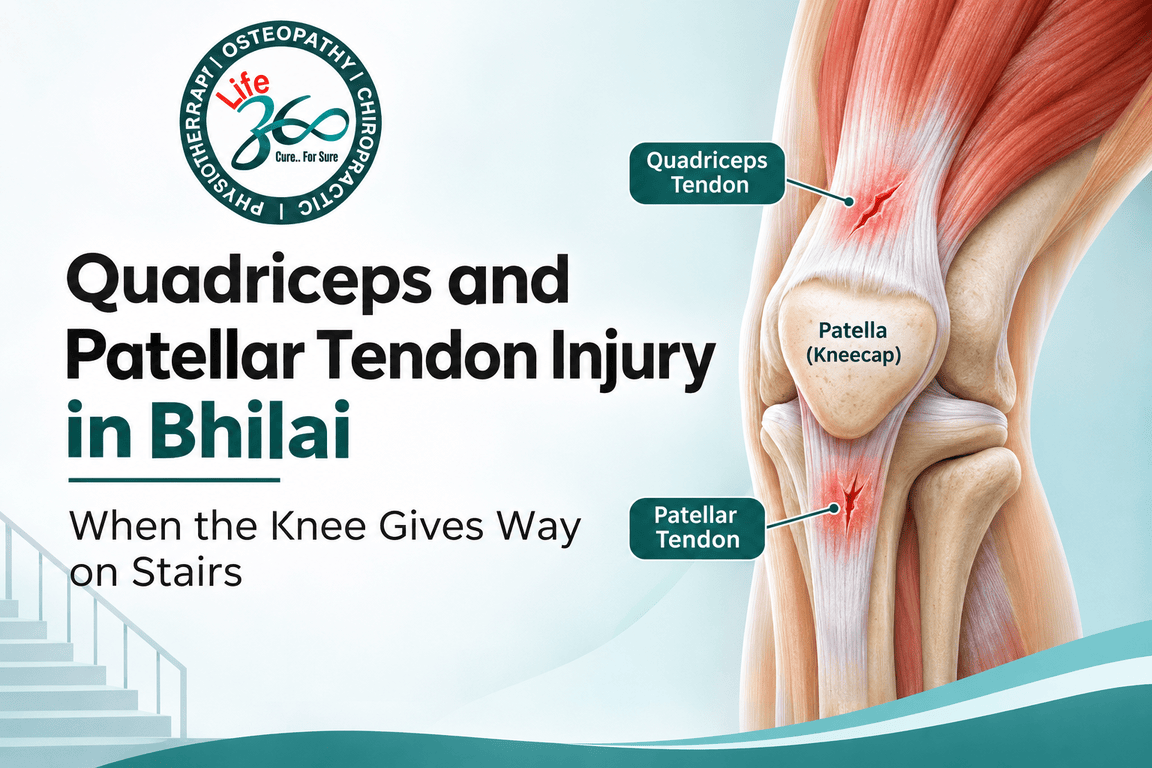
Quick answer: The quadriceps and patellar tendons connect your thigh muscle to the shin through the kneecap. A complete rupture of either stops you straightening the knee or lifting the leg off the bed, and it is a surgical emergency that should be repaired within days, not weeks. Partial tears and tendinopathy are managed with bracing and graded loading over eight to sixteen weeks.
People walk into my clinic on a completely ruptured tendon. That single fact is why this injury gets missed, and why I have written the test into this page before anything else.
A 56-year-old contract supervisor from Jamul reached the Smriti Nagar centre nineteen days after a stumble on a stepped kerb. He felt a tearing sensation above the kneecap, sat for ten minutes, then walked home by swinging the leg from the hip with the knee locked. Two places had treated him for a sprain.
There was a soft dip above his kneecap that took the tip of my finger. He could not hold his heel an inch off the couch.
He saw a surgeon that afternoon. Nineteen days is already late.
Do this now if you have had a sudden knee injury and the knee feels untrustworthy.
Lie flat. Straighten the knee, then lift the whole leg a few inches off the bed and hold it. If you cannot lift it, or it lifts but the knee sags, the extensor mechanism has failed.
Feel above and below the kneecap. Run a finger along the top edge and then the lower edge. A soft gap or dip that your fingertip sinks into is the torn end.
Compare kneecap positions. Sit with both knees bent to 90 degrees and look. A quadriceps tendon rupture lets the kneecap sit low. A patellar tendon rupture lets it ride high.
Any one of those findings, after a sudden injury, means an orthopaedic surgeon today rather than physiotherapy.
The chain runs from the quadriceps muscle, through the quadriceps tendon, into the kneecap, out as the patellar tendon, and onto the tibial tubercle. It fails at the weakest point for your age.
Quadriceps tendon rupture, typically past 40 and often past 50, after a stumble or sudden load on a bent knee. The kneecap drops.
Patella fracture, the middle link failing, usually from a direct blow such as a two-wheeler fall onto the knee.
Patellar tendon rupture, the younger injury, usually under 40, after a forceful jump or landing. The kneecap rides up.
A gradual ache below the kneecap with jumping and squatting, and no loss of strength, is tendinopathy rather than a tear: patellar tendinitis treatment in Bhilai.
Because descending a step is the one everyday movement that asks the quadriceps to control body weight while the knee bends, and a torn or weakened tendon cannot transmit that force.
Flat ground can be managed on a locked knee with hip muscles and momentum, which is how people with complete ruptures keep walking for weeks. The moment the knee bends under load, the chain is tested and the leg buckles. Patients call it the knee "folding" on the second or third step down.
Which is why the stairs, not the pain, should send you for assessment.
A healthy tendon in a healthy person does not snap on a kerb. When it does, there is usually something in the background weakening the collagen.
Diabetes, common locally and the most frequent association I see
Chronic kidney disease, particularly on dialysis, where the patellar tendon is notably vulnerable
Corticosteroids, oral or injected into or near the tendon
Fluoroquinolone antibiotics, which carry a recognised rupture risk
Gout, rheumatoid arthritis and lupus
Long-standing tendinopathy that was painful for a year and then gave way
Obesity and deconditioning, which raise the load per fibre
Two of those together, with a trivial injury and a leg that will not lift, makes rupture likely rather than possible.
Active straight leg raise, and whether you can hold the heel off the couch for ten seconds.
Palpation for a gap above and below the kneecap, with the knee relaxed and then with the quadriceps contracted.
Kneecap height by hand at 90 degrees against the other side, often clearer than a scan.
Active extension from 90 degrees with the thigh supported, noting any extension lag in degrees.
Bruising pattern, which tracks upward into the thigh in quadriceps ruptures.
Thigh girth 15 cm above the kneecap, both legs, which differs measurably by three weeks.
Medical screen: sugar levels, kidney history, recent antibiotics, steroid injections, gout.
How you walk in, watched from the waiting area. The stiff-legged swing of a locked knee is recognisable before any test.
The other knee, because bilateral rupture happens in systemically affected tendons and the second side is often quietly abnormal.
Ultrasound, usually, and it is the fastest and cheapest answer. In experienced hands it shows the gap, its size and whether fibres remain intact, and it can be done while the quadriceps contracts.
A plain X-ray still earns its place: it shows a kneecap sitting too low or too high, rules out a patella fracture, and may show an avulsed flake of bone. MRI is for unclear cases, late presentations and finely balanced partial tears.
The scan does not change the urgency. If you cannot lift the leg, the referral happens first and imaging follows.
An acute complete rupture repaired within the first week or two generally does better than one repaired after a month, and the reason is mechanical.
Once the tendon ends retract, the muscle shortens and scar fills the gap, so the surgeon must pull tissue that no longer reaches. Late repairs may need lengthening, grafting or augmentation, with stiffness and extension lag more common. Nineteen days put my Jamul patient into that group.
This is the one knee injury where I stop a consultation, make a phone call, and send someone out of my room unfinished.
Protocols vary between surgeons, and the surgeon's instructions always override what follows. The usual shape is this:
Weeks 0–2. Brace locked in full extension. Weight-bearing as instructed, often allowed while locked. Whatever quadriceps isometrics the surgeon permits, ankle pumps, hip work with the knee supported. Wound and swelling care.
Weeks 2–6. Flexion opened in stages, commonly 30 degrees at two weeks, 60 at four, 90 at six. Passive and active-assisted range only, with no active extension against resistance.
Weeks 6–12. Brace progressively discarded. Active extension begins, closed-chain strength in a protected range, cycling once 100 degrees is available, and gait retraining to undo the locked-knee habit that has become automatic.
Months 3–6. Progressive loading: leg press, step-ups, split squats, hamstring and calf work. Stair descent trained deliberately and counted in flights, because it returns last.
Months 6–12. Heavy work, ladders, squatting, sport if relevant. Most people regain functional strength between six and twelve months, and a small extension lag or a slightly smaller thigh is a common long-term finding. General post-operative principles: knee arthroscopy rehabilitation in Bhilai.
Do not let anyone force passive bending to "break the stiffness" in the first six weeks. A repaired tendon under forced flexion can gap or fail, and range gained by force early costs more than range gained slowly. Our Raipur page, quadriceps tendon injury treatment, covers the surgical decision.
You cannot lift the straight leg off the bed, or the knee sags when you try
A palpable gap or dip above or below the kneecap
A kneecap that has clearly shifted up or down compared with the other side
Inability to bear weight at all, or a knee that buckles on every step
A grossly deformed knee after high-energy trauma, which may be a dislocation and needs the checks described in knee and kneecap dislocation treatment in Bhilai
Fever with a hot, red, swollen knee, or a discharging surgical wound
Why could I still walk if the tendon was completely torn?
Because flat-ground walking can be done with a locked knee, swinging the leg from the hip. The quadriceps controls a bending knee, not a straight one. Being able to walk is why this injury is repeatedly labelled a sprain, and it is not reassurance.
Can a partial tear be treated without surgery?
Often yes, when extension strength is preserved and you can hold the straight leg against gravity. A brace with staged range, then graded loading over eight to sixteen weeks. Partial tears are watched closely, because a half-torn tendon can complete the tear with one awkward step.
Does diabetes change the recovery?
It does. Tendon healing is slower with poor sugar control, wound problems and infection are more frequent, and stiffness is more common. I ask for recent sugar readings and HbA1c at the first visit, and set slower timelines where control has been poor.
Do I have to wear the brace at night?
For the first two to four weeks, usually yes, locked in extension, because the knee bends in sleep without permission. After that most surgeons allow it off. What matters more than the brace is avoiding the sudden unguarded bend getting out of bed.
When can I drive or ride a two-wheeler again?
A car with automatic transmission and a left-sided repair is sometimes possible by six weeks. A right leg repair, or any two-wheeler, waits until the brace is off, flexion reaches 100 degrees, and you can control the knee in a sudden stop. Usually three to four months.
Can the repair tear again?
Yes, though it is uncommon. Risk is highest in the first three months, in diabetic and dialysis patients, and in people returning to squatting or ladder work early. That is the honest reason the programme runs to six months rather than six weeks.
Come in if your knee gives way going down stairs, if you cannot hold the straight leg off the bed, if you feel a dip above or below the kneecap, or if you are recovering from a tendon repair and want rehabilitation staged properly rather than left to a printed sheet.
If you cannot lift the leg at all, call us and we will tell you where to go today rather than booking a session.
Life 360 — Smriti Nagar, Bhilai, Chhattisgarh
Phone: 0771 490 8010 · 70007 84644
Hours: 11:00 am – 6:00 pm
Email: [email protected]
Main centre: HIG-16, Sector 1, Shankar Nagar, Raipur 492007
Bring with you: the operation note and the surgeon's range instructions, ultrasound or MRI reports, your brace, recent sugar and kidney reports, and shorts.
Dr. Nitu Verma (P.T.) is the founder and clinical director of Life 360 Physiotherapy Center, Shankar Nagar, Raipur, and of Life 360 at Smriti Nagar, Bhilai. She is widely recognised as India's first female chiropractor, and has more than fifteen years in clinical practice with over 50,000 patient consultations behind her.
Her training: Master of Physiotherapy (Sports) · Master Diploma in Chiropractic, Ackerman Institute, Sweden · Diploma in Osteopathy and DO Certification, Canada · Fellowship in Orthopaedic Manual Therapy (FOMT), Australia · Cranio-Sacral Therapy, USA · Pelvic Floor Osteopathy, Madrid School · Certified Pilates Instructor, Ireland.
She received the Nari Shakti Award 2026, and appeared on Doordarshan in a national discussion titled "Breaking the Myth About Chiropractic".
She treats spine and joint conditions non-surgically across Raipur, Bhilai, Durg and the wider Chhattisgarh region.
Clinics: HIG-16, Sector 1, Shankar Nagar, Raipur 492007 · Smriti Nagar, Bhilai
Appointments: 0771 490 8010 · 70007 84644 · [email protected]
Dr. Nitu Verma (P.T.) — Chiropractor and Physiotherapist, Life 360, Raipur and Bhilai.
General information only. A complete tendon rupture is a surgical problem and this page is not a substitute for urgent assessment.