Life 360 Physiotherapy Center, HIG-16, Sector 1, Shankar Nagar, Raipur, Chhattisgarh 492007
-
For Appointment: 09115719395 , 07000784644 , 07714908010
-

At Life 360 Physiotherapy Center, led by Dr. Nitu Verma, India’s first lady chiropractor, we are dedicated to delivering top-quality chiropractic and physiotherapy care. Recognized as the best chiropractor in India, Dr. Verma specializes in holistic treatments for pain relief, spinal alignment, and sports injury rehabilitation. Our clinic in Raipur provides personalized care designed to address the root causes of discomfort and restore balance to your body, helping you achieve long-term health and wellness. Experience relief and recovery with India’s leading chiropractic expert at Life 360 Physiotherapy Center.
For Appointment: 09115719395 , 07000784644 , 07714908010
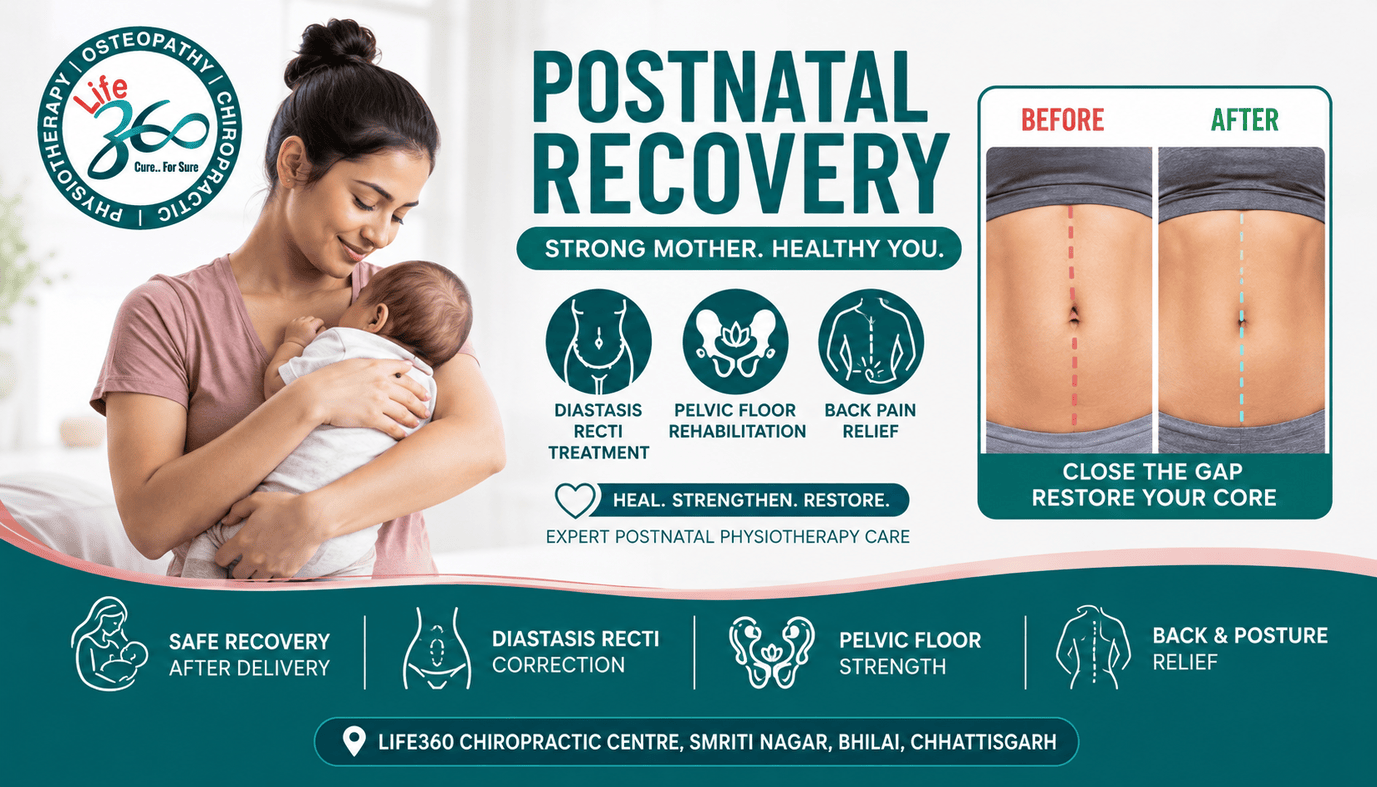
Quick Answer: After delivery, a mother's body carries three unfinished projects: a stretched abdominal wall (often with diastasis recti — the persistent "mummy tummy" gap), a loaded pelvic floor, and a posture reshaped by nine months plus baby care. Postnatal physiotherapy systematically closes the abdominal separation, restores the pelvic floor, resolves back pain, and returns you safely to exercise — and it works even years after delivery. In Bhilai, Chhattisgarh, Life360 Chiropractic Centre, Smriti Nagar provides complete postpartum rehabilitation. Call 08819801000.
In Bhilai households, the six weeks after delivery revolve — rightly — around the baby. But visit any gathering of mothers in Smriti Nagar or Nehru Nagar and listen: a tummy that never went back despite dieting, a back that aches from every lift, sneezes that leak, a core that feels absent. These are not cosmetic complaints or inevitable motherhood taxes. They are rehabilitation cases that were never rehabilitated — and they remain fixable, whether your delivery was six weeks or six years ago.
Direct Answer: Your six-pack muscles run as two vertical bands joined by a connective seam. Pregnancy stretches this seam sideways — normal and necessary. Diastasis recti is when the separation persists after delivery: a gap wider than about two fingers, a doming bulge when you sit up, and a core that cannot generate tension. It affects roughly one in three mothers at one year if untreated — and it is why the tummy bulge resists every diet: the wall is mechanically open, and fat loss cannot close a mechanical gap.
Direct Answer: Lie on your back, knees bent. Place fingers across your midline just above the navel. Lift your head slightly. Feel between the two muscle ridges: how many fingers fit, and do they sink deep? Repeat above and below the navel. A gap of 2.5+ fingers, deep sinking, or visible doming = get professionally assessed.
Direct Answer: Crunches and sit-ups spike abdominal pressure against a weakened seam — pushing it outward (that doming) and widening the gap. Correct rehabilitation runs the opposite direction: first reawaken the deep corset muscle (transversus abdominis) with breath-led activation, restore the pressure system, then progressively reload. Sequence decides success — and it is where every YouTube "flat tummy" routine goes wrong for diastasis mothers.
Diastasis measurement (width and depth at three points), pelvic floor screening, posture, breathing pattern, back and pelvis check, and C-section scar evaluation.
The evidence-based 8–12 week sequence: breathing-led deep core activation → tension-building → functional loading — closing and, more importantly, tensioning the separation.
Assessment-guided training for leakage, heaviness, or weakness — synchronized with core work, because the two systems recover as one.
Treatment of the back pain, neck strain, and thumb/wrist pain (De Quervain's — "mommy thumb") that baby care produces, plus feeding and carrying technique correction.
Once healed — releasing scar adhesions that cause pulling, numbness, and core inhibition.
From core restoration to walking, strength training, and running — with readiness testing so fitness returns without leakage, doming, or injury.
Direct Answer: Gentle breathing and pelvic floor activation can begin within days of an uncomplicated delivery; the structured program ideally starts at 6 weeks after your medical check (same timeline post-C-section, with scar-stage care). And no — it is never too late: diastasis and core dysfunction respond to correct loading even 5–10 years after delivery. Older separations simply take somewhat longer.
Direct Answer: With a structured program: most functional change in 8–12 weeks — the gap narrows, the wall regains tension, the back pain eases, and the profile flattens. Severe separations: 4–6 months. The goal is a working, tensioned wall; a small residual gap with full function is a win.
Address: Opp: Dream Homes, 42A, Cross Street 1, Smriti Nagar, Bhilai, Chhattisgarh 490020
Phone: 08819801000
Website: https://life360.co.in
Q1. Where can I get diastasis recti treatment in Bhilai?
Life360 Chiropractic Centre, Smriti Nagar, Bhilai — measured, staged core restoration programs for mothers at any distance from delivery.
Q2. My delivery was years ago. Can my tummy gap still close?
Yes — connective tissue regains tension under progressive loading at any stage. Years-old separations respond; they simply need a somewhat longer program.
Q3. Why hasn't dieting flattened my tummy?
Because the bulge is structural — an open abdominal wall — not fat. Close and tension the wall first; then body composition work shows results.
Q4. Which exercises must I avoid with diastasis?
Crunches, sit-ups, double-leg raises, and early front planks — anything that domes the midline. We substitute staged safe alternatives that actually close the gap.
Q5. When can I exercise after normal delivery?
Walking and gentle activation within days; structured core rehab from 6 weeks; impact and running only after core and pelvic floor readiness testing — typically 3–6 months.
Q6. And after C-section?
Same milestones with scar respect: gentle work early, structured rehab from 6–8 weeks with medical clearance, scar mobilization once healed.
Q7. Does a post-delivery abdominal belt fix the gap?
It gives early comfort, but no belt retrains muscle. Use it briefly for support; the closure comes from the exercise program.
Q8. Is my back pain related to the weak core?
Directly — an inactive core sends every baby-lift to the spine. Core restoration, not repeated massage, is the fix.
Q9. I leak urine when I sneeze since delivery. Treatable?
Very — postpartum stress leakage responds excellently to pelvic floor rehabilitation, integrated into every postnatal program we run.
Q10. What is "mommy thumb" and do you treat it?
De Quervain's tenosynovitis — thumb-side wrist pain from baby lifting. Yes: splinting, lifting-technique change, and graded loading resolve it.
Q11. How many sessions does postnatal rehab take?
Typically 8–12 sessions over 2–3 months with a progressive home program. Combined problems (diastasis + pelvic floor + back pain) are treated within one plan.
Q12. Does diastasis ever need surgery?
Only severe cases with hernia or failed thorough rehabilitation. The great majority achieve strong, flat, functional walls through exercise-based treatment.
Q13. Where is Life360 Chiropractic Centre located?
Opp: Dream Homes, 42A, Cross Street 1, Smriti Nagar, Bhilai, Chhattisgarh 490020. Phone: 08819801000.
Dec 05, 2024

:-early-warning-signs-you-should-never-ignore-icon-044150.png)
-icon-054426.png)
-icon-080621.png)
-icon-081941.png)
-icon-092359.png)
-icon-093248.png)
-icon-093852.png)
-icon-094609.png)
-icon-095238.png)
-icon-103429.png)
-icon-103224.png)
-icon-104305.png)
-icon-074623.png)
-icon-075551.png)
-icon-080620.png)
-icon-081325.png)
-icon-082141.png)
-icon-083016.png)
-icon-085607.png)
-icon-090354.png)
-icon-091256.png)
-icon-092441.png)
-icon-093257.png)
-icon-094048.png)
-icon-094827.png)
-icon-095622.png)
-icon-092325.jpg)
-icon-100332.png)
-icon-101125.png)
-icon-101922.png)