Life 360 Physiotherapy Center, HIG-16, Sector 1, Shankar Nagar, Raipur, Chhattisgarh 492007
-
For Appointment: 09115719395 , 07000784644 , 07714908010
-

At Life 360 Physiotherapy Center, led by Dr. Nitu Verma, India’s first lady chiropractor, we are dedicated to delivering top-quality chiropractic and physiotherapy care. Recognized as the best chiropractor in India, Dr. Verma specializes in holistic treatments for pain relief, spinal alignment, and sports injury rehabilitation. Our clinic in Raipur provides personalized care designed to address the root causes of discomfort and restore balance to your body, helping you achieve long-term health and wellness. Experience relief and recovery with India’s leading chiropractic expert at Life 360 Physiotherapy Center.
For Appointment: 09115719395 , 07000784644 , 07714908010
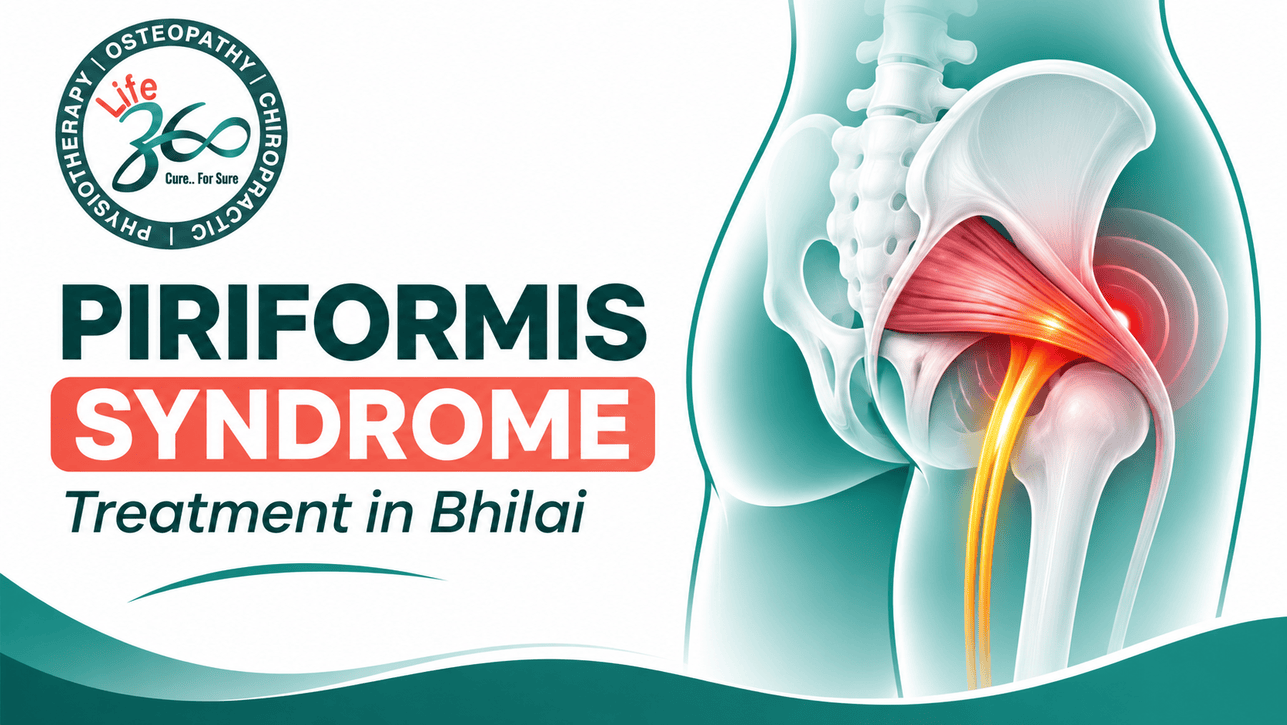
Quick answer: Piriformis syndrome is sciatic-type pain caused by irritation of the sciatic nerve in the deep buttock, not by a disc pressing a nerve root in the spine. Sitting is the main provoker and standing relieves it quickly. Most cases settle over six to twelve weeks with nerve glides, hip strengthening and changes to how you sit.
"It starts after Kumhari, every single trip."
A 42-year-old bus driver who lives in Kumhari and runs the Durg route told me that in his first two minutes. Right buttock, deep, beginning around the forty-minute mark, travelling down the back of the thigh and stopping just above the knee. Never into the calf. A minute standing at the stop and it faded.
He had been treated for a slipped disc for seven months on the strength of one MRI showing a mild L4-L5 bulge. Reflexes crisp. Strength normal. Straight leg raise 80 degrees on both sides.
I pressed deep into the middle of his right buttock and he came off the couch.
His phone had been living in his right back pocket for nine years.
In the deep gluteal space, a pocket behind the hip joint that the sciatic nerve has to pass through.
Four structures there can irritate the nerve: the piriformis muscle, which runs from the front of the sacrum to the top of the thigh bone and sits directly over it; the obturator internus and gemelli below; fibrous bands formed by repeated microtrauma; and narrowing of the gap between ischium and femur, called ischiofemoral impingement.
Anatomy adds a twist. In most people the sciatic nerve runs under the piriformis. In a minority, post-mortem studies suggest ten to twenty per cent, part of the nerve splits and passes through the muscle belly.
So the familiar name describes a problem that often involves more than the piriformis. Treating the whole space works better than treating one muscle.
Because the right leg does the work and the right buttock takes the pressure.
Driving holds the hip in sustained flexion, which pulls the piriformis across the nerve, and the accelerator foot adds hours of low-grade hip internal rotation. Body weight presses the buttock into a seat base that is usually flat, worn and transmitting engine vibration into the tissue.
Whole-body vibration is an established contributor to low back and sciatic complaints in professional drivers. It is not just the sitting.
Add a wallet or phone in the back pocket and there is compression from underneath too. I have lost count of the drivers whose first improvement came from emptying one pocket.
These two are mixed up constantly, and the treatment is close to opposite.
Piriformis and deep gluteal pain sits in the middle of the buttock, is reproduced by deep pressure there, builds with sitting duration and eases within a minute of standing. Reflexes and strength are normal.
Hamstring origin tendinopathy sits lower and to the side, right on the sitting bone. It hurts in the first minutes on a hard seat and flares with uphill walking, sprinting and lunging rather than with sitting time. It needs progressive loading, not nerve calming.
Lumbar radiculopathy follows a nerve root map below the knee, often dulls a reflex, can weaken one specific movement, and changes with repeated bending or arching.
They coexist more often than textbooks suggest, because a sensitised nerve root makes the whole nerve irritable along its length. When both are present, the spine is treated first.
Where the pain stops, drawn on a body chart by the patient rather than described.
Deep palpation from the sacrum to the greater trochanter, side-lying with the hip slightly flexed, looking for reproduction of the exact symptom.
FAIR test: hip flexed, adducted and internally rotated, held 30 to 60 seconds.
Pace sign, resisted hip abduction and external rotation in sitting.
Beatty test, side-lying, holding the bent top leg a few centimetres off the couch.
Ischial tuberosity palpation and resisted hamstring testing, to clear the commonest mimic.
Full neurological screen plus straight leg raise and slump, where what is absent matters as much as what is present.
Hip and sacroiliac clearing tests, since both refer into the buttock.
Sitting tolerance in minutes, re-measured at every review.
Your seat, photographed on your phone.
Yes, and I say that as someone who treats it weekly.
There is no confirmatory test. Lumbar MRI is normal or shows incidental findings. Estimates of how much sciatica originates in the deep gluteal space run from under one per cent to around six per cent depending on the definition used, which tells you how unsettled the question is. MR neurography can sometimes image the nerve, and it is not routinely available in Chhattisgarh.
So the diagnosis rests on pattern and exclusion. The practical consequence is a deadline: if four weeks of sensible treatment aimed at that space changes nothing, the label is probably wrong, and we return to the spine, the hip or the hamstring origin.
Four adjustments, and they take ten minutes in the depot.
Raise the seat base so your hips sit slightly above your knees, which reduces hip flexion and takes tension off the piriformis. Reduce the recline so the backrest is close to upright, with lumbar support filling the hollow. Set the distance so the knee stays slightly bent at full pedal travel. Put firm foam over a worn seat base rather than something soft.
Then the non-negotiable part: break the sitting. Ninety minutes is my limit for this condition, and two minutes standing at the stop resets the tissue.
For plant shift workers, the long ride home after twelve hours is often the real culprit rather than the shift.
Weeks 0–2, calm the nerve rather than stretch it. Soft tissue work to the piriformis and deep rotators in side-lying. Gentle sciatic nerve glides, kept to mild symptoms only. Seat and pocket changes made the same day. Heat over the buttock before exercise.
Weeks 2–6, build the hip. Gluteus maximus and medius strengthening is the heart of it: bridges, side-lying abduction, band walks, then step-ups and split squats. External rotator strength in the shortened range, and progressive loading of the piriformis itself, which is the opposite of resting it.
Weeks 6–12, restore the task. Driving time rebuilt in roughly twenty per cent weekly increases, with the stopping rule held. Running, kabaddi or gym work staged the same way.
Beyond twelve weeks. Twice-weekly hip strength, indefinitely. Relapses almost always belong to people who stopped the glute work the week the pain went.
A usual course at our Smriti Nagar centre is eight to fourteen sessions over six to ten weeks. Longer in people driving more than six hours daily, in anybody who cannot change the seat, and where a lumbar nerve root is involved too.
One, sometimes. Four, no.
A single image-guided injection into the deep gluteal space can be genuinely useful when pain is severe enough to block all exercise. Ultrasound or CT guidance matters, because blind injections at that depth land unpredictably.
Botulinum toxin into the piriformis has been studied in small trials with mixed results. I am not against it in a stubborn, well-selected case. I would not want it offered before a proper loading programme has been tried, and I say so even when a patient arrives asking for it.
Do not drive with the seat reclined well back. It feels kinder on the lower back while increasing hip flexion and sciatic tension and pushing more weight into the buttock. Drivers do this constantly, and it is the change I reverse most often.
Do not force the figure-four or pigeon stretch in the first fortnight. A nerve under tension does not want more tension. Gentle stretching has a place from week three, held 20 to 30 seconds, never into shooting pain.
Do not let anybody dig an elbow into the mid-buttock for ten minutes. That compresses a major nerve against bone, and I have seen numbness (sunnpan) appear that was not there before.
Do not take a full-day route the day you improve.
Loss of bladder or bowel control, or difficulty starting urination
Numbness around the saddle area: inner thighs, buttocks, genitals
Weakness in both legs, or weakness worsening day by day
Fever with buttock or back pain, or pain with unexplained weight loss
Night pain that wakes you and ignores position
A hot, swollen, exquisitely tender buttock, suggesting abscess
Can shift work itself cause buttock pain?
Indirectly, often. Rotating shifts fragment sleep, which lowers pain tolerance, and they come with a long ride at the end of a long standing day. Fatigue plus prolonged hip flexion on a vibrating seat is the combination I see, rather than the roster itself.
Why does my pain switch off within a minute of standing?
Because standing straightens the hip, releases the piriformis across the nerve and removes the direct pressure of body weight on the buttock. That rapid on-off pattern with position is far more typical of a deep gluteal problem than of a compressed nerve root in the spine, which usually settles more slowly.
Is there a cushion that actually helps for driving?
A firm wedge that tilts the front of the seat down slightly, so the hips sit above the knees, helps most drivers. Soft gel cushions make things worse by letting the buttock sink. Nothing in the back pocket, ever, whatever cushion you use.
Does a sciatic nerve passing through the muscle need surgery?
Rarely. That anatomical variation is found in a minority of people, most of whom never have symptoms, and it is not an indication for surgery by itself. Surgical release of the deep gluteal space is reserved for carefully selected cases after months of failed non-surgical treatment.
How long until I can run a full-day route again?
Most drivers get back to a full route between weeks eight and twelve, provided sitting tolerance has roughly doubled and single-leg strength is even. Shorter routes come back earlier. The stopping rule stays permanently, because it is cheaper than a relapse.
Come in if buttock pain starts after a predictable number of minutes of sitting, if standing relieves it within a minute, if you have been treated for a disc without improvement, or if pressing deep in your buttock reproduces the pain. Piriformis syndrome treatment in Bhilai starts with an examination and a look at your seat.
Life 360 — Smriti Nagar, Bhilai, Chhattisgarh
Phone: 0771 490 8010 · 70007 84644
Hours: 11:00 am – 6:00 pm · Email: [email protected]
Main centre: HIG-16, Sector 1, Shankar Nagar, Raipur 492007
Bring with you: any lumbar MRI or X-ray reports, how many minutes you can sit, a photograph of your driving seat, and loose track trousers.
Dr. Nitu Verma (P.T.) is the founder and clinical director of Life 360 Physiotherapy Center, Shankar Nagar, Raipur, and of Life 360 at Smriti Nagar, Bhilai. She is widely recognised as India's first female chiropractor, and has more than fifteen years in clinical practice with over 50,000 patient consultations behind her.
Her training: Master of Physiotherapy (Sports) · Master Diploma in Chiropractic, Ackerman Institute, Sweden · Diploma in Osteopathy and DO Certification, Canada · Fellowship in Orthopaedic Manual Therapy (FOMT), Australia · Cranio-Sacral Therapy, USA · Pelvic Floor Osteopathy, Madrid School · Certified Pilates Instructor, Ireland.
She received the Nari Shakti Award 2026, and appeared on Doordarshan in a national discussion titled "Breaking the Myth About Chiropractic".
She treats spine and joint conditions non-surgically across Raipur, Bhilai, Durg and the wider Chhattisgarh region.
Clinics: HIG-16, Sector 1, Shankar Nagar, Raipur 492007 · Smriti Nagar, Bhilai
Appointments: 0771 490 8010 · 70007 84644 · [email protected]
Dr. Nitu Verma (P.T.) — Chiropractor and Physiotherapist, Life 360, Raipur and Bhilai.
General information only, and no substitute for an in-person assessment.