Life 360 Physiotherapy Center, HIG-16, Sector 1, Shankar Nagar, Raipur, Chhattisgarh 492007
-
For Appointment: 09115719395 , 07000784644 , 07714908010
-

At Life 360 Physiotherapy Center, led by Dr. Nitu Verma, India’s first lady chiropractor, we are dedicated to delivering top-quality chiropractic and physiotherapy care. Recognized as the best chiropractor in India, Dr. Verma specializes in holistic treatments for pain relief, spinal alignment, and sports injury rehabilitation. Our clinic in Raipur provides personalized care designed to address the root causes of discomfort and restore balance to your body, helping you achieve long-term health and wellness. Experience relief and recovery with India’s leading chiropractic expert at Life 360 Physiotherapy Center.
For Appointment: 09115719395 , 07000784644 , 07714908010
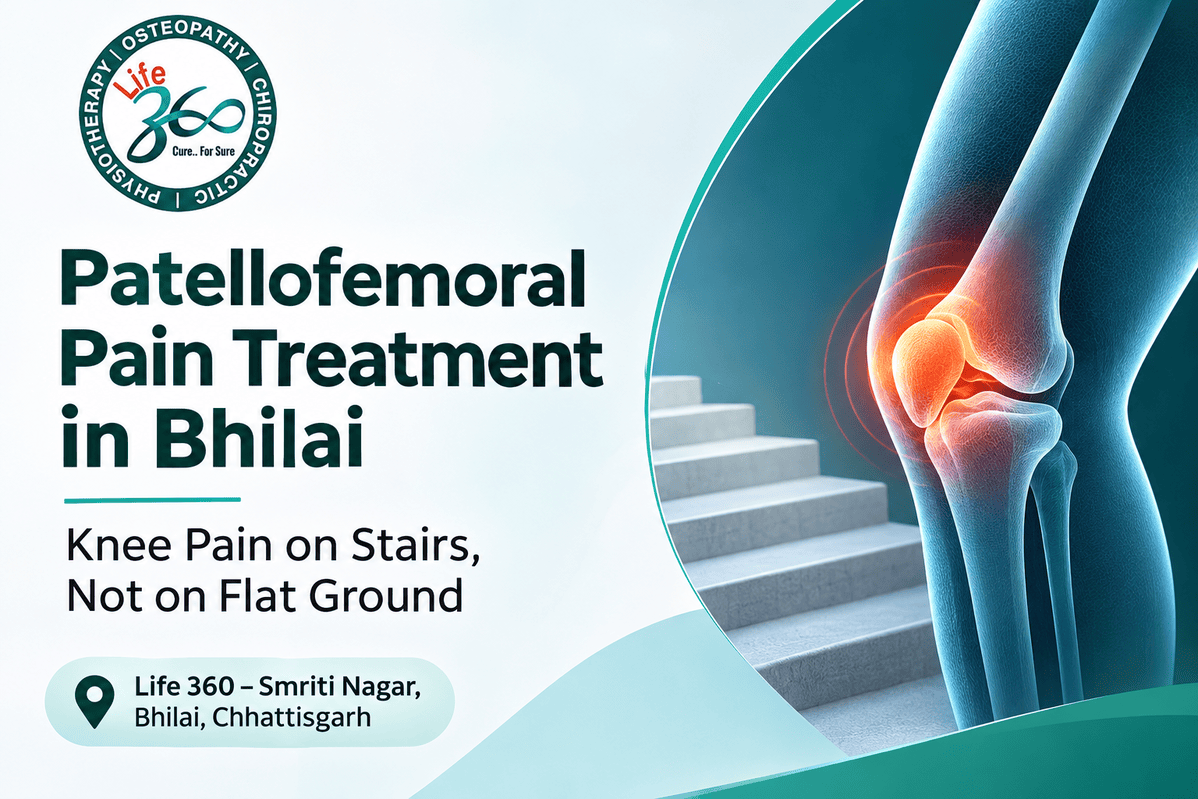
Quick answer: Patellofemoral pain is pain around the kneecap that appears on stairs, slopes, squatting and after long sitting, while flat walking stays comfortable. Nothing is torn. Patellofemoral pain treatment in Bhilai is progressive hip and thigh loading over eight to twelve weeks, with the dose measured in flights of stairs rather than pain scores.
"I can walk to Supela market and back. I cannot get to my own first floor."
A 33-year-old school teacher from Nehru Nagar said that in her first two minutes, and it is the cleanest description of this condition I have heard. Flat ground, forty minutes, no trouble. Fourteen steps to her classroom, pain under the right kneecap by the ninth. Coming down was worse than going up. Forty minutes of sitting during the exam period and the knee ached until she straightened it.
She had already had a normal X-ray and a month of hot packs and ultrasound at a clinic near the market.
Her right thigh was a centimetre and a half thinner than her left. Nobody had measured it.
Because the force squeezing your kneecap against the thigh bone climbs steeply as the knee bends, and flat walking barely bends the knee at all.
Level ground sends roughly half your body weight through the joint behind the kneecap. A staircase sends three to four times body weight. A full squat to the floor can reach seven or eight times. Nothing has changed about your knee between the corridor and the staircase except the angle it works at.
That is why a knee that hurts on flat ground usually has something else going on.
The load through that joint has gone past what the tissue can currently tolerate. Either the demand rose, or the capacity fell, or both.
The structures generating the pain are the bone under the cartilage, the joint lining and the soft tissue around the edges of the kneecap, all richly supplied with nerves. The cartilage on the back of the kneecap has no nerve endings at all, which is why a report mentioning mild cartilage change explains very little.
What I cannot explain honestly is why two people with the same strength, mechanics and job end up with one painful knee between them. Pain sensitivity, sleep and workload are all in the mix, and the research on which matters most is inconsistent. I do not pretend to know your reason. I do know what changes the outcome.
Worth answering carefully, because the two directions point different ways.
Worse coming down is the classic patellofemoral pattern. Descent asks the thigh muscle to lengthen under load while the knee bends, which produces higher joint force and keeps it there longer. It is also the first thing to improve when treatment is working.
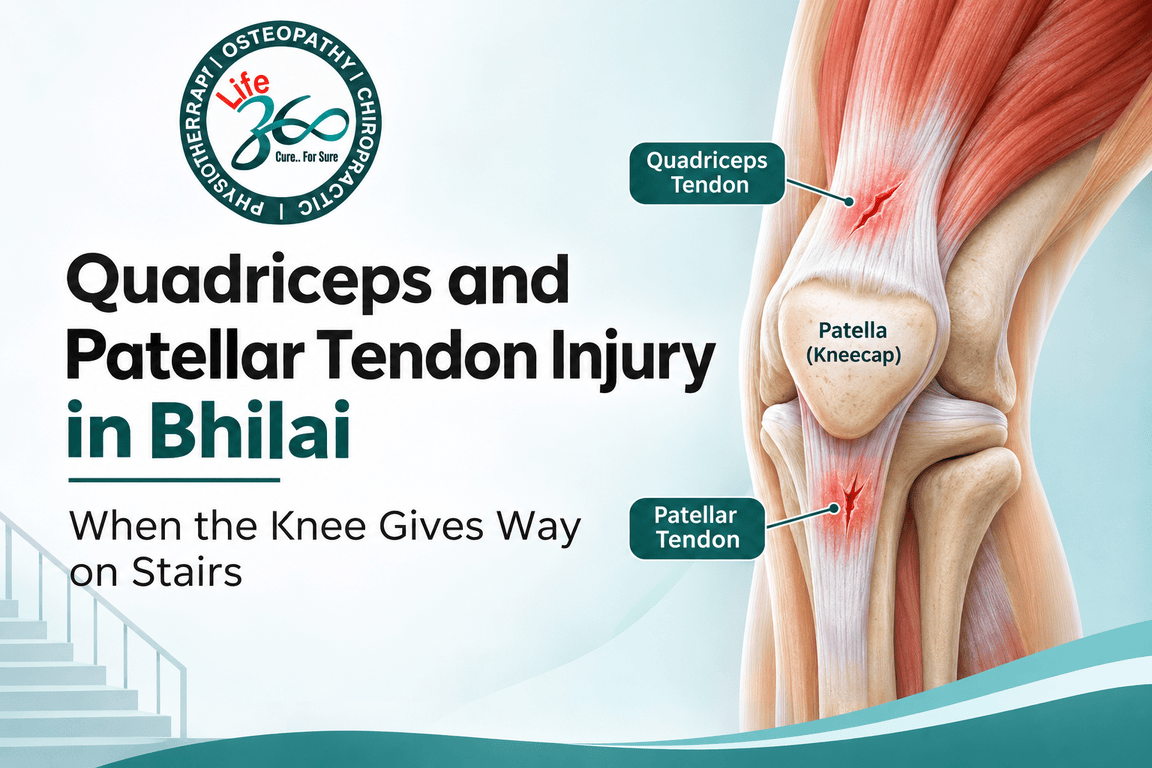
Worse going up, with the pain low on the tendon, points at the patellar tendon rather than the joint.
Worse going up with a sense of buckling makes me check the quadriceps mechanism and, in older patients, the inner compartment.
Equally bad both ways, with swelling the next day, raises a meniscal or cartilage problem.
So the staircase is a test, not just a symptom.
One-finger localisation. Around the kneecap and at its borders fits this diagnosis. Two centimetres below, on the tendon, does not.
Flights and minutes. Steps before pain starts, how long you can sit, how long you can squat at floor level. These are the numbers we work from, not a score out of ten.
Single-leg squat to 60 degrees, watching whether the knee drifts inward and the pelvis drops.
Step-down from a 20 cm step, both legs, scored for pain and control.
Quadriceps strength at 60 and 90 degrees, both sides, measured rather than guessed.
Hip abductor and external rotator strength. The side-lying tests are crude; against a dynamometer the difference between legs is usually obvious.
Thigh circumference 15 cm above the kneecap, both legs, and knee-to-wall ankle range in centimetres.
Your actual stairs. Step height at home and at work, whether there is a handrail, and how many times a shift you use them.
More than almost anyone expects, and it is the measurement most often skipped.
Try the knee-to-wall test: foot flat, knee driven forward to touch the wall, toes moved back until the knee just misses. Under about 9 or 10 centimetres of clearance means the ankle cannot bend enough, so on a step down the shin cannot travel forward. The knee then collapses inward to find the range, and the kneecap is loaded on one edge.
The hip matters too. The thigh bone moves under the kneecap rather than the other way round, so weak abductors and external rotators let the femur rotate inward and drop toward the midline, swinging the groove sideways under a kneecap that stays where the quadriceps holds it.
Trials comparing knee-only with hip-plus-knee exercise consistently favour the combined programme. An honest addition: I find a stiff ankle in about a third of these knees, and treating the hip while ignoring the ankle leaves that third stuck.
The demand side of this problem looks different in Bhilai than in a textbook. Floor sitting means repeated deep flexion several times a day. Plant work means platform staircases with high steps, steel ladders and hours on concrete. None of that has to stop, but all of it has to be counted, because adding three gym sessions a week to an uncounted sixty flights of stairs a day is adding straw to a camel.
Weeks 0–2, settle it without stopping. Isometric quadriceps holds at 30 to 45 degrees, five sets of 45 seconds, twice a day; these often take the edge off within the session. Stair use reduced to an agreed number rather than avoided. Floor sitting broken into ten-minute blocks, with a low stool for anything longer.
Weeks 2–6, build the base. Leg press and wall sits through the comfortable arc, step-ups, banded hip abduction, side planks, calf raises, and daily ankle mobility if the knee-to-wall test was short. Two to three sessions a week, with load added each week rather than more repetitions.
Weeks 6–10, go into the range that hurts. Step-downs from a rising step height, split squats, deeper squats, single-leg work. Discomfort up to 3 out of 10 during exercise is accepted, provided the knee has settled by next morning.
Weeks 10–16, meet the real demand. Loaded step descent, ladder work if the job needs it, floor-to-stand transfers under load, running or badminton. Twice-weekly strength work then continues indefinitely.
That is eight to ten supervised sessions across twelve weeks, with daily home work between. Shift workers coming off a night take the 11 am slot, the easiest hour to get.
Retiring from stairs. Here is my disagreement with most of the advice these patients bring in. Being told to use the lift, avoid floor sitting and stop squatting lowers the joint's tolerance month by month. The knee then hurts at a load that never used to trouble it, and the flare that follows gets blamed on the activity rather than the deconditioning before it. Stairs are trained, not retired from.
The low-saddle, high-resistance cycle. Cycling is routinely recommended as knee-friendly, and it can be, but a low saddle keeps the knee deeply bent through the whole stroke and heavy resistance adds force at exactly that angle. Raise the saddle until the knee is almost straight at the bottom and keep the resistance light for a month.
Wearing a knee cap all day. Comfortable, and useless for capacity. I use a sleeve for a few weeks when pain blocks the start of exercise, then take it off.
Stopping at week six because the pain has gone. Pain improves before strength does. That gap is where recurrences live.
The knee locks and will not straighten, or gives way without warning
The joint is hot, red and swollen with fever
Night pain that wakes you and does not change with position
Pain after a fall or kneecap dislocation, where a fracture or loose fragment needs excluding
Unexplained weight loss with knee pain
A growing child with knee pain, where the hip must be examined and imaged first, because hip conditions refer pain to the knee
Why can I walk for an hour but not climb two floors?
Because flat walking keeps the knee nearly straight and the force through the kneecap low, while each step up bends it past 60 degrees under three to four times body weight. Your walking capacity is good. It is the high-angle, high-load end of the range that has lost tolerance.
Can I still sit on the floor to eat and work?
Yes, with limits for the first few weeks. Deep flexion compresses the kneecap hardest, so the aim is shorter spells rather than none: ten minutes, then up and move. Use a low stool for long floor-level work. Banning floor sitting in an Indian household is advice nobody follows, so we do not give it.
Is this the beginning of arthritis?
Not necessarily, and most people with patellofemoral pain in their twenties and thirties do not go on to develop patellofemoral arthritis. What raises the risk is a kneecap that runs off-centre, long-standing weakness and carrying extra weight. Two of those three we can change.
How much pain am I allowed during the exercises?
Up to about 3 out of 10 during the exercise, settling back to baseline by the next morning. Chasing a pain-free programme means never loading the joint enough to change it. Pain still raised the following day means the session was too big, so we drop the load rather than abandon the exercise.
I work twelve-hour rotating shifts. When do I fit this in?
Around the shift rather than against it. The isometric holds need six minutes and can be done in a canteen chair. Loading sessions go on rest days, two or three a week, and a night-shift week is a maintenance week rather than a progress week. A plan built for someone with free evenings is a plan you will quit.
Come in if the front of your knee hurts on stairs but not on flat ground, if forty minutes of sitting makes you straighten the leg, if squatting to floor level has become a two-hand job, or if a normal scan left you with no plan.
Life 360 — Smriti Nagar, Bhilai, Chhattisgarh
Phone: 0771 490 8010 · 70007 84644
Hours: 11:00 am – 6:00 pm
Email: [email protected]
Main centre: HIG-16, Sector 1, Shankar Nagar, Raipur 492007
Bring with you: the shoes you stand in at work, any scan reports, your shift roster, and shorts.
Dr. Nitu Verma (P.T.) is the founder and clinical director of Life 360 Physiotherapy Center, Shankar Nagar, Raipur, and of Life 360 at Smriti Nagar, Bhilai. She is widely recognised as India's first female chiropractor, and has more than fifteen years in clinical practice with over 50,000 patient consultations behind her.
Her training: Master of Physiotherapy (Sports) · Master Diploma in Chiropractic, Ackerman Institute, Sweden · Diploma in Osteopathy and DO Certification, Canada · Fellowship in Orthopaedic Manual Therapy (FOMT), Australia · Cranio-Sacral Therapy, USA · Pelvic Floor Osteopathy, Madrid School · Certified Pilates Instructor, Ireland.
She received the Nari Shakti Award 2026, and appeared on Doordarshan in a national discussion titled "Breaking the Myth About Chiropractic".
She treats spine and joint conditions non-surgically across Raipur, Bhilai, Durg and the wider Chhattisgarh region.
Clinics: HIG-16, Sector 1, Shankar Nagar, Raipur 492007 · Smriti Nagar, Bhilai
Appointments: 0771 490 8010 · 70007 84644 · [email protected]
Dr. Nitu Verma (P.T.) — Chiropractor and Physiotherapist, Life 360, Raipur and Bhilai.
General information only. It is not a substitute for an in-person assessment.