Oct 03, 2026

Author : Dr. Nitu Verma (P.T)

A mother sits down and tells me the neighbour's child walked at eleven months. Her cousin's baby sat at six. Hers is nine months old, shows no interest in crawling, and one aunt has told her not to worry while another has told her to worry immediately.

Then she asks me which of them is right.
Development genuinely varies, and most of that variation is fine. But some patterns should be acted on, and parents almost never get told where the line sits. So they either panic about nothing or wait through something that mattered. Most families who come to me for paediatric physiotherapy in Raipur arrive with exactly that question and no clear answer from anybody.
I'll draw the line here as clearly as it can honestly be drawn.

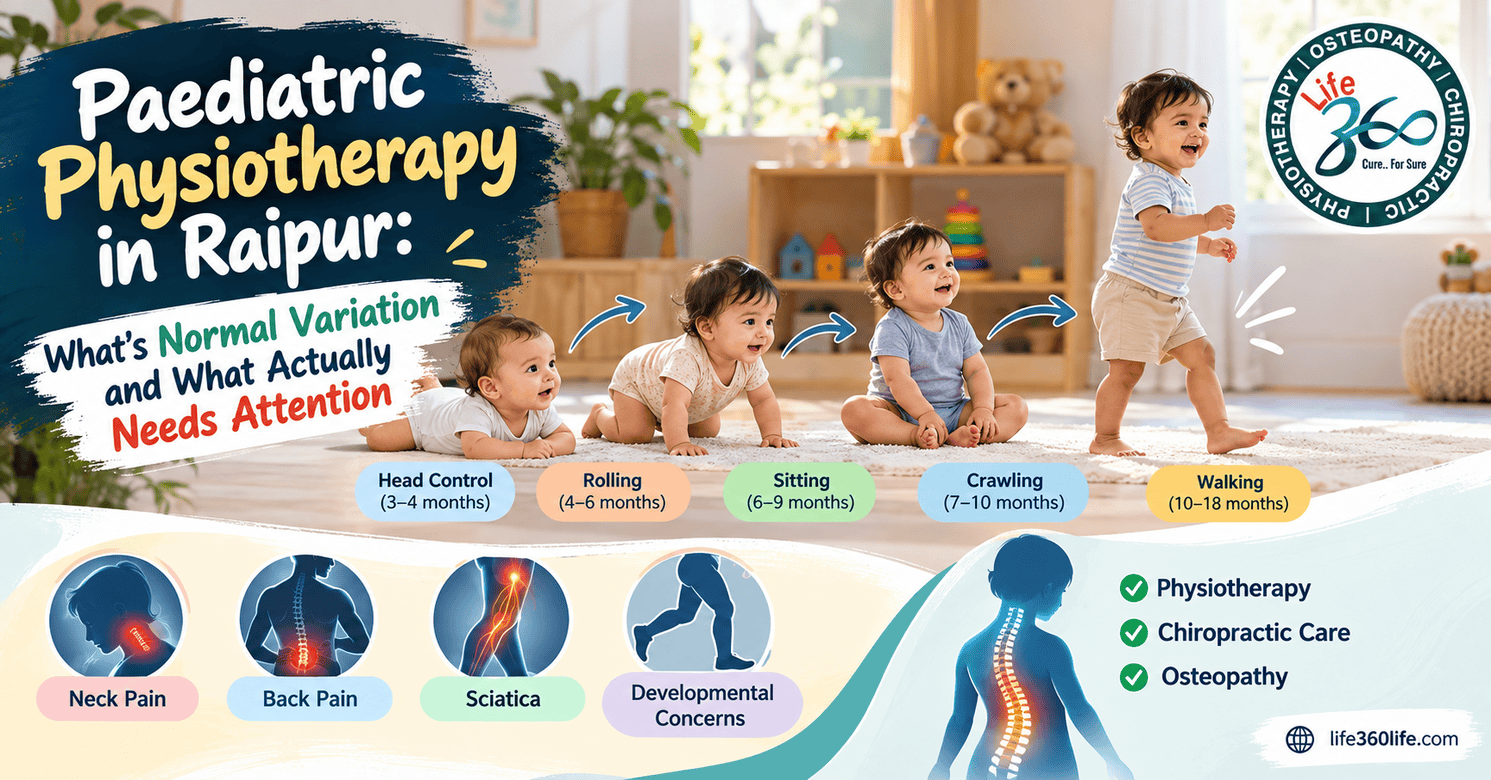
When should a child reach each milestone?

Ranges tell you something. Averages tell you almost nothing, and the average age is what everybody quotes at you.
Head control, steady by around 3 to 4 months.
Rolling, typically 4 to 6 months, usually front to back first.
Sitting without support, commonly 6 to 8 months, sitting independently by around 9 months.
Crawling, usually 7 to 10 months. Some children never crawl at all. They go from sitting to pulling up to walking, and that's normal variation. On its own it isn't a concern.
Pulling to stand, around 8 to 11 months.
Walking on their own, and the range here is wide, commonly 10 to 18 months. A child walking at 16 months is inside normal limits, whatever your neighbour says.
Running and stairs, around 18 to 24 months.
What matters more than any single milestone is the direction of travel. Is the child still picking up new skills, and is the movement even on both sides?

When should my child be assessed?

Get an assessment for any of the signs below rather than waiting them out. Two of them, asymmetry and losing a skill, should never be watched and waited on.
  • Poor head control beyond 4 months
  • Not rolling in either direction by 6 months
  • Not sitting without support by 9 months
  • Not taking weight through the legs when supported by 9 to 10 months
  • Not walking by 18 months
  • Clear asymmetry at any age, so always using one hand, one side moving less, or the head turning consistently to one side
  • Persistent stiffness or floppiness in the limbs
  • Losing a skill the child already had, which always needs prompt medical assessment
  • Toe walking still there past age 2 to 3
  • Hands staying fisted beyond 3 to 4 months
  • Marked difficulty with balance and coordination next to children the same age
Asymmetry and regression are the two findings nobody should be watching and waiting on. Everything else has room in it.
A quick aside that will save you an appointment or make one much more useful. Take videos on your phone. Thirty seconds of your child sitting, reaching, crawling, walking across the room. Children behave differently in a clinic, usually by refusing to do the thing you came about, and a video of an ordinary afternoon at home tells me more than an hour of coaxing.

What does paediatric physiotherapy in Raipur treat?

Most child physiotherapy in Raipur involves a short list of conditions: torticollis, flat feet, toe walking, W-sitting, in-toeing, delayed motor development, coordination difficulties and growth-related pain. Here they are in turn.

Congenital torticollis

The baby's head tilts one way and rotates the other, because the sternocleidomastoid muscle on one side is short. Parents often call it a twisted neck or a stiff neck. Usually noticed in the first weeks.
It matters for two reasons beyond the neck. The head stays in one position, so one side of the skull flattens, which is called positional plagiocephaly. And the baby starts using one side by preference, which then shows up in rolling and in everything that follows.
It responds very well to early treatment. Torticollis treatment in Raipur means stretching, positioning, and changing the environment, so approaching the baby from the side they don't favour and putting the interesting things, the door, the toys, the people, on that side. Treatment started in the first few months is far more effective than treatment started at a year.
Which brings me to the thing parents don't want to hear. A short muscle treated at four months takes weeks. The same muscle at two years takes months, sometimes much longer, and the result is often less complete. Waiting is not free.

Are flat feet in children a problem?

Usually not. Nearly all babies have flat feet, and the arch builds gradually through childhood, often not fully formed until six to eight, sometimes later than that.
Flexible flat feet that don't hurt need no treatment at all. If an arch appears when the child goes up on tiptoes, or when they're sitting, the foot is flexible and you can stop worrying.
Get it assessed if the foot is rigid and no arch appears in any position, if there's pain, if the child tires oddly fast or avoids walking, if the flattening is on one side only, or if there's in-turning or out-turning that's affecting how they walk.
Arch supports get sold to families in Raipur who don't need them, constantly, usually by somebody in a shoe shop with a foot-scanning mat. It irritates me more than most things in this job. A painless flexible flat foot in a small child is a stage of development, and the money would be better spent on shoes that fit.

Is toe walking normal?

In new walkers, yes, and most children grow out of it. Toe walking still present past roughly two to three, or a child who can't put the heels flat when asked, needs looking at.
Two reasons for that. Walking on the toes for a long time shortens the calf muscles and the Achilles tendon, and the longer it goes on the harder it is to reverse. And persistent toe walking is occasionally a sign of an underlying neurological or developmental condition, so it should be examined properly rather than written off as a habit. I've seen it assumed to be habit. It isn't always.
Toe walking treatment covers calf stretching, strengthening the muscles that lift the foot, sensory work, gait training, and where it's needed, orthoses or serial casting.

Is W-sitting harmful?

Rarely on its own. Knees forward, feet splayed out behind, legs making a W.
Children sit like that because it gives them a wide stable base that needs almost no trunk control. It's very common, and people get more alarmed about it than they need to. Usually it's telling you the trunk and hips could be stronger and the child has found a clever way around that.
So encourage other positions. Cross-legged, side sitting, legs out long. Build the trunk and hip strength through play. Repeatedly correcting the position without building the strength just makes everybody miserable and changes nothing.
Worth an assessment if W-sitting is the only position the child will use, if there's marked in-toeing when walking, or if the child seems generally weak or clumsy.

In-toeing and out-toeing

Feet turning in or out during walking. Parents usually describe it as pigeon toes. Most of it comes from normal rotational variation in the growing legs and sorts itself out through childhood.
Get it checked for marked asymmetry, frequent tripping, pain, or a pattern that's getting worse rather than better with age.

Delayed motor development

Milestones consistently late with no diagnosed condition behind it. Delayed milestones in Raipur are one of the commonest reasons a paediatrician sends a child to me. We work on strength, postural control, variety of movement, and the specific skills the child hasn't got yet. Part of the job is also working out whether a medical referral is needed, and saying so.

Coordination difficulties in older children

The clumsy child. Can't catch, can't throw, struggles with cycling and handwriting, and quietly stops joining in games. Targeted motor learning helps a lot here, and honestly the change in confidence often matters more to the family than the change in skill.

Growth-related pain in sporty children

Heel pain in active children between eight and fourteen, and pain at the front of the shin just below the kneecap in adolescents, are both growth-plate related and both common in young athletes. They settle with load management, stretching and strengthening.
Any child with night pain, pain at rest, a swollen joint, fever or unexplained weight loss needs a doctor rather than a physiotherapist. That one has no grey area in it.

What does a paediatric assessment involve?

It is mostly watching your child play, plus a detailed history and specific motor testing for their age. Nothing about it is uncomfortable and parents stay in the room throughout.
A long history first. Pregnancy, delivery, birth weight, any time in neonatal care, and the order in which skills appeared.
Then a lot of watching them play. Most of a paediatric assessment happens during play, because a child asked to perform on command will simply refuse, and quite right too.
Milestone and motor skill testing for the age. Muscle tone and strength. Joint range and flexibility. Gait analysis if they're walking. Posture and spine, including a forward bend check where the age suits it. Foot and lower limb alignment.
Parents stay in the room the whole time. The home programme gets built into play and into the day you already have, because a programme that doesn't fit the family's routine doesn't get done, and then everyone feels guilty about it at the next visit.

Why early is better

The developing nervous system adapts, and it adapts best in the early years. Movement patterns learned early become the base that everything later sits on.
There's a practical side too. A child who avoids physical play because they find it hard slips a little further behind every year, and the gap grows through confidence as much as through ability.
Early assessment also ends in reassurance a lot of the time, and that counts for something. A good proportion of the children I see in Raipur are developing perfectly normally, and telling an anxious parent exactly that, with the reasons, is a real outcome and not a wasted appointment.
I'll admit the boundaries aren't always crisp. There are children I've assessed where I genuinely couldn't tell at that visit whether I was looking at a slow developer or the start of something, and the honest answer was to see them again in eight weeks. I'd rather say that than invent certainty.

Why families come to us

Life 360 Physiotherapy Center in Shankar Nagar, Raipur, is run by Dr. Nitu Verma (PT), a physiotherapist who went on to train in chiropractic and osteopathy. Paediatric sessions here are play-based and not rushed, and parents leave understanding what they're looking at and what to do about it.
Where the findings point towards something needing paediatric or neurological input, I say so plainly and refer.
Families bring children to Shankar Nagar from across Raipur, Durg and Bhilai, and there's a second centre at Smriti Nagar in Bhilai.

Book a paediatric assessment

If your child is late with a milestone, uses one side more than the other, walks on their toes, or seems clumsier than others their age, an assessment will tell you whether this is normal variation or something to work on. Parents searching for paediatric physiotherapy near them in Raipur usually want one clear answer, and that is the answer the assessment is designed to give.
Life 360 Physiotherapy Center
HIG-16, Sector 1, Shankar Nagar, Raipur, Chhattisgarh 492007
Also at Life360 Chiropractic Centre, Smriti Nagar, Bhilai
Bring your child's immunisation and growth records if you have them.

Questions parents ask

My baby isn't crawling at 10 months. Should I worry?
Not necessarily. Some children skip crawling completely and go from sitting to pulling up to walking. What matters is that new skills keep arriving and movement is even on both sides.
When should a child walk independently?
Commonly between 10 and 18 months. Not walking by 18 months needs assessment.
Are flat feet in children a problem?
Flexible, painless flat feet are a normal stage and usually need nothing. Rigid flat feet, pain, flattening on one side only, or a child tiring early should be assessed.
Is toe walking normal?
Common in early walkers and usually outgrown. Past two to three years, or if the heels can't be put down, get it assessed.
Is W-sitting harmful?
It's common and usually reflects trunk and hip stability that could be better. Vary the sitting positions and build the strength, rather than only correcting the posture.
What is torticollis and can it be treated?
One neck muscle tightens and the infant's head stays tilted. It responds very well to early stretching, positioning and handling advice, and treating it early also prevents the skull flattening.
How do I know if my child needs physiotherapy or just more time?
Asymmetry, losing a skill they already had, and clearly missed milestone ranges are the ones to act on. A single milestone at the later end of a normal range usually isn't.
Do children cooperate during physiotherapy sessions?
Sessions are play-based, so cooperation gets built through the activity instead of demanded. Much of the assessment is just watching, and parents are involved throughout.
What exercises help delayed milestones at home?
The ones that suit the skill your child is missing, built into play rather than done as a set. Tummy time, reaching across the midline, supported sitting and pull-to-stand practice all get prescribed, and which of them you use depends on what the assessment finds.
What does paediatric physiotherapy cost in Raipur?
It depends on how many sessions the child needs, and many children need only an assessment and a home programme with a review. Ask at the first visit how many visits are expected before you commit to a block.
 
Go to Top