Sep 21, 2026

Author : Dr. Nitu Verma (P.T)

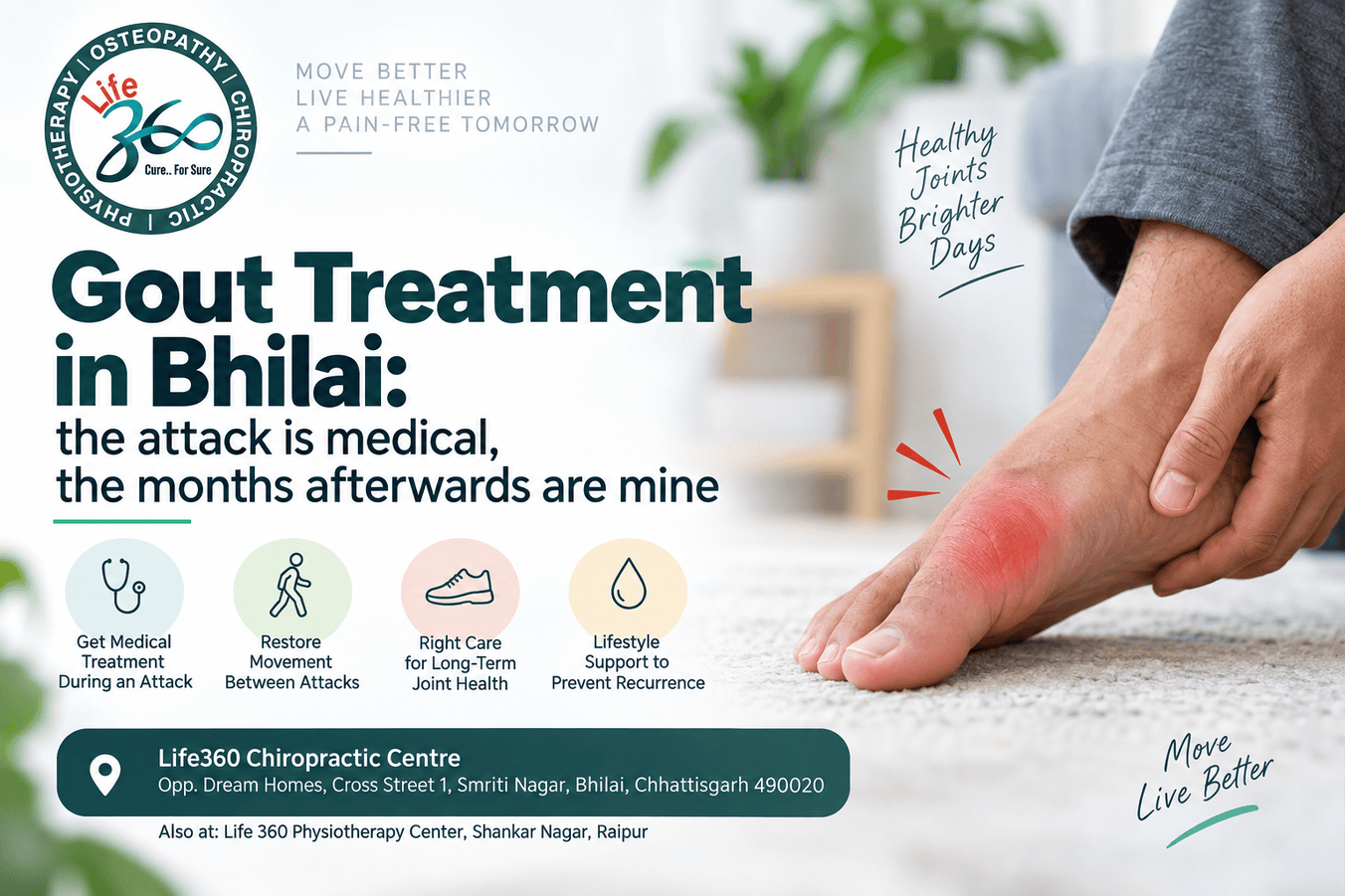
A man goes to bed perfectly well and wakes at three in the morning unable to bear the weight of a bedsheet on his big toe. Red, hot, swollen out of shape, and so tender that the fan moving air across it is a problem. Patients describe it as the worst pain of their lives, and I believe them.

If that's happening to you right now, close this page and see a doctor.
During an acute attack, the treatment is medical. Physiotherapy has nothing useful to offer an inflamed gouty joint. If somebody offers to mobilise or massage it, refuse. It will make things worse, not better.
I used to leave gout there. Medical condition, someone else's department, nothing for me to do. I was wrong about the second half of that.
Because gout isn't only the attack. In between, there's joint damage to limit, function to rebuild, a walking pattern that's gone wrong, weight and activity to work on, and further attacks to prevent. Patients are almost never told any of that, which is why gout treatment in Bhilai so often stops the day the swelling goes down.
At Life360 Chiropractic Centre in Smriti Nagar, Bhilai, gout gets treated as a long-term condition rather than a run of emergencies.

What is gout?

Gout is a form of inflammatory arthritis caused by monosodium urate crystals depositing in and around joints. The pain people describe as uric acid joint pain is the immune system reacting to those crystals.
Uric acid is an ordinary waste product. Your body makes it when it breaks down purines, which come from certain foods and from normal cell turnover. Usually it dissolves in the blood and the kidneys get rid of it.
When the level in the blood stays high, it can crystallise instead. Those crystals are needle-shaped and they settle into joints. When your immune system comes across them it reacts, hard.
That reaction is the attack.
Two things patients should know, because both cause confusion. High uric acid doesn't always produce gout, and plenty of people walk around with raised levels and never have a single attack. And uric acid can read normal during an acute attack, so a normal result on the day proves nothing.

Why does gout go for the big toe first?

Because urate crystallises more readily at lower temperatures and the feet are the coolest part of the body. That joint also carries a very high load with every step. Gout big toe pain in Bhilai is the first attack in most of the patients I see.
Any previous wear in the joint also gives the crystals surfaces to settle on.
Other sites that get hit: the midfoot, the ankle, the knee, the wrist, the fingers, and the bursa at the elbow.

What does a gout attack look like?

Sudden, usually overnight, one joint, red and hot and swollen, with pain severe enough that a bedsheet is unbearable. It builds to full intensity within hours.
  • Fast onset, often overnight, at full intensity within hours
  • Severe pain, usually described as the worst the person has known
  • The joint red, hot and visibly swollen
  • Extreme tenderness, to the point that light touch is unbearable
  • Usually one joint on its own, especially in early attacks
  • Skin over the joint may go shiny, then peel as things settle
  • Attacks tend to resolve over days to a couple of weeks even with no treatment at all
That last point causes more long-term damage than any of the others. The attack goes away by itself, so people conclude the problem went away by itself, and nobody comes back for the management that would stop the next one.

Before anything else, read this

A single hot, swollen, painful joint can also mean septic arthritis, a joint infection, which is a medical emergency.
Septic arthritis and gout can look identical. An infection can destroy a joint within days and it can kill.
Get urgent medical assessment for a hot swollen joint, especially if you also have a fever, feel generally unwell, or if this is your first episode. Don't assume it's gout, even if you've had gout before. Telling the two apart may need the fluid drawn from the joint and analysed, which is a medical procedure.
I want to be plain about my own limits here. I cannot tell gout from a joint infection by looking at it. Neither can your doctor with certainty. That's why the test exists, and why "it looks like my usual gout" is not a safe reason to stay home.

What should I do during a gout attack?

See a doctor, rest the joint completely, ice it, elevate it, keep bedding off it, and drink water. No massage, no mobilisation, no physiotherapy on the joint at all.
  • See a doctor. Prescription anti-inflammatory treatment shortens attacks by a lot, and the earlier it starts the better it works.
  • Rest the joint. Real rest, not reduced activity.
  • Ice it. Cold packs genuinely help in gout, which isn't true of every condition. Wrap the pack in a cloth, twenty minutes at a time.
  • Elevate the limb.
  • Keep bedding off the joint. A frame, or pillows arranged to hold the sheet up.
  • Drink plenty of water.
  • Do not massage or mobilise the joint. It increases the inflammation and the pain.
  • Do not start or stop uric acid lowering medication during an attack without medical advice, because shifting uric acid levels mid-attack can drag it out.
  • No physiotherapy on the acutely inflamed joint. None.
That list is the whole of gout attack management from my side of the room.

Can physiotherapy help gout between attacks?

Yes, and this is where it belongs. Gout physiotherapy rebuilds the joint's movement and strength, corrects the walking pattern the attack left behind, and builds an exercise habit that survives the next flare.
This is the phase that decides how the next twenty years go, and it's the phase where patients get almost no guidance at all.

Getting the joint working again

After an attack the joint is stiff and the muscles around it have wasted from being unused. Range of movement work and progressive strengthening bring the function back and get rid of the limp that otherwise settles in permanently.

The walking pattern

Weeks of walking around a painful toe changes how you walk. That new pattern loads the other foot, both knees and the lower back. And it becomes a habit, long after the toe stopped hurting.
I see people years after their attacks with knee pain and back pain that traces straight back to a foot they were protecting in 2019. Nobody ever checked their gait.

Feet and shoes

Where repeated attacks have damaged the big toe joint, it stops moving properly and walking suffers. A shoe with a stiff sole and a roomy toe box takes load off that joint. Orthotic support helps in some cases.
Stiff sole. I mean that. Most patients go and buy the softest, bounciest shoe they can find, and for this particular joint that's the wrong instinct.

Weight

Higher body weight is a recognised risk factor for gout, and losing weight is associated with lower uric acid. What physiotherapy adds is a route to exercise for someone whose joints make exercise hard, which describes nearly everybody with gout.
One caution. Very rapid weight loss and fasting can set off an attack, so this needs to be gradual.

Building an exercise habit that survives a flare

Regular exercise supports weight management and metabolic health, and both matter in gout.
The programme has to be built with attacks in mind. Everyone gets a written plan for what to do when a flare comes, because otherwise one bad week ends the whole habit and I don't see the person again for two years.

The rest of the picture

Gout keeps company with high blood pressure, diabetes, kidney disease and cardiovascular disease. Exercise helps with all of them, and a gout diagnosis should prompt your doctor to look at the wider metabolic picture rather than just the toe.

Damage that's already there

Where repeated attacks have left a damaged joint, we manage it the way we manage osteoarthritis. Strengthening, sensible load management, function.

Diet, honestly

These are dietary and medical matters more than physiotherapy ones, and I'm covering them because every patient asks.
Weight is the modifiable factor with the most behind it, with the caution about rapid loss noted above.
Alcohol, and beer especially, has a strong association with attacks.
Sugar-sweetened drinks and fructose raise uric acid.
Purine-rich foods contribute, meaning red meat, organ meats and certain seafood.
Dehydration is a common trigger. In a Bhilai summer that matters more than most people realise, and it's the factor I bring up most and get taken least seriously. Drink more water than you think you need between April and July. The same goes for anyone working outdoors in Durg or on the plant side.
Some medications, including certain diuretics, raise uric acid. Take that to your doctor. Don't adjust anything yourself.
Here's the digression, and it's the question I field in almost every gout consultation. Dal and tomatoes. Whole families have removed both, permanently, on advice from a neighbour. The items that actually earn attention are the ones listed above. I'd rather someone kept their dal and dealt with the beer.
And for most people with recurring attacks, diet on its own isn't enough. Medication to lower uric acid is the main tool for prevention. Diet supports it. Diet does not replace it. Patients don't like hearing that, because taking a tablet daily for years feels like a defeat and changing what you eat feels like taking charge. I understand the feeling. It still doesn't work.

What happens if you just live with it

Attacks that get endured rather than managed have consequences.
  • They become more frequent over time without preventive treatment
  • More joints get involved
  • Chronic joint damage develops, leaving permanent stiffness, deformity and disability
  • Tophi form, which are visible lumps of urate crystals under the skin, around joints, on the fingers and on the ears
  • Kidney stones and kidney damage can occur
  • Gout carries a strong association with cardiovascular disease, so it's a reason to get your overall cardiovascular and metabolic risk assessed
Preventive medication exists and it works well when it's taken every day and monitored properly.
The most common reason people do badly is that they stop taking it once the attacks settle down. Which is exactly the moment it's doing its job. That one wears me out. I've had the conversation so many times and I still haven't found the sentence that lands.
If you've had two attacks, go and ask your doctor about preventive treatment. Don't wait for a third to make the case for you.

Why patients in Bhilai come here

Dr. Nitu Verma (PT) runs Life360 Chiropractic Centre in Smriti Nagar. Her training started in physiotherapy and went on into chiropractic and osteopathy. Gout is managed here between attacks, restoring function, correcting the walking pattern the attacks left behind, and building an exercise route that works for joints that have made exercise miserable.
Gout physiotherapy at Life360 Chiropractic Centre, Smriti Nagar, Bhilai starts after the flare has settled, never during it.
Acute attacks and uric acid management are medical matters. I say that clearly and I refer.

Book an assessment

If gout has left you with a stiff joint, a changed walking pattern, or years of avoiding exercise, an assessment will work out what's changed and how to rebuild it.
Dr. Nitu Verma (PT) sees patients with gout and other uric acid joint pain at Life360 Chiropractic Centre, Smriti Nagar, Bhilai.
Life360 Chiropractic Centre
Opp. Dream Homes, Cross Street 1, Smriti Nagar, Bhilai, Chhattisgarh 490020
Also at Life 360 Physiotherapy Center, Shankar Nagar, Raipur
Please bring recent uric acid results and a list of your medications.

Questions patients ask

Can physiotherapy help during a gout attack?
No. During an acute attack the joint needs rest, ice, elevation and medical treatment. Massage or mobilisation increases the inflammation and the pain. Physiotherapy earns its place between attacks.
Why does gout usually go for the big toe first?
Urate crystallises more readily at lower temperatures and the feet are the coolest part of the body. That joint also carries a very high load every time you walk.
How do I know it's gout and not an infection?
You can't tell from how it looks, and neither can I. Septic arthritis can look identical and it's an emergency. A hot swollen joint, especially with fever or as a first episode, needs urgent medical assessment.
Can diet alone control gout?
For most people with recurring attacks, no. Diet helps and it isn't usually enough on its own. Uric acid lowering medication is the main preventive tool.
Why do attacks keep coming even though I changed my diet?
Because dietary change usually produces only a small drop in uric acid. Attacks that keep coming are a reason to discuss preventive medication with your doctor.
Is dehydration really a trigger?
It's a recognised contributor and it matters here more than in cooler places. Drinking enough water is simple and worth doing.
Should I exercise if I have gout?
Yes, between attacks. Regular exercise supports weight management and metabolic health, both of which matter in gout. Make sure your programme includes a plan for what to do when a flare hits.
Can gout damage joints permanently?
Yes. Repeated untreated attacks cause chronic joint damage, deformity and disability, and can lead to visible urate deposits and kidney problems. That's the whole argument for long-term preventive management.
Where can I get gout treatment near me in Bhilai?
Life360 Chiropractic Centre, Opp. Dream Homes, Cross Street 1, Smriti Nagar, Bhilai 490020, for the between-attack work. Patients come from across Bhilai and from Durg. Acute attacks go to a doctor first.
Which exercises are safe once the attack has settled?
Gentle range of movement for the affected joint, calf and foot strengthening, and cycling or seated work before you go back to walking distances. We start once the joint is cool and no longer tender.
 
Go to Top