Life 360 Physiotherapy Center, HIG-16, Sector 1, Shankar Nagar, Raipur, Chhattisgarh 492007
-
For Appointment: 09115719395 , 07000784644 , 07714908010
-

At Life 360 Physiotherapy Center, led by Dr. Nitu Verma, India’s first lady chiropractor, we are dedicated to delivering top-quality chiropractic and physiotherapy care. Recognized as the best chiropractor in India, Dr. Verma specializes in holistic treatments for pain relief, spinal alignment, and sports injury rehabilitation. Our clinic in Raipur provides personalized care designed to address the root causes of discomfort and restore balance to your body, helping you achieve long-term health and wellness. Experience relief and recovery with India’s leading chiropractic expert at Life 360 Physiotherapy Center.
For Appointment: 09115719395 , 07000784644 , 07714908010
-poster-093248.png)
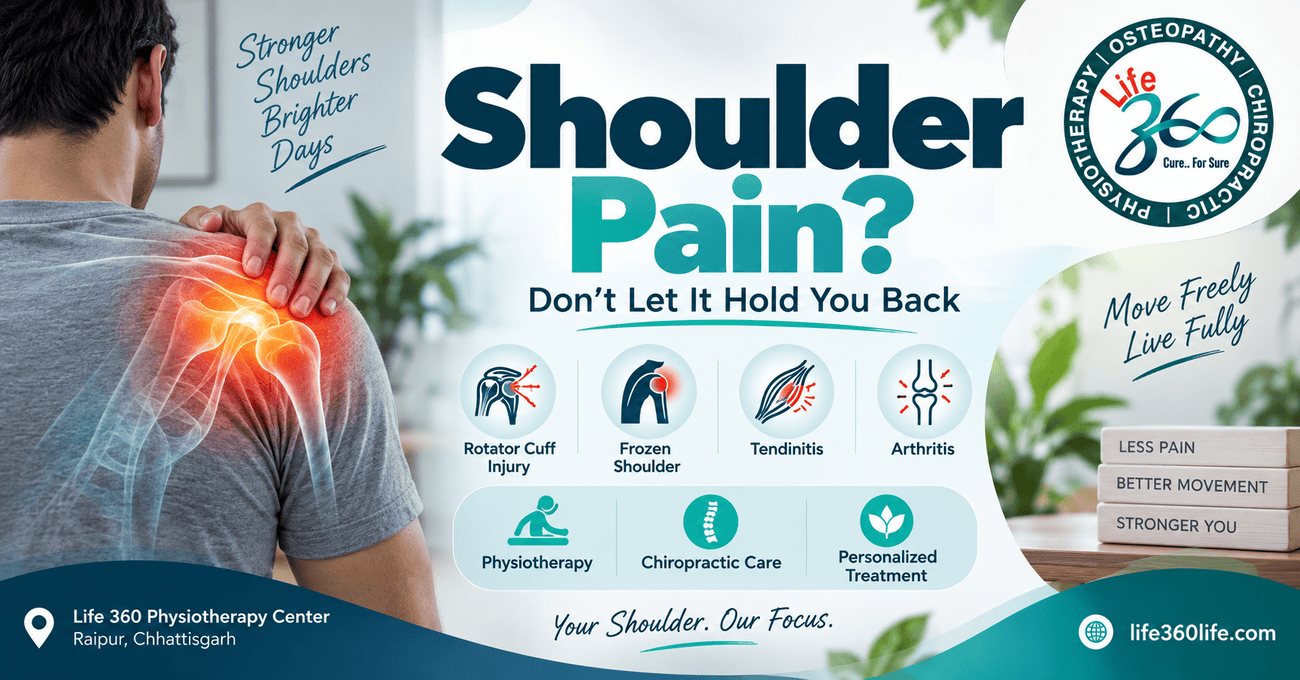
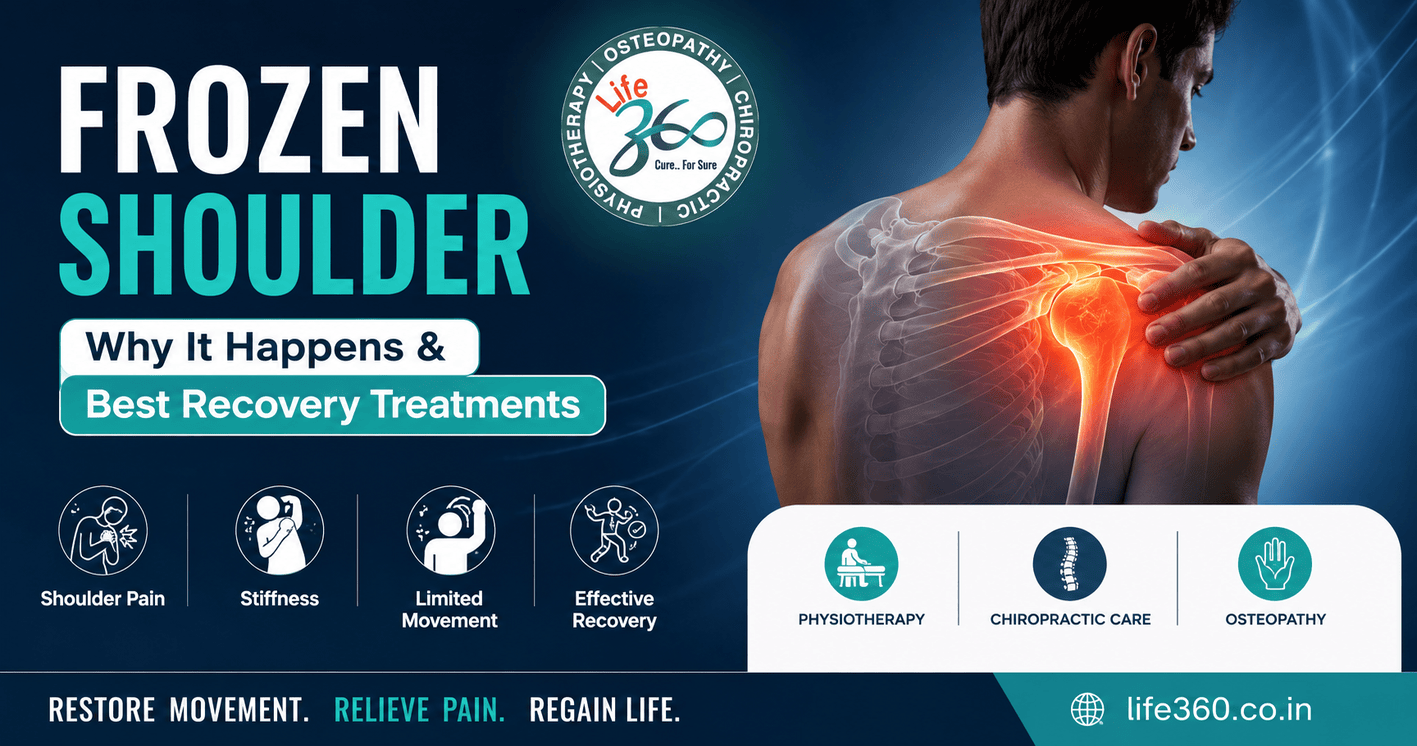
Quick Answer: Frozen shoulder (adhesive capsulitis) is a condition where the shoulder capsule thickens and tightens, causing severe pain and progressive loss of movement. It is fully treatable without surgery through structured physiotherapy, capsular stretching, manual therapy, and guided exercise. In Raipur, Chhattisgarh, Life 360 Physiotherapy Center in Shankar Nagar — led by Dr. Nitu Verma, India's first lady chiropractor — specializes in frozen shoulder recovery. Call 09115719395.
Can you no longer reach behind your back to tuck in your shirt? Is combing your hair, fastening a seatbelt, or reaching a high shelf becoming painfully impossible? Does your shoulder ache more at night, disturbing your sleep? These are the classic signs of a frozen shoulder — a condition that affects 2–5% of the population and is especially common among diabetics, thyroid patients, and adults between 40 and 60 in Raipur and across Chhattisgarh.
Direct Answer: Frozen shoulder is inflammation and tightening of the shoulder joint capsule — the flexible envelope surrounding the joint. The capsule thickens, forms adhesions, and shrinks, making the shoulder progressively stiffer and more painful in all directions of movement.
Direct Answer: Frozen shoulder progresses through three stages: the Freezing (painful) stage lasting 2–9 months, the Frozen (stiff) stage lasting 4–12 months, and the Thawing (recovery) stage lasting 6–24 months. Without treatment, the full cycle can take 1.5 to 3 years — but proper treatment shortens it dramatically.
|
Stage |
Duration |
Main Feature |
|---|---|---|
|
Stage 1 – Freezing |
2–9 months |
Increasing pain, especially at night; movement starts reducing |
|
Stage 2 – Frozen |
4–12 months |
Pain reduces but stiffness peaks; daily tasks become very hard |
|
Stage 3 – Thawing |
6–24 months |
Movement slowly returns |
Deep, aching shoulder pain — often worse at night and when lying on the affected side
Progressive stiffness — difficulty raising the arm, reaching behind the back or head
Trouble with daily activities — dressing, combing, bathing, wearing a seatbelt
Pain radiating to the upper arm
Loss of both active and passive movement (the defining feature)
Direct Answer: The exact trigger is often unknown, but the biggest risk factors are diabetes (up to 5 times higher risk), thyroid disorders, age 40–60, female gender, prolonged shoulder immobilization after injury or surgery, and cervical spine problems.
In our Raipur practice, nearly half of our frozen shoulder patients are diabetic. If you have diabetes and developing shoulder stiffness, do not wait — early treatment prevents months of suffering.
Direct Answer: Frozen shoulder is diagnosed clinically — by demonstrating restricted movement in a specific pattern (external rotation most limited, then abduction). X-rays rule out arthritis; MRI is rarely needed.
Frozen shoulder is frequently confused with rotator cuff injury and shoulder impingement. The key difference: in frozen shoulder, even someone else cannot move your arm beyond the restriction (passive movement is lost). Correct diagnosis at Life 360 Physiotherapy Center ensures you get the correct treatment from day one.
Treatment must match your stage. In the freezing stage, we prioritize pain relief and gentle mobility; in the frozen stage, progressive capsular stretching; in the thawing stage, strength restoration. Wrong-stage treatment (aggressive stretching too early) worsens the condition — a mistake we frequently correct in patients who come to us after failed treatment elsewhere.
Specialized hands-on techniques (Maitland and Mulligan mobilizations) gradually stretch the tightened capsule and restore joint glide.
Targeted stretches for the posterior and inferior capsule — the structures most responsible for lost movement.
Releases secondary muscle tightness in the rotator cuff, deltoid, and shoulder blade muscles that develops from months of guarding.
The shoulder never works alone. Restoring cervical and thoracic spine mobility — Dr. Nitu Verma's specialty — accelerates shoulder recovery significantly.
Pendulum exercises, wall climbing, towel stretches, and pulley exercises — progressed weekly so recovery continues between sessions.
Direct Answer: With structured treatment, most patients regain functional movement in 2–4 months — compared to 1.5–3 years if left untreated. Night pain typically improves within the first 3–4 weeks. Complete recovery of full range takes 3–6 months in most cases.
Direct Answer: Frozen shoulder is often called "self-limiting," but studies show up to 40% of untreated patients still have residual stiffness years later. Treatment shortens the disease course dramatically and ensures complete — not partial — recovery.
Address: HIG-16, Sector 1, Shankar Nagar, Raipur, Chhattisgarh 492007
Phone: 09115719395 | 07714908010 | 07000784644
Timing: 11:00 AM – 6:00 PM
Website: https://life360.co.in
Q1. Who provides the best frozen shoulder treatment in Raipur?
Life 360 Physiotherapy Center in Shankar Nagar, Raipur — led by Dr. Nitu Verma — offers stage-specific frozen shoulder treatment combining physiotherapy, manual therapy, and chiropractic care.
Q2. Can frozen shoulder be cured without surgery?
Yes. The vast majority of frozen shoulders recover fully with structured physiotherapy and manual therapy. Surgery or manipulation under anesthesia is needed only in rare resistant cases.
Q3. How long does frozen shoulder take to heal with physiotherapy?
Most patients regain functional movement within 2–4 months of proper treatment, compared to 18–36 months without treatment.
Q4. Why is frozen shoulder more common in diabetics?
High blood sugar promotes collagen cross-linking in the capsule, making it stiffer and more prone to adhesions. Diabetics have up to five times higher risk and often both shoulders get affected.
Q5. Why does frozen shoulder hurt more at night?
Lying still reduces circulation and lying on the shoulder compresses the inflamed capsule. Night pain is a hallmark of the freezing stage and improves within weeks of starting treatment.
Q6. Should I exercise a frozen shoulder or rest it?
Guided exercise — never complete rest. Rest allows more adhesions to form. However, over-aggressive stretching in the painful stage worsens inflammation, so exercises must match your stage.
Q7. What is the difference between frozen shoulder and rotator cuff injury?
In frozen shoulder, both active and passive movements are lost. In rotator cuff injury, someone else can still lift your arm fully (passive movement preserved). Treatment for the two is completely different.
Q8. Can frozen shoulder come back?
Rarely in the same shoulder, but 20–30% of patients (especially diabetics) may develop it in the opposite shoulder within five years. Maintenance exercises reduce this risk.
Q9. Are steroid injections necessary for frozen shoulder?
Not always. Injections can reduce pain in the early freezing stage, but movement returns only with physiotherapy. Many of our patients recover fully without any injection.
Q10. Can frozen shoulder affect both shoulders at once?
Yes, in about 14% of cases — most commonly in diabetic patients. Both shoulders can be treated simultaneously.
Q11. Which sleeping position helps frozen shoulder?
Sleep on the unaffected side hugging a pillow, or on your back with a small pillow supporting the affected arm. Avoid lying directly on the painful shoulder.
Q12. How many physiotherapy sessions are needed for frozen shoulder?
Typically 15–25 sessions over 2–4 months, along with a daily home exercise program. Diabetic patients may need slightly longer.
Q13. Is frozen shoulder related to neck problems?
Often, yes. Cervical spine stiffness alters shoulder mechanics and can coexist with or mimic frozen shoulder — which is why we assess and treat the neck too.
Q14. Where can I get frozen shoulder treatment in Chhattisgarh?
Life 360 Physiotherapy Center, HIG-16, Sector 1, Shankar Nagar, Raipur — patients visit from Bhilai, Durg, Bilaspur, and across Chhattisgarh. Phone: 09115719395.
Dec 05, 2024

:-early-warning-signs-you-should-never-ignore-icon-044150.png)

-icon-054426.png)
-icon-080621.png)
-icon-081941.png)
-icon-092359.png)
-icon-093852.png)
-icon-094609.png)
-icon-095238.png)
-icon-103429.png)
-icon-103224.png)
-icon-104305.png)
-icon-074623.png)
-icon-075551.png)
-icon-080620.png)
-icon-081325.png)
-icon-082141.png)
-icon-083016.png)
-icon-085607.png)
-icon-090354.png)
-icon-091256.png)
-icon-092441.png)
-icon-093257.png)
-icon-094048.png)
-icon-094827.png)
-icon-095622.png)
-icon-092325.jpg)
-icon-100332.png)
-icon-101125.png)
-icon-101922.png)