Life 360 Physiotherapy Center, HIG-16, Sector 1, Shankar Nagar, Raipur, Chhattisgarh 492007
-
For Appointment: 09115719395 , 07000784644 , 07714908010
-

At Life 360 Physiotherapy Center, led by Dr. Nitu Verma, India’s first lady chiropractor, we are dedicated to delivering top-quality chiropractic and physiotherapy care. Recognized as the best chiropractor in India, Dr. Verma specializes in holistic treatments for pain relief, spinal alignment, and sports injury rehabilitation. Our clinic in Raipur provides personalized care designed to address the root causes of discomfort and restore balance to your body, helping you achieve long-term health and wellness. Experience relief and recovery with India’s leading chiropractic expert at Life 360 Physiotherapy Center.
For Appointment: 09115719395 , 07000784644 , 07714908010
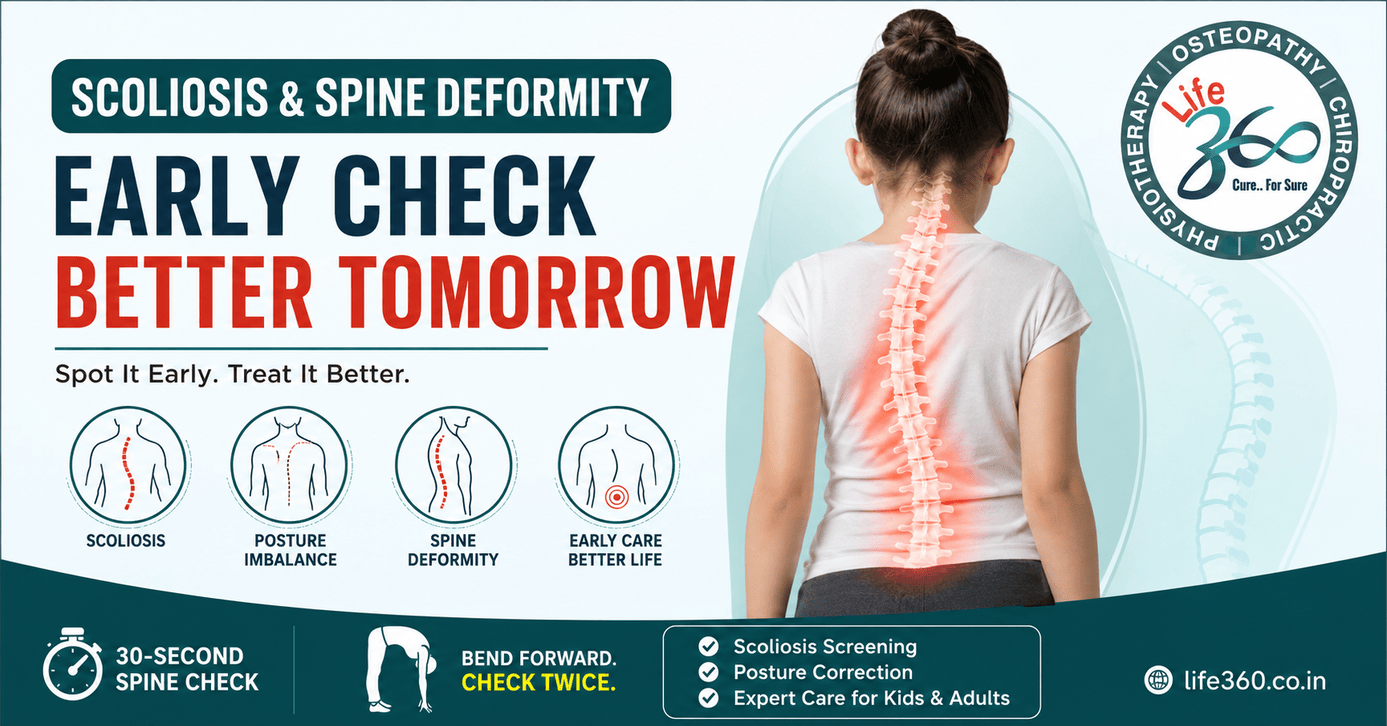
Quick Answer: Scoliosis — a sideways, rotating curve of the spine — typically appears silently during the adolescent growth spurt, ages 10–16. Caught early, mild and moderate curves can be managed and often improved with scoliosis-specific exercises (Schroth-based); ignored during growth, curves can progress toward bracing or surgery. In Bhilai, Chhattisgarh, Life360 Chiropractic Centre, Smriti Nagar provides scoliosis screening and exercise-based deformity care for children and adults. Call 08819801000.
A mother in Smriti Nagar notices her daughter's kurti hanging unevenly. A school teacher in Durg sees one shoulder blade jutting out during PT. A tailor measuring a teenager finds one hip higher. These small observations — usually painless, easily dismissed — are how scoliosis introduces itself. And because the teenage spine grows fast, the months between noticing and acting can decide everything.
Direct Answer: Scoliosis is a three-dimensional spinal deformity — the spine curves sideways and rotates, measured on X-ray as the Cobb angle. Above 10 degrees defines scoliosis: 10–25 is mild, 25–45 moderate, beyond 45–50 severe. Around 80% of cases are "idiopathic" — arising during adolescence without a known cause — and curves in growing girls progress most often.
Direct Answer: The Adam's Forward Bend Test: have your child stand feet together and slowly bend forward, arms hanging loose. Look along the back from behind. A hump on one side of the rib cage or lower back means the spine is rotating — get a professional screening. Also check standing: uneven shoulders, one prominent shoulder blade, uneven waist creases, head not centered over the hips. Ideal screening ages: 10–14, yearly through the growth spurt.
Direct Answer: Curves progress fastest during rapid growth — a spine can worsen noticeably within months. The management ladder is time-sensitive: mild curves → specific exercises and monitoring; moderate curves in growing children → bracing plus exercises; severe curves → surgical consultation. Every step up the ladder that early detection prevents is a lifetime gain. After growth ends, correction potential drops sharply — though adult treatment still improves pain, posture, and function substantially.
Direct Answer: Generic gym work and yoga cannot — but Physiotherapeutic Scoliosis-Specific Exercises (PSSE, Schroth-based) can. These use the curve's own three-dimensional pattern: individualized de-rotation positioning, asymmetric strengthening, rotational breathing, and posture integration. Research shows PSSE reduces progression, can improve Cobb angle in mild-moderate curves, and improves posture, appearance, and pain. The exercises must match your curve pattern — a mirror-image exercise done on the wrong side works against you, which is why professional prescription matters.
|
Condition |
What It Is |
Approach |
|---|---|---|
|
Hyperlordosis |
Exaggerated lower-back arch, belly pushed forward |
Hip flexor release + core/glute strengthening |
|
Flat back syndrome |
Lost natural lumbar curve |
Mobility restoration + postural retraining |
|
Kyphotic (hunched) posture |
Excess upper-back rounding |
Extension mobility + strengthening |
|
Body imbalance |
Uneven shoulders/hips from muscle asymmetry |
Cause correction + symmetry training |
|
Functional scoliosis |
Curve from leg-length difference or spasm |
Fix the cause — curve resolves |
Forward-bend screening, curve pattern identification, flexibility testing, leg-length check, posture photography, and X-ray review — mapping what kind of curve you have and its correction potential.
Schroth-principle exercises individually built for your curve pattern — taught, supervised, and progressed across months, with home practice as the daily engine.
Mobilizing stiffened segments and releasing the asymmetric muscle pull — supporting the corrective work with techniques appropriate to deformity care.
Scheduled re-measurement every few months through the growth spurt — catching any progression early, coordinating bracing referral when thresholds approach.
For adult and degenerative curves: pain management, core stabilization, mobility, and posture — keeping life active and comfortable regardless of the curve's age.
Direct Answer: An intensive learning phase of 6–12 weeks (2–3 sessions weekly), then a supervised home program maintained through the growth period for adolescents, with reviews every 3–6 months. Posture improves within weeks; curve behavior is measured over months. Adults typically run 8–12 week programs with maintenance.
Address: Opp: Dream Homes, 42A, Cross Street 1, Smriti Nagar, Bhilai, Chhattisgarh 490020
Phone: 08819801000
Website: https://life360.co.in
Q1. Where can I get scoliosis treatment in Bhilai?
Life360 Chiropractic Centre, Smriti Nagar, Bhilai — screening, curve-specific exercise programs, and growth monitoring for children and adults across the Bhilai-Durg region.
Q2. Can scoliosis be corrected without surgery?
Mild-moderate curves can be stabilized and often improved with scoliosis-specific exercises — especially during growth. Severe curves have limited correction potential, which is precisely why early detection matters.
Q3. At what age should my child be checked?
Ages 10–14, yearly through the growth spurt — plus anytime you notice uneven shoulders, a rib hump on bending, or asymmetric clothing fit.
Q4. My teenager has no pain — can it still be scoliosis?
Yes — adolescent scoliosis is usually painless, which is exactly why it progresses unnoticed. Painlessness is not reassurance; the visual screen is.
Q5. Will the curve definitely worsen?
Not always — progression risk depends on curve size, growth remaining, and pattern. Growing children with curves need monitoring every few months; exercises resist progression meanwhile.
Q6. Can yoga or swimming cure scoliosis?
General activity is healthy but does not correct a curve — correction needs pattern-specific asymmetric exercises. Symmetric exercise can feel good while a curve quietly progresses.
Q7. What is the Schroth method?
The most researched scoliosis exercise approach — three-dimensional self-correction, rotational breathing, and curve-specific strengthening. Our corrective programs are built on its principles.
Q8. Does a heavy school bag cause scoliosis?
It does not cause structural scoliosis, but one-shoulder carrying creates postural asymmetry and pain. Use two straps, under 10–15% of body weight.
Q9. Is one high shoulder always scoliosis?
No — muscular imbalance causes uneven shoulders without any spinal curve. The forward-bend test and assessment distinguish them; both are treatable.
Q10. Can adults with old scoliosis still benefit?
Substantially — pain, posture, strength, and function all improve with adult programs, even where the curve itself changes little.
Q11. When is bracing needed?
Typically for growing adolescents with curves around 25–45 degrees — worn alongside exercises, not instead of them. We coordinate the referral when thresholds approach.
Q12. What is hyperlordosis and is it serious?
An exaggerated lower-back arch from tight hip flexors and weak core — a posture pattern, not a disease, and very correctable with targeted work.
Q13. Where is Life360 Chiropractic Centre located?
Opp: Dream Homes, 42A, Cross Street 1, Smriti Nagar, Bhilai, Chhattisgarh 490020. Phone: 08819801000.
Dec 05, 2024

:-early-warning-signs-you-should-never-ignore-icon-044150.png)
-icon-054426.png)
-icon-080621.png)
-icon-081941.png)
-icon-092359.png)
-icon-093248.png)
-icon-093852.png)
-icon-094609.png)
-icon-095238.png)
-icon-103429.png)
-icon-103224.png)
-icon-104305.png)
-icon-074623.png)
-icon-075551.png)
-icon-080620.png)
-icon-081325.png)
-icon-082141.png)
-icon-083016.png)
-icon-085607.png)
-icon-090354.png)
-icon-091256.png)
-icon-092441.png)
-icon-093257.png)
-icon-094048.png)
-icon-094827.png)
-icon-095622.png)
-icon-092325.jpg)
-icon-100332.png)
-icon-101125.png)
-icon-101922.png)