Oct 11, 2026

Author : Dr. Nitu Verma (P.T)

There's one question I ask every young adult who comes in with a back that has been hurting for months. How long does it take you to loosen up in the morning?

If the answer is ten minutes, I'm thinking about discs and muscles and how they sit at work.
If the answer is an hour, and they say it while looking slightly embarrassed because nobody has ever asked them that before, I start thinking about something else entirely. That question is where ankylosing spondylitis treatment in Raipur usually begins, because almost nobody gets asked it.
Nearly all back pain follows the same rule. Rest helps, activity aggravates. Ankylosing spondylitis runs the rule backwards. Rest makes it worse. Movement makes it better. People with this wake up stiff as a board, take an hour to get going, feel best around the middle of the day, then seize up again if they sit through a long meeting or a long train ride.
That reversal is the single most useful clue anybody has for spotting this condition early, and it gets missed over and over. The gap between first symptom and diagnosis routinely runs into years. Young people across Raipur are told they've strained something, told to rest, handed painkillers, and the inflammatory disease underneath carries on while the spine changes shape.

What is ankylosing spondylitis?

It is a chronic inflammatory arthritis of the spine and the sacroiliac joints, where the base of the spine meets the pelvis. It sits within a wider family of conditions now often grouped as axial spondyloarthritis.
The inflammation happens at entheses, the points where ligaments and tendons attach into bone. The body responds to that inflammation by laying down new bone. In advanced disease that isn't controlled, the new bone can bridge between vertebrae and fuse segments of the spine together.
Ankylosing means fusing. Spondylitis means inflammation of the vertebrae. The name is unusually honest about what it does.
Two things I want people to hear early. Not everyone goes on to fuse in any meaningful way, the course varies enormously between one person and the next, and modern medical treatment has changed what the long run looks like. And the shape a spine sets into is influenced by the posture it's been held in through the years of inflammation. That second point is the reason physiotherapy belongs in this condition rather than being an optional extra bolted on the side.

Is my back pain inflammatory or mechanical?

Inflammatory back pain gets better with movement and worse with rest, starts before forty-five, and comes with morning stiffness lasting over thirty minutes. Mechanical back pain does the opposite. This is where early recognition lives.
Inflammatory back pain looks like:
  • Onset before forty-five, often in the twenties or thirties
  • A gradual start over weeks or months, with no injury anybody can name
  • Morning stiffness lasting more than thirty minutes, often an hour or longer
  • Improvement with exercise and movement
  • No improvement with rest, or it gets worse
  • Night pain, especially in the second half of the night, bad enough to get you out of bed and walking about
  • Buttock pain that alternates sides
  • A good response to anti-inflammatory medication
  • Going on longer than three months
Mechanical back pain looks like:
  • Onset at any age, usually traceable to something you did
  • Morning stiffness under thirty minutes
  • Worse with activity, better with rest
  • Pain that depends on what position you're in
If several of the inflammatory features fit you, that combination is a reason to see a rheumatologist. Not a reason for another strip of painkillers. Morning stiffness back pain lasting an hour is the symptom that should send a young adult in Raipur for a rheumatology opinion rather than another course of tablets.

The bits that aren't the back

This is a systemic condition, and the features outside the spine are often the piece of the puzzle that makes everything else make sense.
Eye inflammation, uveitis or iritis. A painful, red, light-sensitive eye needs same-day ophthalmology assessment. Do not wait on this one. A history of red painful eyes coming back repeatedly, alongside back pain, is a strong pointer.
Heel pain, from enthesitis where the Achilles inserts or underneath the heel.
Dactylitis, where a whole finger or toe swells up. People describe it as a sausage digit and that's exactly what it looks like.
Peripheral joints, especially hips, knees and shoulders.
Chest wall pain and reduced chest expansion, when the joints between the ribs and the spine get involved.
Fatigue. Patients rank this among the worst parts of having the condition, and clinicians underrate it, year after year. I include myself in that. It took me years of listening to people before I stopped treating fatigue as a footnote to the joint problem.
Inflammatory bowel symptoms, or psoriasis. Both travel with this condition.

Why does posture matter so much in ankylosing spondylitis?

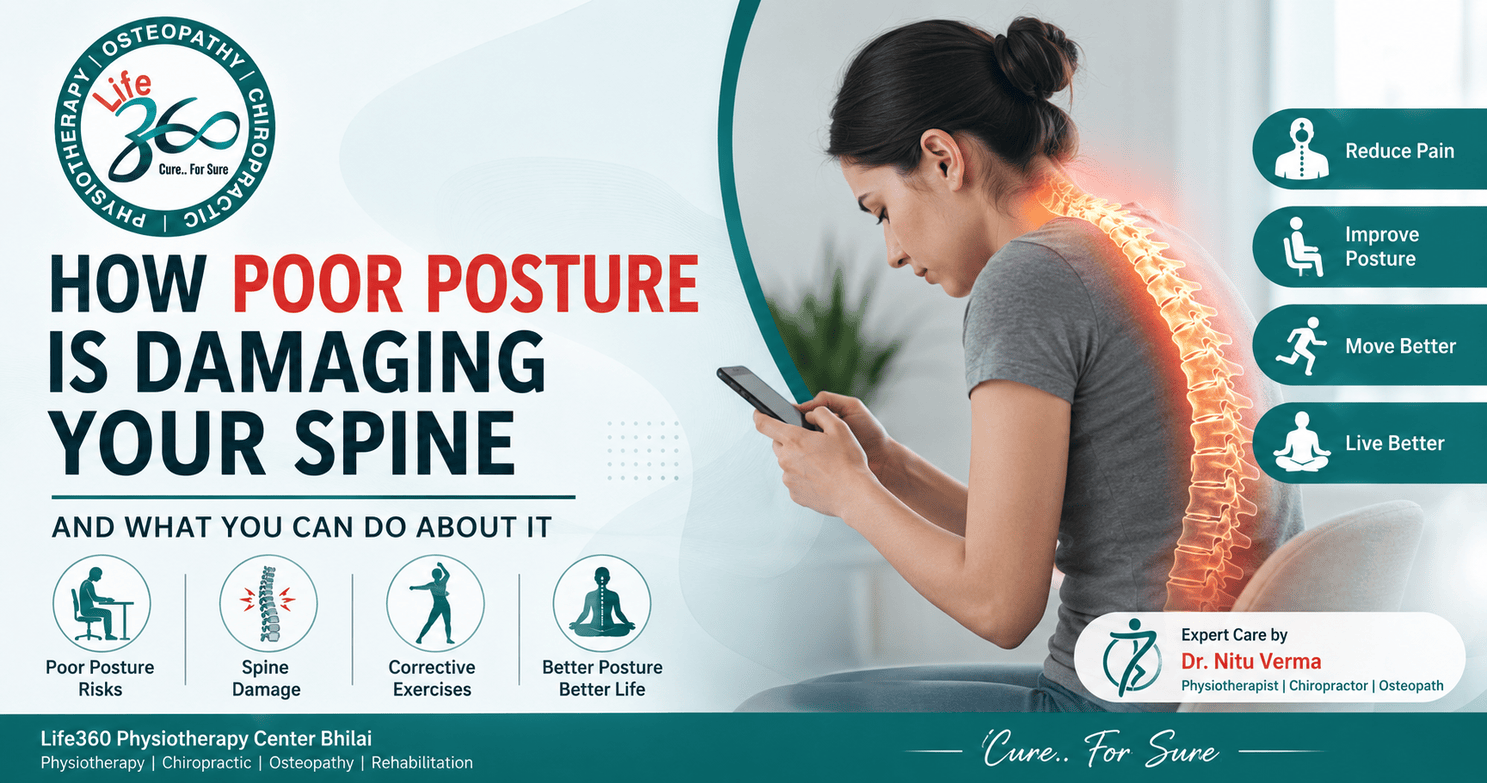
Because where fusion happens, the spine sets in whatever position it has been habitually held. Once you follow that reasoning the daily exercise stops feeling like homework.
Somebody who spends years hunched forward, because forward hurts less, can fuse in that flexed position. Permanently stooped, head carried in front of the body, chest that won't expand, and real difficulty looking straight ahead at the person they're talking to.
Somebody who works on extension and upright posture through those same years, with their disease medically controlled, is much less likely to end up there.
Medication treats the disease. What you do daily influences the shape you finish in. Both matter and neither one covers for the other.
I can't tell you which patients will progress and which won't. Nobody can, honestly, not at the first visit. Which is exactly why I treat everybody as though posture will matter to them, because for some of them it will matter enormously.

What I assess

A detailed history, aimed squarely at the inflammatory pattern above.
Spinal mobility, measured properly. Lumbar flexion, side flexion, cervical rotation, and the distance from the back of the head to the wall when you stand flat against it. These get written down and repeated over time, because change is only visible if somebody recorded the starting point.
That last measurement, head to wall, is worth a paragraph of its own. It's a piece of string and a wall. No machine, no scan, no fee. And it will show a change in posture long before anybody notices it in the mirror. I've never understood why it isn't done more widely.
Chest expansion, measured with a tape at the level of the nipples on full inspiration and expiration. Reduced expansion is a recognised feature and worth tracking.
Sacroiliac joint testing.
Postural assessment, with attention to thoracic kyphosis and head position.
Hip range of motion. Hip involvement is common and it hits walking and daily function harder than most people expect.
And referral, where the pattern fits. If somebody has inflammatory back pain features and no diagnosis, I say so and send them for a rheumatology opinion. Blood tests including inflammatory markers and HLA-B27, plus imaging of the sacroiliac joints, are what the medical side involves. MRI can pick up inflammation years before anything shows on an X-ray, which is why a normal X-ray doesn't settle the question.

What does ankylosing spondylitis treatment in Raipur involve?

A daily spinal mobility routine, postural extension work, breathing and chest expansion exercises, strengthening, and low-impact cardiovascular work, all running alongside the medical treatment rather than instead of it. Axial spondyloarthritis exercise sits inside international management guidance for exactly this reason.
Daily spinal mobility work comes first. Extension, rotation, side flexion, every single day. Consistency beats intensity here by a wide margin. Five focused minutes every morning does more for you than forty minutes twice a week, and I'll argue that with anyone.
Then postural extension work, aimed straight at the forward-flexed position. Prone lying. Thoracic extension over a support. Chin retraction to counter the forward head.
Chest expansion and breathing exercises. Deep breathing, rib mobility, thoracic rotation, to hold on to lung capacity as the costovertebral joints get involved.
Strengthening for the back extensors, gluteals and core. Strong extensors are what physically hold you upright, so they're doing the postural job all day long when you aren't thinking about it.
Hip mobility and strength, for the reasons above.
Low-impact cardiovascular work, and hydrotherapy where it's available. Swimming suits this condition better than almost anything else, because it gives you extension, rotation, deep breathing and whole-body movement without loading the joints.
Manual therapy, meaning gentle mobilisation of the thoracic spine and ribs to keep the movement that's still there. High-velocity manipulation is avoided in ankylosing spondylitis, especially where there's fusion or reduced bone density, because a fused or inflamed spine fractures more easily. I trained in manipulation and I still won't do it on these spines.
Fatigue and pain management. Pacing, planning the day around the good hours, sleep advice, and heat, which a lot of patients find genuinely useful for morning stiffness.
And the practical stuff. Desk setup, driving position, getting out of static postures, movement breaks built into the working day. Sitting still for hours is specifically bad in this condition, not just generally unhelpful.

The daily list

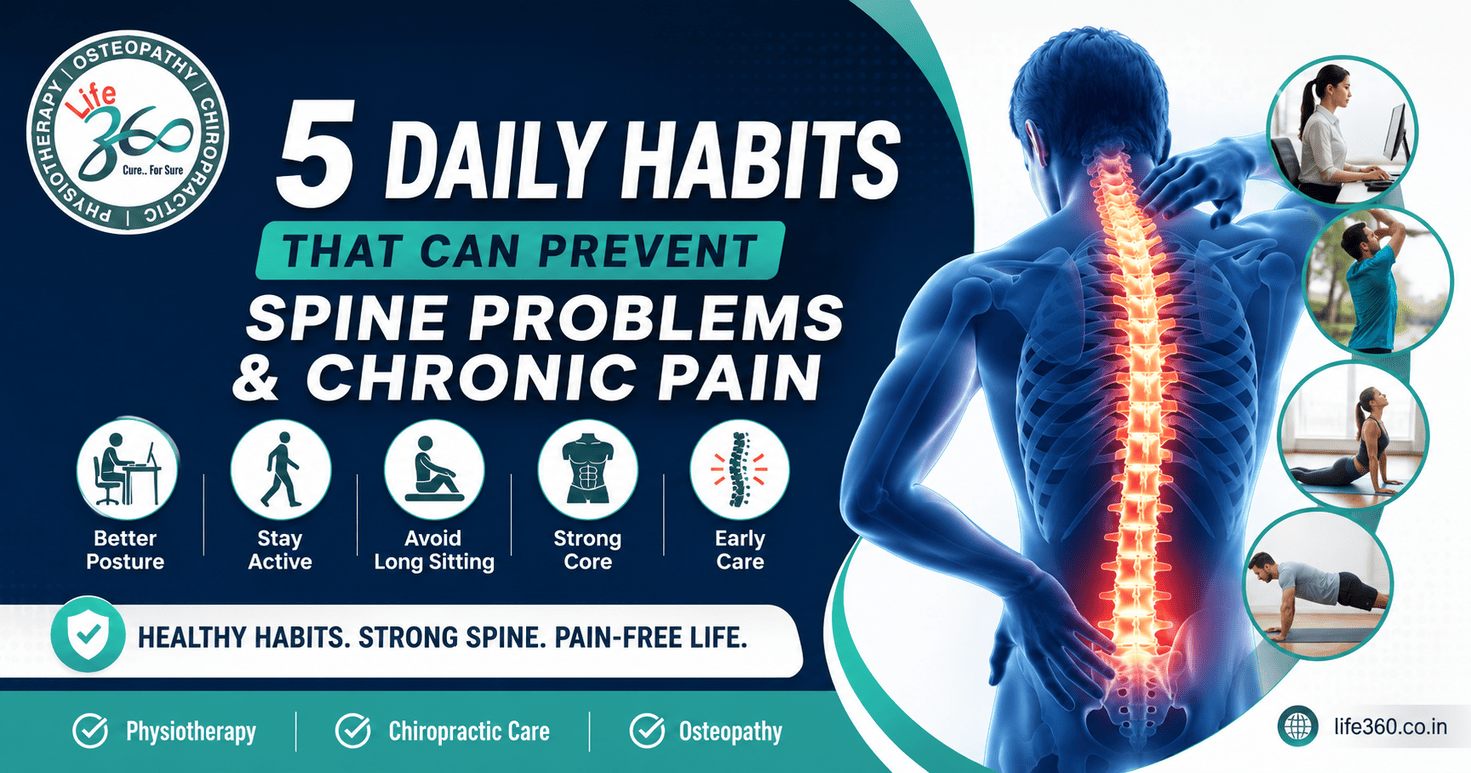
Do the mobility routine every morning, before the day runs away from you. It also cuts down the morning stiffness itself, so it pays for itself within the hour. These are the spondylitis exercises Raipur patients should be doing before breakfast rather than saving for a clinic visit twice a week.
Sleep on a firm mattress with a thin pillow, or none at all, so you aren't spending eight hours a night training a forward head position.
Lie prone for a few minutes a day if you can tolerate it. Plenty of people can't at first. Build up.
Get up and move every thirty to forty minutes, at work and at home.
Keep exercising through flares. Gently, within limits, but keep going rather than stopping dead.
And don't smoke. Smoking goes with worse outcomes and faster progression in this condition. That's the part people don't want to hear from a physiotherapist, and I say it anyway.

Medication and physiotherapy are not alternatives

I need to be blunt here, because I meet people who have decided that exercise will let them avoid the medicines.
Anti-inflammatory medication, and biologic therapy where it's indicated, control the inflammatory process itself. Nothing I do in this room controls inflammation. Medical treatment for this condition has moved a long way from where it was a couple of decades ago and it changes outcomes.
Physiotherapy keeps mobility, posture, chest expansion, strength and function going while the medical treatment does its part. Best results come when a rheumatologist and a physiotherapist are both involved and both know what the other is doing.
What genuinely irritates me is the young man in his twenties who was told he was too young to have back pain, took that seriously, and lost four years to it. He wasn't too young. Nobody is too young.

Where can I get ankylosing spondylitis treatment in Raipur?

Dr. Nitu Verma (PT) treats ankylosing spondylitis at Life 360 Physiotherapy Center in Shankar Nagar, Raipur. I trained as a physiotherapist and went on to train in chiropractic and osteopathic manual therapy.
Young adults with persistent back pain get screened here for the inflammatory pattern and sent for a rheumatology opinion when the features fit, rather than being treated as a mechanical back for the next two years. Anyone comparing options for the best physiotherapy for ankylosing spondylitis Raipur offers should ask one thing: does the clinic measure and record spinal mobility and chest expansion at the first visit.
For people already diagnosed, those measurements get tracked over time, so progression, or the happy absence of it, is something we can see rather than guess at. That is what AS physiotherapy in Raipur should look like.

Book an assessment

If your back is worse in the morning and better once you move, if you wake in the second half of the night with back pain, or if you've had painful red eyes coming back alongside back pain, get it looked at properly.
Life 360 Physiotherapy Center
HIG-16, Sector 1, Shankar Nagar, Raipur, Chhattisgarh 492007
Also at Life360 Chiropractic Centre, Smriti Nagar, Bhilai
Bring any blood test results, X-rays or MRI reports. Dr. Nitu Verma (PT) sees spondylitis patients at Life 360 Physiotherapy Center, Shankar Nagar, Raipur.

Questions patients ask

How is ankylosing spondylitis different from ordinary back pain?
It improves with movement and gets worse with rest, causes morning stiffness lasting over thirty minutes, and often wakes people in the second half of the night. Mechanical back pain behaves the opposite way.
Can exercise stop my spine fusing?
Exercise doesn't stop the inflammatory disease process. Medication addresses that. What exercise strongly influences is the posture your spine holds, your mobility, your chest expansion and your function, and those decide how disabling the condition becomes.
Is spinal manipulation safe in ankylosing spondylitis?
High-velocity manipulation is generally avoided, especially where there's fusion or reduced bone density, because of fracture risk. Gentle mobilisation and exercise are the right approaches.
Which ankylosing spondylitis exercises are best?
A daily routine combining spinal extension, rotation, side flexion and deep breathing, with strengthening added. Swimming suits the condition unusually well. Daily consistency matters more than how hard you go.
Should I exercise during a flare?
Yes, gently and within tolerance. Stopping completely during a flare leaves you with stiffness that's harder to get back. Drop the intensity rather than dropping the routine.
Why does my chest feel tight?
The joints connecting your ribs to your spine can be affected, which reduces chest expansion. Breathing and rib mobility exercises are in the programme for this reason, and chest expansion gets measured at assessment.
Is it hereditary?
There's a genetic association, especially with the HLA-B27 marker, and it can run in families. Carrying the marker doesn't mean you'll develop the condition. Most people who carry it never do.
When should I see an eye doctor?
Straight away, the same day, if an eye becomes painful, red and sensitive to light. Uveitis travels with this condition and it is not something to watch for a few days.
Where do I find an ankylosing spondylitis doctor in Raipur?
Start with a rheumatologist for the diagnosis and the medication, and pair that with a physiotherapist who measures spinal mobility and chest expansion. Dr. Nitu Verma (PT) provides ankylosing spondylitis treatment in Raipur from Life 360 Physiotherapy Center in Shankar Nagar.
How long does it take to get diagnosed?
Often years, because the pain gets put down to mechanical causes. Recognising the inflammatory pattern and asking for a rheumatology opinion is what shortens that delay.
 
Go to Top