Sep 23, 2026

Author : Dr. Nitu Verma (P.T)

When I ask a patient to point at the pain, most of them put a whole hand on the side of their pelvis and say "here, hip".

Then I ask them to use one finger.
That's usually when the consultation becomes useful, because at least five different problems produce buttock and leg pain that feels nearly identical from the inside. Five conditions, one set of symptoms, and a fairly good chance that the last three people who treated you were treating the wrong one.
That's the real cost. Months of treatment aimed at a structure that was never the problem. The back gets treated when the hip is at fault. The hip gets treated when the nerve is irritated. Everyone works hard, nothing changes, and the patient decides physiotherapy doesn't work.
This is a practical guide to telling them apart. It won't replace an examination. It will tell you what to pay attention to, and it will make your next appointment far more useful, whoever you see.
Sorting out whether you have sciatica or hip pain is one of the most valuable things a first appointment at Life360 Chiropractic Centre in Smriti Nagar, Bhilai, can give you.

The five candidates

1. Lumbar radiculopathy, which is true sciatica. A nerve root compressed or irritated where it leaves the spine, usually by a disc bulge or by narrowing of the space it travels through.
2. Hip joint pathology. Osteoarthritis, impingement, a labral tear, or avascular necrosis.
3. Sacroiliac joint dysfunction, at the joint where the base of the spine meets the pelvis.
4. Piriformis and deep gluteal syndrome, where the sciatic nerve is irritated by muscle deep in the buttock rather than at the spine.
5. Gluteal tendinopathy, a tendon problem at the outer hip that gets called bursitis or sciatica far too often.
Those five cover almost every case of buttock pain I assess in Bhilai.

Where does sciatica hurt compared with hip pain?

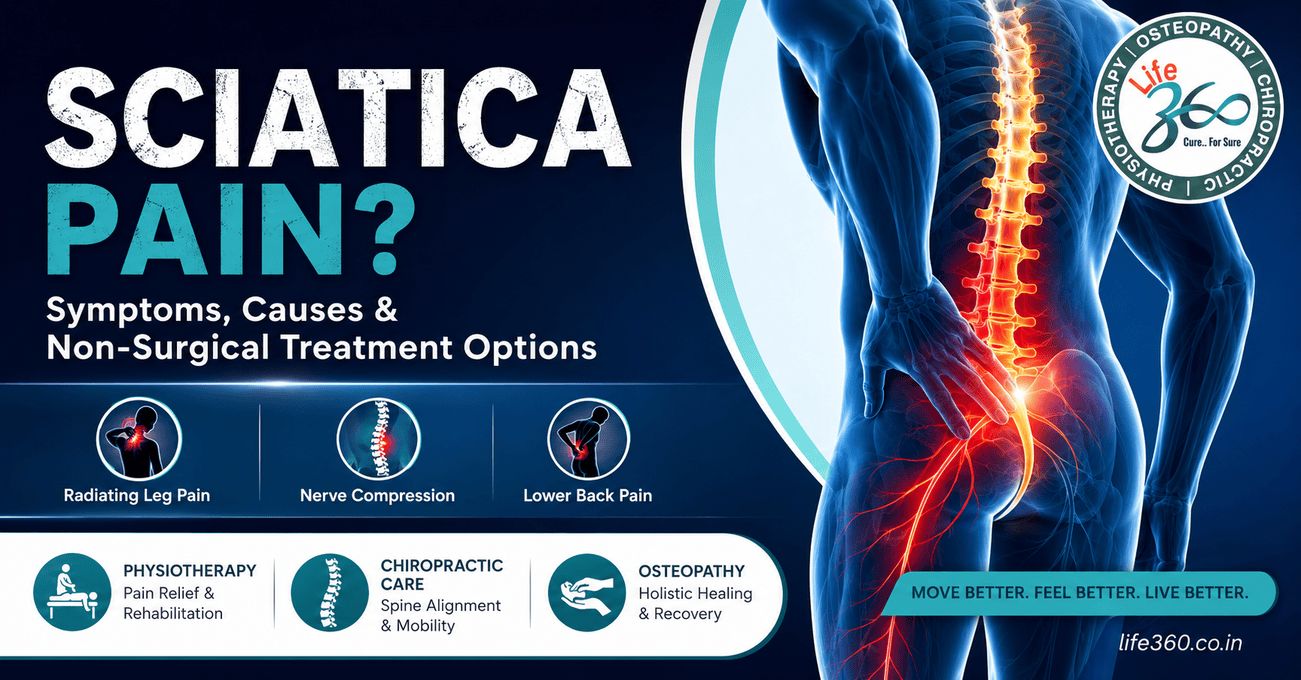
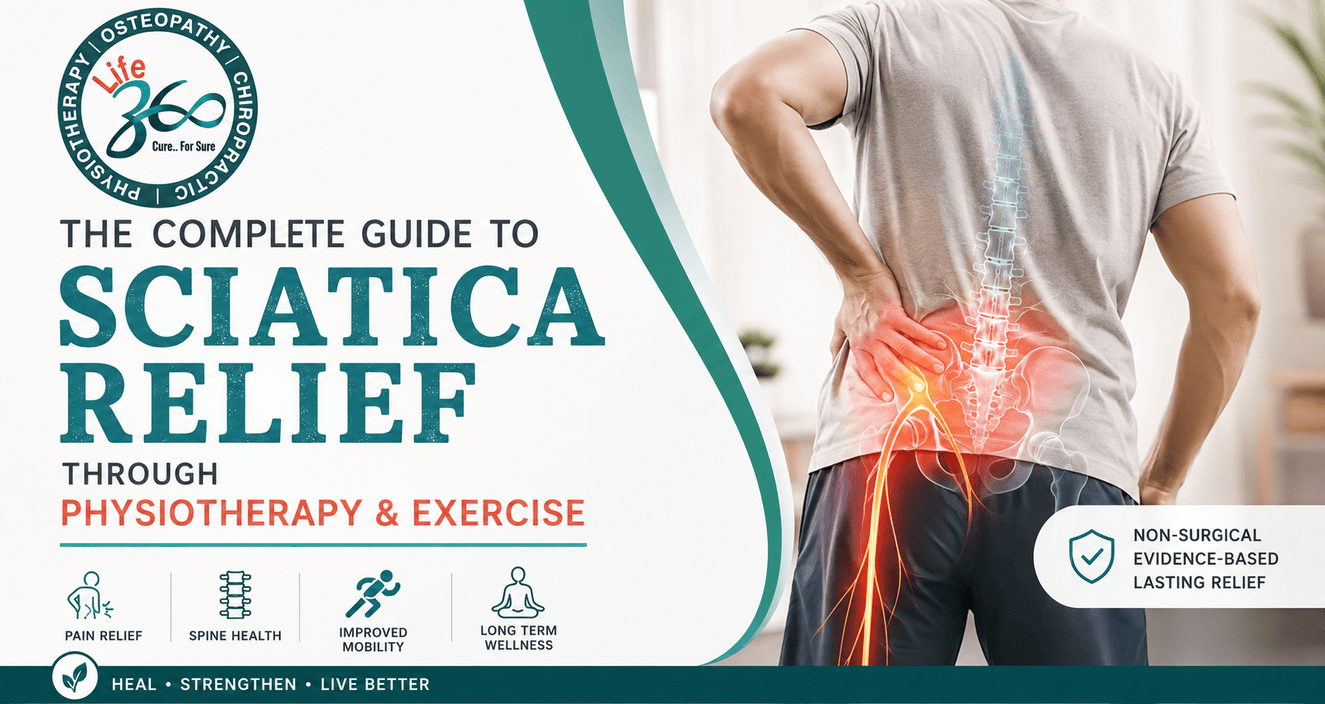
Sciatica runs in a line down the back of the leg, often below the knee. Hip joint pain sits deep in the groin. Location is the single most informative question, and almost everyone answers it too loosely.
Pain in the groin, at the front, deep, in the crease. That points strongly at the hip joint. It's the classic site of genuine hip pathology and it's the one nobody connects to the hip, because in ordinary speech the hip is that bony point on the side. That word causes more confusion in my clinic than any other. People say hip and mean the outside of the pelvis, doctors say hip and mean a ball and socket sitting deep in the groin, and the two are talking past each other for the whole consultation. Anyway.
Pain over the bony point on the outer hip points at gluteal tendinopathy.
Pain deep in the middle of the buttock could be sacroiliac joint, piriformis, or coming from the lumbar spine. That location doesn't decide anything by itself.
Pain just beside the base of the spine, over an area small enough to cover with one finger, points at the sacroiliac joint.
A line of pain running down the back of the leg points at nerve involvement, either from the spine or from the deep gluteal region.
And pain travelling below the knee makes nerve involvement a lot more likely than referral from a joint or a muscle.

How do I know if a nerve is involved?

Tingling, numbness, burning or weakness means a nerve is involved. Aching or sharp pain with no tingling at all points to a joint or a muscle instead.
This is the question that separates the groups most cleanly, and it's simple enough to answer at home.
Nerve symptoms are pins and needles, numbness, burning or electric sensations, and weakness.
If you have any of those, a nerve is involved. Either at the spine or in the deep gluteal region.
If you have none of those, and what you have is aching or sharp pain with no tingling at all, the problem is more likely to be a joint or a muscle.
Hip joint problems don't cause tingling. That one fact clears up an enormous number of arguments.

What makes each of them worse?

Bending, sitting and coughing worsen disc-related sciatica. Getting out of a car and putting on socks worsen hip joint pain. Lying on that side at night worsens gluteal tendinopathy. Aggravating factors tell you a great deal, more than most patients expect.
Worse when you bend forward, sit for long stretches, cough or sneeze. That suggests lumbar disc involvement. Coughing and sneezing raise the pressure inside the spinal canal, which is why they set off disc and nerve root pain and leave hip pain untouched.
Worse walking uphill, worse standing for a long time, and better when you lean forward onto a trolley. That suggests spinal stenosis, especially in older adults.
Worse getting in and out of the car, putting on socks, squatting, and turning over in bed. That points to the hip joint.
Worse standing on one leg, rolling over in bed, and going up stairs one at a time. That points to the sacroiliac joint.
Worse sitting on a hard surface for a long time, especially with the weight on the painful side, and worse driving. That suggests piriformis syndrome or deep gluteal syndrome. Two-wheeler commuters across Bhilai and Durg get this one often.
Worse lying on that side at night, and worse climbing stairs. That strongly suggests gluteal tendinopathy. The night pain on the affected side is very characteristic and it's the detail I ask about first when someone points at the outside of their hip.

Things you can check yourself

These aren't diagnostic and none of them should be forced. They give you information worth bringing to an appointment.
The sock test. Sitting down, can you comfortably put a sock and shoe on the painful side? Trouble here, especially with groin discomfort, points towards the hip joint.
The one-finger test. Can you point to the pain with one finger? Pain in a small spot beside the base of the spine points towards the sacroiliac joint. Pain spread vaguely across the whole buttock doesn't.
The cough test. Does coughing or sneezing bring on or worsen the leg pain? If yes, that suggests a spinal origin, most likely the disc.
The night-lying test. Does it hurt to lie on that side at night? That points towards gluteal tendinopathy.
The below-the-knee test. Does pain travel below the knee, with tingling or numbness? That points towards nerve root involvement.

Get urgent medical assessment for any of these

Whichever of the above fits your case, these override all of it:
  • Numbness in the saddle area, meaning between the legs, around the genitals or anus
  • Loss of bladder or bowel control, or difficulty starting urination
  • Weakness in both legs
  • Progressive weakness in one leg, such as a foot that catches when you walk, or trouble lifting the front of the foot
  • Severe pain with fever
  • Unexplained weight loss along with back or leg pain
  • Pain after a major injury, such as a fall or a road accident
  • A history of cancer with new spinal pain
The first two together are cauda equina syndrome. That's a surgical emergency and it means a hospital today, not a clinic appointment next week.

Why do these get mixed up so often?

Because referred pain crosses anatomical boundaries, because people frequently have two problems at once, and because scans find changes that aren't the cause of anything.
Referred pain ignores anatomical boundaries. The hip refers to the groin, the thigh and the knee. The lumbar spine refers into the buttock and down the leg. Trigger points in the gluteal muscles refer down the outer thigh in a pattern that looks like sciatica to anybody, including me, without testing.
You can have more than one problem. A patient can have hip osteoarthritis and lumbar degenerative change at the same time, with both contributing something. Working out which one is producing today's symptoms takes an examination, and no scan will do it for you.
And imaging finds things that aren't the cause. Disc bulges and degenerative changes show up in large numbers of people with no pain whatsoever, and they get more common with age. An MRI showing a disc bulge doesn't prove the bulge is what hurts.
Which brings me to the thing that tires me most in this particular presentation. People arrive holding an MRI report and a diagnosis that came entirely from that report. Nobody tested a reflex, nobody checked hip internal rotation, nobody pressed on the greater trochanter. The scan named a structure and the treatment followed the name.
A scan describes structure. An examination tells you which structure produces your symptoms when you test it. Those aren't the same question.

How is sciatica or hip pain diagnosed?

By examination, not by scan. History, neurological testing, nerve tension testing, hip and sacroiliac testing, palpation and functional testing, with imaging only where the findings call for it.
A detailed history first, going through the location, the nerve symptoms and the aggravating factors above.
Neurological examination. Reflexes, sensation, muscle strength. This is what tells me whether a nerve root is genuinely involved and which level it is.
Nerve tension testing, which reproduces symptoms when a nerve is irritated and stays quiet when it isn't.
Hip joint testing, including range of movement. Internal rotation especially, since that's often the first movement to go in hip pathology, along with specific provocation tests.
Sacroiliac testing, using a cluster of tests rather than any one of them, because individual SI tests on their own aren't reliable enough to trust.
Palpation of the greater trochanter, the deep gluteal muscles and the SI region.
Lumbar examination, movement in each direction and what each one does to your symptoms.
Functional testing. Walking, stairs, standing on one leg, getting out of a chair.
Referral for imaging when the findings call for it, rather than as the opening move.

Why any of this matters

Because the treatments have almost nothing in common.
True sciatica from a disc responds to directional preference exercises, nerve mobilisation, decompression in selected cases, and core stabilisation.
Hip osteoarthritis responds to hip and gluteal strengthening, joint mobilisation and sensible load management.
Sacroiliac dysfunction responds to pelvic stabilisation work, specific mobilisation, and sometimes a support belt. SI joint pain treatment aimed at the disc gets nowhere.
Piriformis and deep gluteal syndrome responds to soft tissue release, dry needling, nerve gliding, and sorting out how you sit.
Gluteal tendinopathy responds to progressive tendon loading. It does not respond to rest, and it does not respond to the stretching that half these patients have been given. Stretching can compress the tendon further and make things worse.
So if you have outer hip pain that's worse lying on that side, and you've been doing a figure-four stretch faithfully every morning for four months, stop. That's a firm recommendation and some therapists will disagree with me. I'll take the disagreement.
Give a gluteal tendinopathy patient nerve gliding exercises for sciatica and nothing improves. Give a disc patient tendon loading and nothing improves. Both of them then decide physiotherapy is useless, and I can't really argue with how they got there.
I'll own my share of it. For years I treated buttock pain as sciatica by default. Gluteal tendinopathy wasn't something I was looking for, and I must have missed plenty of it early in my career. I think about that more than I'd like to.

Why patients in Bhilai come here

Life360 Chiropractic Centre, Smriti Nagar, is led by physiotherapist Dr. Nitu Verma (PT), who has since added chiropractic and osteopathic training. Buttock and leg pain gets examined here across every candidate structure. Spine, hip, sacroiliac joint, deep gluteal muscles and tendons. That happens before treatment starts, which is what stops you spending months on the wrong one.
Dr. Nitu Verma (PT) examines every one of the five candidate structures at Life360 Chiropractic Centre, Smriti Nagar, Bhilai before naming a diagnosis.

Book an assessment

If you've had buttock or leg pain treated without lasting improvement, more treatment isn't your next step. A proper assessment of which structure is responsible is.
Patients don't always enjoy hearing that the reason nothing worked is that nobody examined them properly. I'd still rather say it than sell them another ten sessions of the same thing.
Life360 Chiropractic Centre
Opp. Dream Homes, Cross Street 1, Smriti Nagar, Bhilai, Chhattisgarh 490020
Also at Life 360 Physiotherapy Center, Shankar Nagar, Raipur
Please bring any X-ray or MRI reports and details of previous treatment.

Questions patients ask

How do I know if my leg pain is sciatica or hip pain?
Sciatica usually brings nerve symptoms, meaning tingling, numbness or burning, often going below the knee, and it's worse with bending, sitting and coughing. Hip pathology usually gives groin pain, trouble putting on socks and discomfort getting out of a car, with no tingling.
Can hip problems cause pain down the leg?
Yes. The hip refers pain to the groin, the front of the thigh and sometimes the knee. What it doesn't usually do is cause tingling or numbness, and that's the detail that separates it.
What is piriformis syndrome?
Irritation of the sciatic nerve by muscle deep in the buttock rather than at the spine. It typically gets worse with long spells sitting on a hard surface and with driving.
Why does my outer hip hurt when I lie on it at night?
That pattern strongly suggests gluteal tendinopathy. It responds to progressive tendon loading, and it does not respond to rest or to the stretching people are so often given.
Does an MRI settle the question?
Not by itself. Disc bulges and degenerative changes are common in people with no pain at all and get more common with age. The examination establishes which structure produces your symptoms. Imaging backs it up.
Can I have more than one problem at once?
Yes, often, especially in older adults where hip and lumbar changes sit side by side. Working out which one is driving your current symptoms takes an examination.
When is buttock and leg pain an emergency?
Saddle numbness, loss of bladder or bowel control, weakness in both legs, or weakness in one leg that's getting worse all need immediate hospital assessment.
Why hasn't treatment worked so far?
Usually because the wrong structure was being treated. These conditions need quite different treatments, and the wrong one delivered brilliantly still gets you nothing.
Where can I get sciatica treatment near me in Bhilai?
Life360 Chiropractic Centre, Opp. Dream Homes, Cross Street 1, Smriti Nagar, Bhilai 490020. Patients also travel in from Durg for the assessment.
Which sciatica exercises should I do?
That depends on which of the five structures is responsible, which is the whole point of this article. Nerve gliding helps a nerve root problem and does nothing for a tendon, so the exercises come after the examination, not before it.
 
Go to Top