Sep 11, 2026

Author : Dr. Nitu Verma (P.T)

I ask patients to open their screen time and read the number out to me.
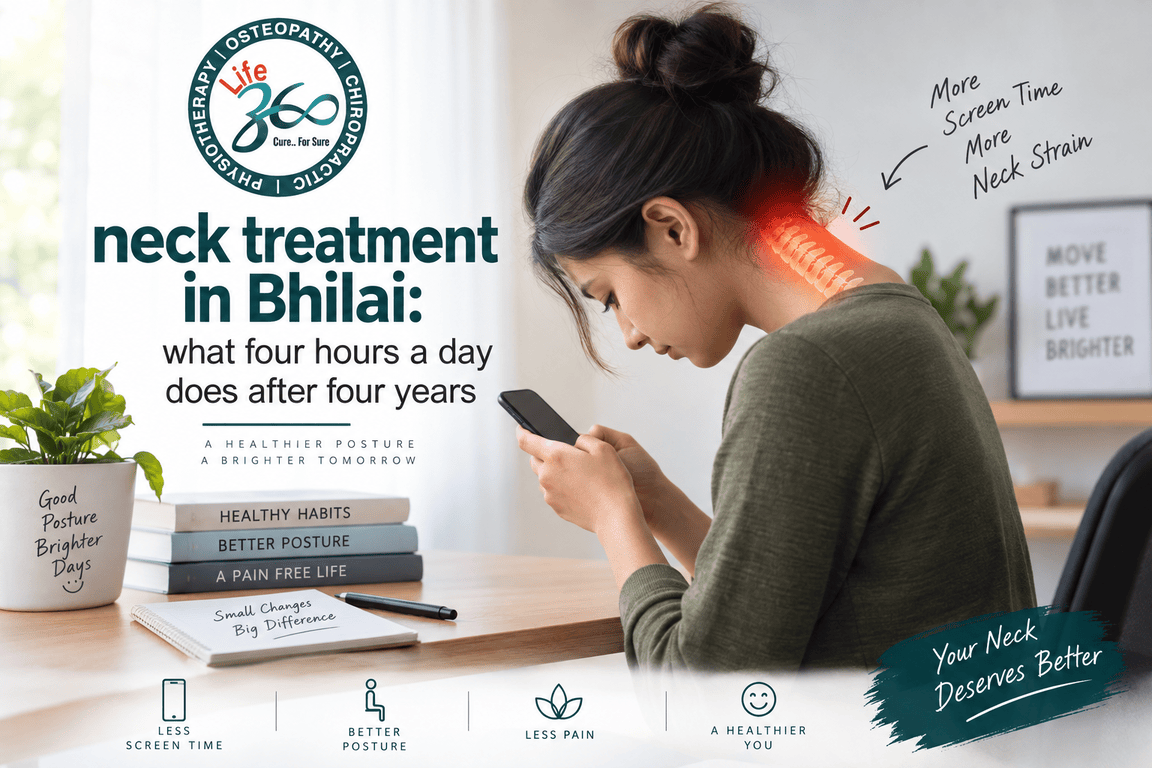
They laugh, or they look embarrassed, and then they say something like four hours twelve minutes and go quiet. Nobody guesses right. The figure is almost always higher than they expected, and I've stopped finding that funny because of who's sitting in front of me when it happens. Most people who come to me for text neck treatment in Bhilai are far younger than the pain history suggests.
People in their twenties. Neck stiffness, aching between the shoulder blades, headaches from the base of the skull. A generation ago I'd have expected that history from someone twice their age.
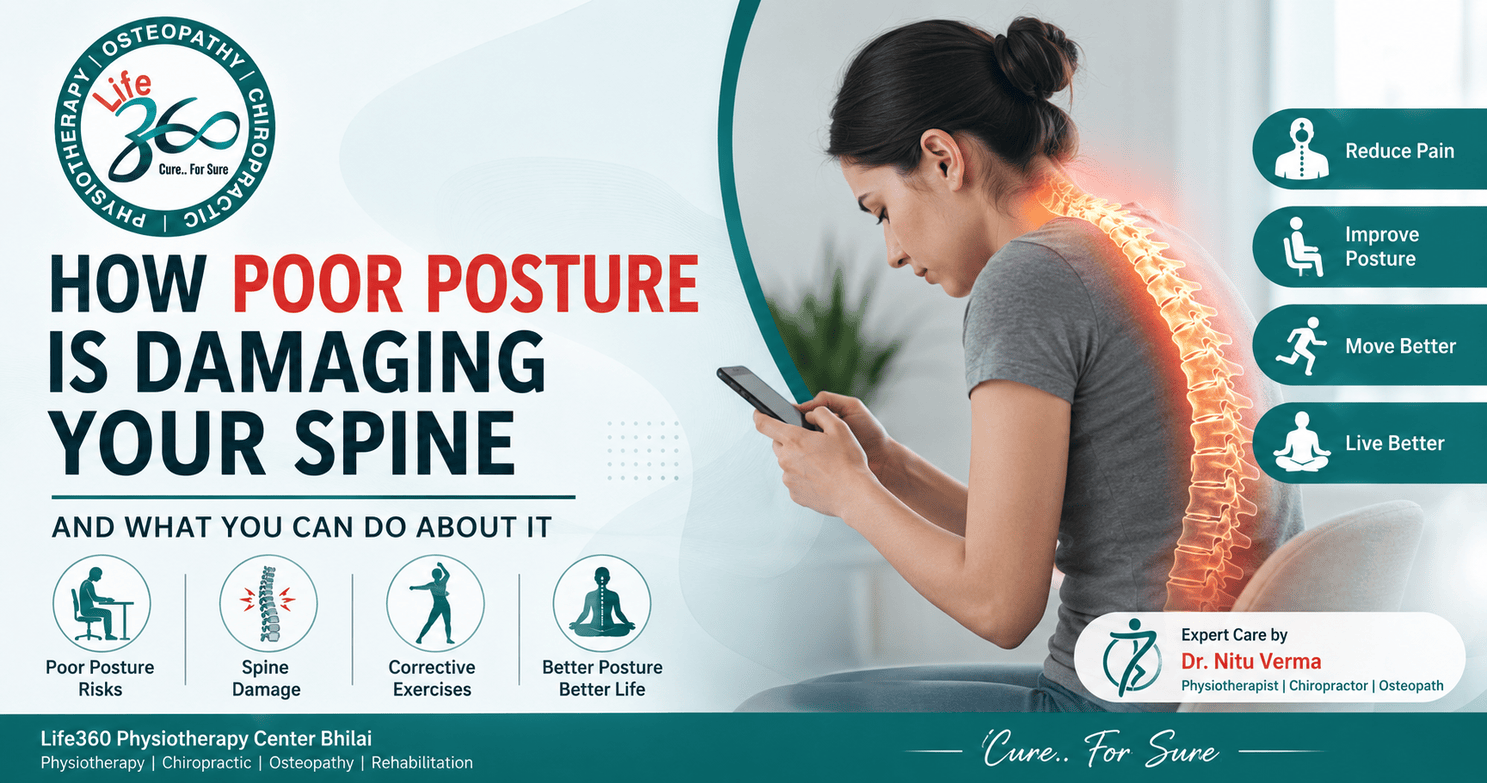
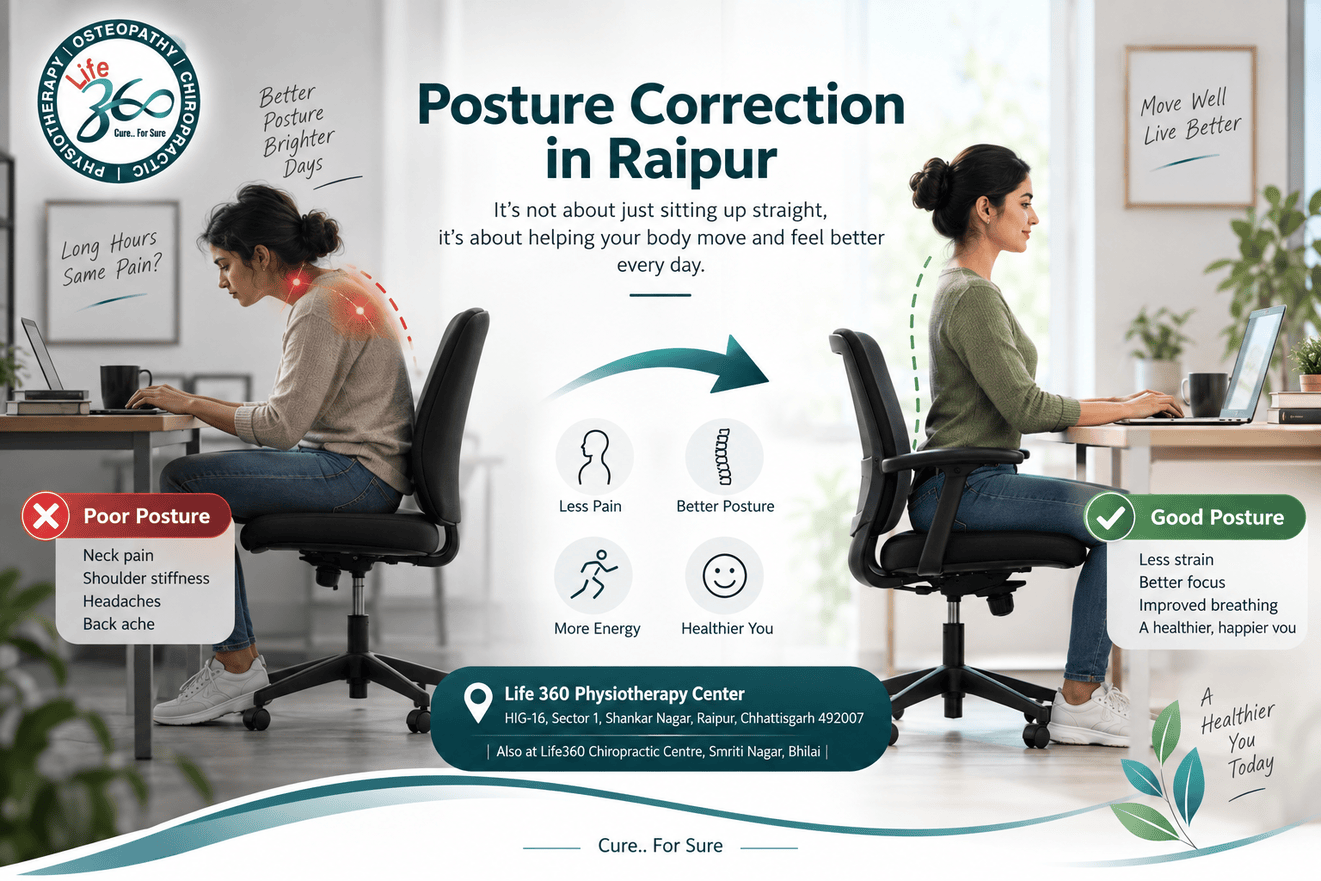
Looking at a phone once harms nobody. It's entirely about how long, repeated over how many years, and the position the head sits in for all of it. Chin down, eyes down, head hanging forward. That position has a clinical name, forward head posture, and patients in Bhilai usually describe it in plainer words: my neck feels like it's carrying something.

The lever

An adult head and everything in it weighs somewhere around four or five kilograms. Think of a small watermelon.
Balanced over the shoulders, that weight sits on a column of bone, and the bone carries most of it. Your muscles do very little.
Tilt the head forward and the column stops being a column. Now it's a lever, and the head is hanging out in front of its own support, and something has to stop it dropping further. That something is the strip of muscle running down the back of your neck.
The further forward the head goes, the harder that muscle has to pull. At the angle most people hold a phone at, the load through the neck is several times what it is in neutral. That's mechanics, not opinion.
Those muscles were built for short bursts of postural work. They were not built to hold a watermelon out on a lever for four hours a day. So they fatigue, they tighten, they develop trigger points, and they refer pain up into the head. That is the mechanism behind almost every case of phone neck pain in Bhilai that I assess.

What changes in the tissue

This is where "just sit up straight" stops being useful advice.
The muscles at the front of the neck lengthen and weaken, and the deep neck flexors go first. Those are the muscles whose job is holding your head in neutral.
The muscles at the back shorten and become overactive. Suboccipitals, upper trapezius, levator scapulae.
Chest muscles shorten and drag the shoulders forward.
Mid-back muscles lengthen and weaken.
The thoracic spine stiffens into a rounded position, and that one matters more than people credit. A stiff mid-back leaves the neck to make up the difference every time you need to look up at anything.
And the joints themselves adapt to where they habitually sit.
After a few years of this, telling someone to sit up straight is asking them to hold a position their tissue no longer supports. They can do it for maybe ninety seconds. Then it's exhausting and they slump again and feel like they've failed at something simple.
They haven't. The instruction was useless.

What are the symptoms of text neck?

Text neck shows up as neck stiffness that worsens through the day, aching between the shoulder blades, and headaches that begin at the base of the skull. Those three together are the pattern I see most often in Bhilai.
  • Neck stiffness that builds up through the day
  • Aching between the shoulder blades
  • Headaches starting at the base of the skull and spreading forward, often into the temples
  • Pain and tightness across the top of the shoulders
  • Not being able to turn the head all the way
  • Clicking or grinding when you move the neck
  • Tingling into the arm or hand in long-standing cases
  • Jaw tension, because head position changes where the jaw rests
  • Tiredness and poor concentration, which sustained muscle tension feeds
  • Reduced breathing capacity from sitting slumped
Patients often call it a stiff neck from mobile use, or say their neck locks up after scrolling. Same thing, plainer words.

Does age change how serious text neck becomes?

Yes. The younger you are when the habit sets in, the more exposure is still ahead of you, and the more likely the posture is to become your default. Two things drive that.
Duration. Somebody in their twenties with a five-hour daily phone habit potentially has five decades of that exposure still to come. Somebody who picked up the same habit at fifty has far less of it ahead.
And growth. Adolescents are still developing, and postural patterns set down during growth are harder to shift later. School and college students are the worst combination I see: long study hours, head down over books, then long phone hours, head down over a screen. Between the schools in Smriti Nagar and the coaching classes across Bhilai and Durg, that combination is close to universal here.
The good side of the same coin is that younger tissue corrects faster. Four years of a pattern takes much less undoing than twenty-four.

Is the phone the only thing causing it?

No. The phone takes all the blame and it's only one of several sources of neck pain from mobile and screen use.
Laptops without an external monitor are badly designed for necks, and there's no fixing that with willpower, because the screen and the keyboard can't both be in the right place at once. On a lap or a low table, worse again.
Tablets held low, especially for long reading or video.
Watching video lying on one side in bed, which loads the neck asymmetrically for an hour at a time.
Studying with books flat on a table, which produces exactly the same head position as a phone and which nobody thinks of as a screen problem because there's no screen.
Gaming, on phones and at desks, where sessions run long and posture disappears entirely into concentration.

The three things that actually fix it

Text neck treatment in Bhilai works when release, strengthening and setup change happen together. Any one of them alone fails, and I've watched patients try each one alone.

1. Release what's shortened

Manual therapy, soft tissue work and dry needling for the suboccipitals, upper trapezius, levator scapulae and the chest muscles. Thoracic mobilisation to get back the extension that's been lost.
Patients often feel great walking out of this. That relief is real. It is also temporary if the treatment stops here, and any clinic that keeps selling you only this part knows exactly what it's doing.

2. Strengthen what's lengthened

Deep neck flexors. Lie on your back, gently nod the chin as if saying yes, without lifting the head off the floor. Hold ten seconds, ten times. It looks like doing nothing at all. It's the most important exercise on this page and the one everyone skips.
Mid and lower trapezius, rhomboids and serratus anterior, which hold the shoulder blades back and down.
Thoracic extensors.
None of these are impressive to watch and none of them will make you sweat. They're what makes the change stay.

3. Change the setup

Raise the phone towards eye level instead of dropping your head down to it. Done every time, this one habit deals with most of your daily exposure.
Raise the screen. A laptop stand and a separate keyboard turns a bad setup into a good one for very little money. Top of the screen roughly at eye level. Screen posture treatment sounds like a service; it's mostly this.
Use voice input for longer messages.
Break every twenty to thirty minutes. Look up, move for thirty seconds.
Check your screen time weekly. Knowing the number changes behaviour more than any lecture from me does.
And don't use the phone lying in bed. For your neck, and for your sleep.

Which tech neck exercises should you do every day?

Five minutes covers it: chin tucks, shoulder blade squeezes, a doorway chest stretch, thoracic extension over a rolled towel, and gentle neck rotation. Do them daily and they hold the ground that treatment gains.
Chin tucks. Ten, held five seconds. Do them at your desk.
Shoulder blade squeezes. Ten, held five seconds.
Doorway chest stretch. Forearms on the doorframe, step gently through. Thirty seconds, twice.
Thoracic extension over a support. Lie with a rolled towel running lengthways along your spine, arms out to the sides, two minutes. This directly reverses the day's rounding and it's the one patients tell me feels best.
Neck rotation and side bending, gently, through comfortable range. Five each way.

How long does text neck treatment in Bhilai take?

Pain and stiffness usually drop inside three weeks. The postural change, the part that stops it returning, takes two to four months.
Weeks 1 to 3, pain and stiffness drop and movement improves. Most people feel clearly better here.
Weeks 4 to 8, the weak muscles get stronger and holding a better position stops being an effort.
Weeks 8 to 16, you stop thinking about it. Upright stops being something you're doing and starts being where you already are.
Be suspicious of anyone offering to fix your posture in three or four visits. What they can honestly give you in that time is a neck that hurts less, which is worth having and is a different thing entirely. Changing how tissue sits takes months, and it won't hold unless the desk, the phone and the study table change alongside it.
I'll be honest about the limit of what I know here. Whether the joint changes we see on long-standing forward head posture fully reverse, or whether people just get strong and comfortable enough that it stops mattering, I can't tell you. In terms of how patients feel and function, the second one is enough. But I don't like claiming more than I can see.

For parents

If your child is on a phone for hours, or studying with their head dropped forward every evening, deal with it now.
Correcting posture at twelve is far easier than correcting the same posture at forty.
Raise the study table or lower the chair so the setup fits the child rather than the other way round. Insist on breaks. Keep phones out of beds. Push sport and outdoor time, which loads the body in the opposite direction to everything above.
And the thing that works isn't the lecture. Parents lecture constantly, the child tunes it out, and everyone stays irritated. Change the height of the things they look at. That does more in a week than a year of reminding.

Why patients in Bhilai come here

The Smriti Nagar practice is led by Dr. Nitu Verma (PT), a physiotherapist who also trained in chiropractic and osteopathic manual therapy. Treatment combines hands-on work with a strengthening programme built from your own assessment findings, plus the practical changes to the setups causing it, because treating the neck while the phone habit carries on unchanged is a subscription, not a treatment.
Life360 Chiropractic Centre in Smriti Nagar, Bhilai assesses forward head posture with movement testing and muscle length testing rather than by eye. Patients travel in from across Bhilai, from Durg, and from the townships either side of the highway.

Book a postural assessment

If your neck stiffens by evening, if headaches start at the base of your skull, or if you've noticed your posture changing in photographs, come and get assessed. You'll leave knowing what's short, what's weak, and what to do about both.
Dr. Nitu Verma (PT) sees text neck patients at Life360 Chiropractic Centre, Smriti Nagar, Bhilai, six days a week.
Life360 Chiropractic Centre
Opp. Dream Homes, Cross Street 1, Smriti Nagar, Bhilai, Chhattisgarh 490020
Also at Life 360 Physiotherapy Center, Shankar Nagar, Raipur

Questions patients ask about text neck treatment in Bhilai

Is text neck a real condition?
It's a label for neck and upper back pain that goes with sustained forward head posture during device use. The postural pattern and what it does to muscles is well recognised, whatever you call it.
How much phone use is too much?
There's no fixed cut-off. What counts is how long you spend with the head dropped. Fifteen minutes is nothing. Three or four hours a day, head down, is the problem.
Can text neck be reversed?
Yes, by combining release of the shortened tissue, strengthening of the lengthened muscles, and changes to your setup. Symptom relief comes in weeks. The structural change takes a few months.
What is the single most useful change?
Raising the phone or screen towards eye level instead of dropping your head to it. It deals with most of your daily exposure directly.
Do posture correctors help?
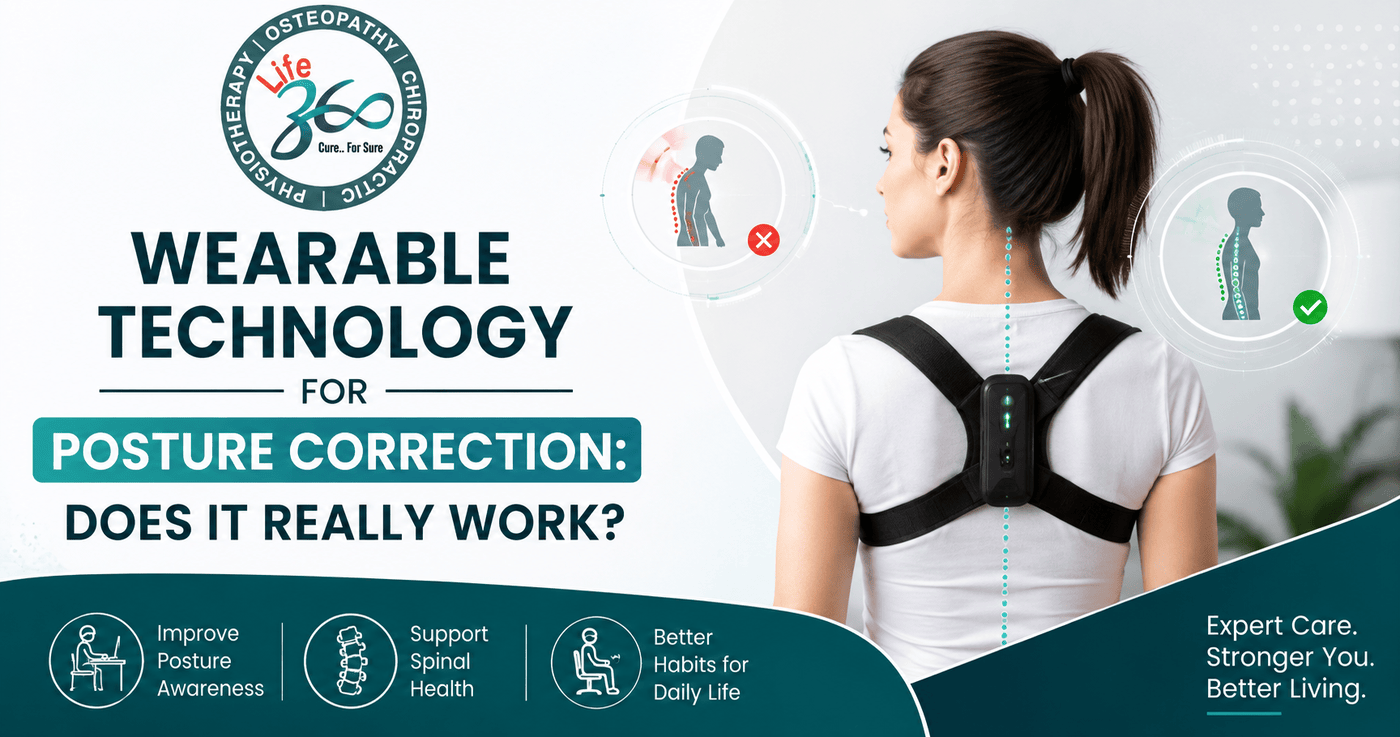
A brace can be a useful nudge for an hour while you learn what neutral feels like. Wear it all day and your own postural muscles hand the job to the strap and get weaker, which leaves you more dependent on it. Training wheels with an expiry date.
Can phone posture cause headaches?
Very commonly. The small muscles under the back of the skull carry the head's weight in that position, and when they're overworked they refer pain forward across the scalp and into the temples. Patients are regularly surprised that treating the neck settles headaches they'd assumed were migraines.
Should children's phone use be limited for posture reasons?
Yes, and the setup matters as much as the hours. Habits corrected during growth are far easier to change than the same habits decades later.
Which exercise matters most?
Deep neck flexor training, the gentle chin nod done lying down. It strengthens the muscles that hold your head in neutral, and it's the exercise most often skipped because it looks like nothing.
Where can I get text neck treatment near me in Bhilai?
Life360 Chiropractic Centre is at Opp. Dream Homes, Cross Street 1, Smriti Nagar, Bhilai 490020, which is a short drive from most of Bhilai and from Durg.
Do I need an X-ray or MRI first?
Usually not. Text neck is diagnosed from your history and a physical examination. Imaging is for cases with nerve symptoms, injury, or findings that don't fit the pattern.
 
Go to Top