At Life 360 Physiotherapy Center, led by Dr. Nitu Verma, India’s first lady chiropractor, we are dedicated to delivering top-quality
chiropractic and physiotherapy care. Recognized as the best chiropractor in India, Dr. Verma specializes in holistic treatments
for pain relief, spinal alignment, and sports injury rehabilitation. Our clinic in Raipur provides personalized care designed
to address the root causes of discomfort and restore balance to your body, helping you achieve long-term health and wellness.
Experience relief and recovery with India’s leading chiropractic expert at Life 360 Physiotherapy Center.
Conatct Us
Life 360 Physiotherapy Center, HIG-16, Sector 1, Shankar Nagar, Raipur, Chhattisgarh 492007
Almost every family asks the same thing in the first ten minutes.
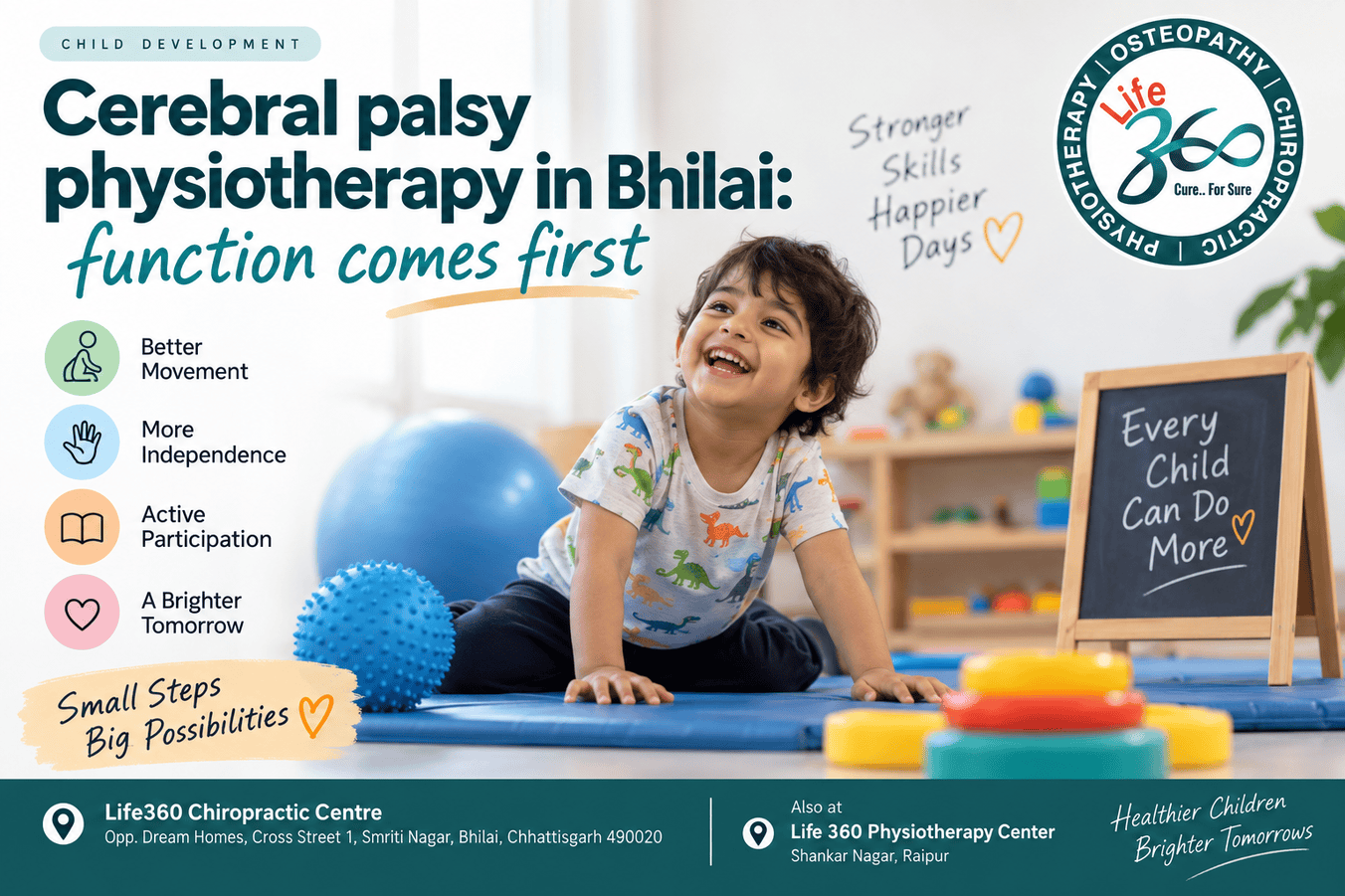
"Will my child walk?" I understand the question completely and I never mind being asked it. But I've watched what happens when a whole childhood of therapy gets organised around that one answer. Years of effort aimed at one milestone, while sitting comfortably, using the hands, communicating, being included at school, staying free of pain and contracture, all of it gets whatever attention is left over. Cerebral palsy physiotherapy in Bhilai now works differently, and so does child neurological rehabilitation generally. It asks what this child, in this family, in this house, needs to be able to do. Then it works at those things directly. That's how we do it at Life360 Chiropractic Centre in Smriti Nagar, Bhilai, with families trained as partners rather than seated in a corner watching.
What is cerebral palsy?
Cerebral palsy is a group of permanent disorders of movement and posture caused by non-progressive damage to the developing brain, happening before, during, or shortly after birth. Two words in there decide everything. Permanent. The brain injury doesn't resolve. Non-progressive. The brain injury doesn't get worse. The musculoskeletal consequences, though, absolutely do get worse when nobody manages them. Muscles held short become shorter. Joints that don't go through their range develop contractures. Hips that go unmonitored can gradually displace. Spines can curve. Which brings me to the thing this entire article rests on. The brain injury is fixed. A great deal of the disability that builds up over a childhood is not, and much of it is preventable. That prevention is my job.
What are the types of cerebral palsy?
Spastic, dyskinetic, ataxic, and mixed. Spastic is the most common, and mixed presentations are what I see most often in practice. Spastic CP means increased tone, stiffness, movement that costs the child effort and stays restricted. It gets described further by which limbs are involved, whether that's one side of the body, both legs, or all four limbs. Dyskinetic CP brings involuntary movement, tone that swings, and trouble holding a posture steady. Ataxic CP shows up as poor coordination and balance, with tremor when the child reaches for something on purpose. Mixed presentations are common, and most of the children I see don't sit neatly in one box.
Other conditions treated the same way
The same principles carry across a lot of paediatric neuro physiotherapy in Bhilai. Developmental delay with no identified cause, genetic and chromosomal conditions affecting movement, neuromuscular conditions including the muscular dystrophies, spina bifida, brachial plexus injury from birth, acquired brain injury, and conditions affecting coordination and motor planning. Developmental delay therapy in Bhilai follows the same goal-based structure, whether or not a cause has ever been named.
When should cerebral palsy physiotherapy start?
As soon as anyone has a concern, without waiting for a confirmed diagnosis. The nervous system is at its most adaptable in the early years, and contracture prevention in children is far easier before a muscle has been short for years. The developing nervous system is at its most adaptable in the early years. What a child experiences by moving during that window shapes the connections that form. There's a mechanical argument too. A muscle that's been short for six months gives way far more easily than the same muscle after six years. Once a contracture has properly set in it's much harder to do anything about, and it can end in surgery that earlier management might have avoided. And there's a developmental one. A child who can't move around doesn't get the experiences that drive learning, and I don't only mean motor learning. Cognitive, social, all of it. Letting a child move, by whatever means including equipment, opens all of that up. What early intervention buys is fewer avoidable secondary problems and a child who gets to take part in things. Speed through milestones isn't the aim.
What happens at a cerebral palsy assessment?
A long history, a period of watching the child play, measurement of tone and joint range, postural control, functional classification, hip and spine monitoring, an equipment review, and a conversation about your family's goals. A long history first. Pregnancy, delivery, the neonatal period, diagnoses, medical care, medication, surgeries, and whatever therapy has already been done. Then watching. A lot of the assessment happens while the child plays and I say very little. Muscle tone across the limbs and trunk. Range of movement measured at every major joint, written down, and tracked. The single number matters less than how it changes over a year, because change is what catches a developing contracture while it's still easy to handle. Postural control. Head control, sitting balance, standing where that applies. Functional ability, using the standard classification systems where they fit. They're useful for setting expectations honestly and for making sure everyone treating your child is describing the same thing. Hip and spine monitoring. Hip displacement is a known risk in cerebral palsy, more so in children with greater involvement, and there are structured surveillance programmes internationally for exactly this reason. Catching it early means simpler management. This should be part of every child's care. It very often isn't. That's the part of this condition's management in our region that bothers me most, and I say it to families plainly. If nobody has ever mentioned hip X-rays to you, ask. Ask your paediatrician, ask your therapist, ask me. Some people will think I'm overstepping by pushing parents to request imaging nobody offered. I'd rather overstep. Equipment review as well. Seating, standing frames, orthoses, walkers, wheelchairs. And family goals. What matters to your family, in your house, this year.
How is cerebral palsy treated with physiotherapy?
By practising the tasks the child needs to do, strengthening, preventing contracture, managing posture across all twenty-four hours, standing where possible, fitting the right equipment, and training the family to run the daily programme.
Goal-directed functional training
This has the strongest evidence behind it right now. You practise the actual task the child needs to do, with the environment and the support adjusted so that success is possible, and you repeat it often. The child practises the task itself. Working on isolated components in the hope they'll assemble later is the older way of doing it.
Strengthening
We used to believe strengthening would increase spasticity. It doesn't, and I was taught the old version. Progressive strengthening is appropriate and it helps, and weakness holds these children back more than most people appreciate.
Range of movement and contracture prevention
Daily stretching, positioning programmes, and where indicated splinting and serial casting. This is the preventive work everything else depends on, and it's daily, and it's boring, and it's the part that decides how your child's teenage years look.
Postural management across all twenty-four hours
This one gets missed constantly and it changes outcomes. A child's position matters during therapy, yes. It also matters at school, at mealtimes, in the car, and in bed. Night-time positioning influences hip and spine development, and it's the twelve hours nobody makes a plan for. If I could add one thing to most of the programmes I inherit from elsewhere, it would be this rather than another weekly session.
Standing programmes
Where a child can't stand on their own, supported standing in a frame gives them weight-bearing. That's good for bone density, for hip development, for bowel function and for posture.
Equipment and orthoses
Ankle-foot orthoses, seating systems, standing frames, walkers, wheelchairs. A wheelchair is not a failure and it is not giving up. For a child who can't walk useful distances, mobility equipment hands back independence, participation, and the energy to do everything else with their day. Treating it as defeat costs children years of being stuck, and I have seen exactly that happen to children who could have been out with their friends.
Working with the medical team
Spasticity management with medication and injections, and orthopaedic surgery where it's indicated, are led by the treating medical team. Physiotherapy runs alongside them, and it matters most in the weeks after any of those interventions.
Family training
The most important item on this list. Your child is with you constantly and with me occasionally. What happens at home is where progress actually gets made. So the programme has to be practical, has to fit inside the day you already have, and has to be taught until you're confident doing it without me watching. I'll take a detour here because it's on my mind. In most of the families I see, one person carries this. Usually the mother. She does the stretches, remembers the appointments, argues with the school, and travels in from Durg or somewhere further on a bus with a child who doesn't sit easily. If there's a second adult in the house who could learn the home programme, bring them to a session. Not for the child's sake alone. Right, back to the therapy.
Goals that are worth writing down
A useful goal is specific, matters to the family, and can be measured. Here are goals I've written in the past that turned out to be worth nothing. Improve balance. Improve hand function. Improve mobility. Here are the versions that did something.
Sit unsupported on the floor for two minutes to play with a sibling
Hold a cup with two hands and drink without help
Walk from the classroom to the toilet with a walker
Goals written that way can be tracked, and they connect to the child's real life. They also make honest conversation possible about what's realistic, which families tell me they want, even when what I have to say is hard.
What families should watch for
Contact your therapist or your doctor if you notice:
A joint becoming progressively harder to move
New or worsening asymmetry
Pain, especially around the hip
A curve developing in the spine
Loss of a skill your child used to have
Increasing difficulty with seating or positioning
Breathing difficulties or repeated chest infections
Feeding or swallowing difficulties
Hip pain and stiffness that's getting worse deserve attention quickly. Picking up hip displacement early is what keeps the management simple.
Honest hope
Families get offered one of two things, and both are useless. Big promises, or quiet resignation. Cerebral palsy cannot be cured. The brain injury is permanent. Anyone who tells you otherwise deserves your suspicion, and such claims are made in this country regularly, sometimes at great cost to families who can least afford it. I've had parents come to me having spent money they didn't have on treatments that were never going to do anything. That one makes me angry in a way I don't fully hide. And a great deal can still be changed. Contractures prevented. Hips protected. Pain avoided. Function improved. Independence increased. School attended. A life lived. Therapy is not trying to make your child typical. It's trying to help this child do as much as possible, as comfortably as possible, for as long as possible. About the walking question. I can't answer it in the first year, and often not in the second. Anyone who gives you a confident answer at eighteen months is guessing at you. What I can do is tell you what I'm seeing now, tell you again in six months, and be straight with you when the picture becomes clearer, including if the answer is one you didn't want.
Why families in Bhilai come to Life360
Treatment at Life360 Chiropractic Centre in Smriti Nagar is overseen by Dr. Nitu Verma (PT), whose background combines physiotherapy with chiropractic and osteopathic training. Paediatric neurological therapy here is goal-based, built around what your family actually needs, with parents trained to run the home programme properly. Range of movement, hip status and posture get measured and tracked over time, so problems are found while they're small. Where paediatric neurology, orthopaedic input or spasticity management is needed, I say so and coordinate rather than keeping the child to myself. Families come to Life360 Chiropractic Centre, Smriti Nagar, Bhilai from across the twin cities, and a good number travel in from Durg every week.
Book an assessment
New diagnosis or ten years of therapy already behind you, a goal-based assessment will make clear what's being prevented, what's being worked towards, and what you can do at home every day. Dr. Nitu Verma (PT) assesses children with cerebral palsy at Life360 Chiropractic Centre, Smriti Nagar, Bhilai. Life360 Chiropractic Centre Opp. Dream Homes, Cross Street 1, Smriti Nagar, Bhilai, Chhattisgarh 490020 Also at Life 360 Physiotherapy Center, Shankar Nagar, Raipur Please bring medical reports, previous therapy notes, and any hip X-rays.
Questions families ask
Can cerebral palsy be cured? No. The brain injury is permanent and it doesn't progress. But much of the disability that builds up through childhood, meaning contractures, hip problems, pain and lost function, can be prevented with good management. Will my child walk? It depends on the type and extent of involvement, and a proper assessment will tell you more than any general statement can. Whatever the answer turns out to be, therapy aims at function and participation, and walking is one part of that. When should therapy start? As soon as anyone has concerns. The nervous system is most adaptable in the early years, and early management prevents the secondary musculoskeletal problems that are so much harder to fix later. Does strengthening increase spasticity? That was the old belief and the evidence hasn't supported it. Progressive strengthening is appropriate and it helps. Weakness is a real limit on what these children can do. Why does night-time positioning matter? Because your child spends many hours in one position overnight, and that position affects hip and spine development. Managing posture across the full twenty-four hours changes outcomes. Is a wheelchair giving up? No. For a child who can't walk useful distances, mobility equipment gives independence, participation, and energy left over for everything else. It widens a life. Why does my child need hip X-rays? Hip displacement is a known risk in cerebral palsy, and structured monitoring catches it while management is still simple. Surveillance belongs in every child's care. How much therapy does my child need? Frequency depends on age, goals and stage. What counts more than the number of sessions is what happens at home each day, which is why I spend so much of a session teaching you. Where can I find cerebral palsy treatment near me in Bhilai? Life360 Chiropractic Centre, Opp. Dream Homes, Cross Street 1, Smriti Nagar, Bhilai 490020. Families also travel across from Durg for assessment and review. What exercises can we do at home? Stretches and positioning for the joints most at risk, plus practice of the specific tasks in your child's goals. The home programme is written for your child and taught to you in the session, because a generic sheet is the fastest way to get a family doing the wrong thing daily.